End the roadmap debate.
Every priority score traces back to real signals. RICE is the default — Reach, Impact, Confidence, and Effort each backed by signal volume, sentiment, and channel diversity. WSJF is available in advanced settings.
RICE drafted from signals — not from feel.
Every component proposed by the engine, traceable to source, overridable by the PM.
RICE proposed from signal volume, sentiment, channel diversity.
Reach from distinct customer signals. Impact from sentiment intensity and account size. Confidence from channel diversity. Effort still human. The score arrives drafted — you stop staring at empty columns.
Click any score component to drill into source signals.
"Confidence 85%" opens the 4 channels it came from. "Reach 4,200" opens the customer list. Roadmap reviews stop being a debate about inputs — the receipts are one click away.
PM judgment still wins — but it starts from a defensible draft.
Override any component with a one-line reason recorded next to the score. Strategic bets, exec asks, partner commitments — judgment stays in the loop, but the deviation from evidence is visible.
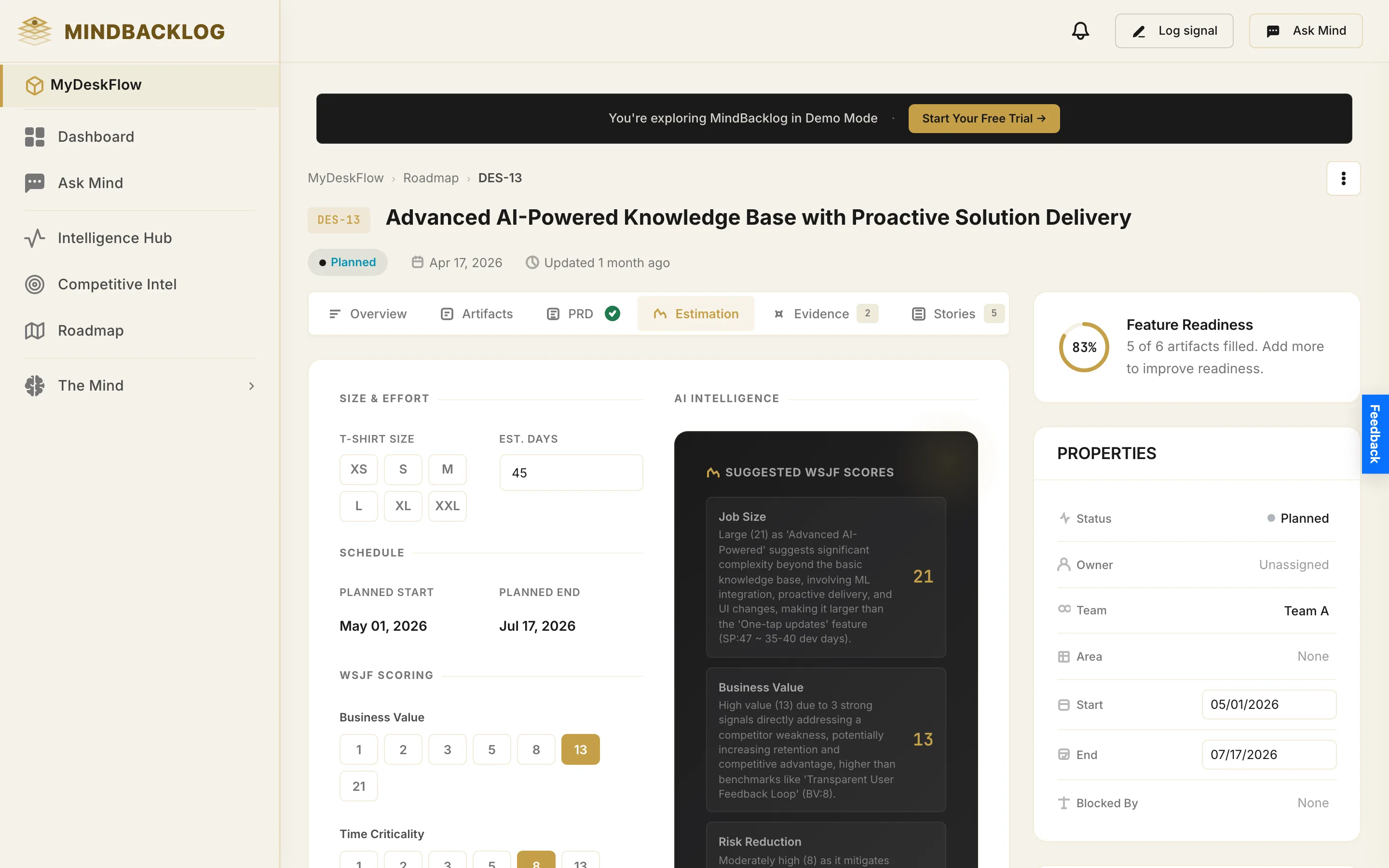
WSJF available in advanced settings; RICE is the default because the evidence is auditable.
Most prioritization is a spreadsheet of guesses dressed up as math.
The PM picks numbers that feel defensible. Leadership pushes back on the one they disagree with. The PM updates the number. The score changes. Now the priorities are different — not because the evidence changed, but because the loudest voice in the room moved a guess. The framework looks rigorous; the inputs are fiction. Worse: by the next review, nobody can remember why a score landed where it did. The PM walks in cold, defends from memory, and the cycle repeats. The framework is not the problem. The evidence behind the framework is.
Receipts, not opinions.
Every component of every RICE score has an evidence trail.
RICE by default
Reach, Impact, Confidence, Effort. The most defensible framework because each component maps cleanly to evidence the pipeline already captures. A score of 892 on search filters: Reach 4,200 (signal-counted), Impact 3 (sentiment-weighted), Confidence 85% (4 channels), Effort 2 weeks (engineering-estimated). Every number has a source.
AI estimation, evidence-backed
The engine proposes scores based on signal volume, sentiment trend, channel diversity, and competitive context — never from imagination. The draft is defensible from the first day. PMs override the components that don't match strategic context; overrides stick across regenerations and are flagged in the audit trail.
Every number is auditable
Click Reach: see the 47 signals across 4 channels. Click Impact: see the 18% sentiment drop and the 3 enterprise accounts citing it. Click Confidence: see the channel diversity. The scorecard is not a verdict — it is a window into the underlying evidence layer, and the drill-in is two clicks deep.
WSJF available in settings
If your team standardizes on WSJF, switch the framework in advanced settings. Cost of delay, job size, and the weighting stay PM-driven; the evidence backing stays the same. RICE is the default because it maps to signal evidence most cleanly — WSJF is one settings toggle away if your organization needs it.
Four moments where the scorecard does the talking.
Concrete scenes from a PM operating with evidence-backed priorities.
"What should the RICE be on this?"
A new feature lands on the list. The engine pulls every signal already linked to that feature area — 23 signals across 3 channels, 4 enterprise accounts, sentiment trending down 12%. RICE draft lands in 4 seconds: Reach 2,800, Impact 2, Confidence 70%, Effort TBD. The PM sets Effort to 3 weeks. Total: 392. Five minutes, defensible.
"Why is search filters ranked higher than the SSO feature sales keeps pushing?"
Click search filters: RICE 892, 47 signals, 4 channels, 3 enterprise accounts cited. Click SSO: RICE 380, 8 signals, 1 channel (Slack), 2 enterprise accounts. The Reach gap is the answer — search is 5x the signal volume. The room moves from debating priorities to debating SSO's sales weight. Productive disagreement, not opinion ping-pong.
Overnight, 12 new signals on bulk export.
The pipeline classified them. The scorecard updates. Bulk export's RICE moves from 540 to 612, Confidence climbs from 75% to 82% as a fourth channel joins. The PM sees the delta in the Friday brief — and reorders the sprint plan based on the new evidence, not the original score.
The top 5 scores defend themselves.
The PM opens the scorecard. Top 5: search filters (892), bulk export (612), onboarding fix (410), SSO (380), audit log (310). Each RICE breakdown is one click away, the source signals two, the customer quotes three. Leadership probes two scores; both drill-ins close the question in under a minute. Nothing is argued from memory.
Scoring is the bridge between signals and the roadmap.
Evidence flows in. Defensible priorities flow out.
Every component sourced from classified signals.
The Signal Pipeline classifies, links, and sentiment-scores signals across 9+ channels under a second per signal. The scorecard reads from that structured layer — Reach is signal count, Impact is sentiment intensity, Confidence is channel diversity.
Every roadmap card carries its RICE.
The Roadmap sorts and groups by RICE by default. Every card shows the headline score with one-click drill into Reach/Impact/Confidence/Effort. Jira-synced tickets carry the RICE breakdown into the engineering tool too.
Section 6 of every PRD is the scorecard.
Every Living PRD includes the RICE breakdown as its sixth section, with the same drill-in evidence trail as the standalone scorecard. The PRD and the prioritization view share the same source of truth.
Scores get sharper as signals accumulate — and they compound from day one.
Every RICE component reads from the MIND engine — signal volume into Reach, sentiment into Impact, channel diversity into Confidence. The first draft is plausible; 2,000 signals later, the same scorecard carries deeper evidence under every number. Scores don't age — they compound.
Questions PMs ask about evidence-based prioritization.
What feeds the scorecard — and what it feeds in turn.
Signal Pipeline
The 9+ channel pipeline that classifies, links, and scores every signal — the structured layer every RICE component draws from.
Read →Roadmap
Sort and group by RICE by default. Every card shows the headline score with one-click drill into the underlying evidence.
Read →Living PRD Generator
Section 6 of every Living PRD is the scorecard — same RICE breakdown, same drill-in evidence trail, same source of truth.
Read →