From scattered signals to evidence-backed decisions.
Three stages. One mechanism. Your product intelligence compounds from day one — and gets sharper with every signal.
A new category — not another PM tool.
The synthesis gap between "we have feedback" and "we know what to build" is where the category exists.
Every existing tool resets.
Productboard organizes feedback but doesn't learn. Jira tracks work but has no idea why you're building it. ChatGPT writes a PRD and forgets everything tomorrow. The context disappears between sessions.
Where PMs lose hours.
Between "we have feedback" and "we know what to build" is the gap nobody owns — and where roadmap reviews fall apart. That work used to happen in a PM's head between sessions.
Context that compounds.
MindBacklog holds the context you used to carry in your head — signals link to features, features to competitors, sentiment to trends. After a few thousand signals it knows your product in ways no team member could hold in working memory.
It works in three stages — capture the signals, compound them into intelligence, prove every decision with evidence.
Every signal. One pipeline.
9+ direct integrations — plus anything you can pipe in via REST API, Zapier, or Make. The AI pipeline classifies, deduplicates, and links every signal in under a second.
Multi-channel ingest
Slack, Email, App Store, Google Play, Public Portal, Feedback Widget, Web Scraper, Web Form, Reddit. All LIVE.
REST API · Zapier · Make
Channels aren't capped at 8. Anything you can hit via API or pipe through Zapier/Make becomes a signal source.
Under-a-second classification
Every signal sorted, scored for sentiment, linked to features, and tagged by department — automatically.
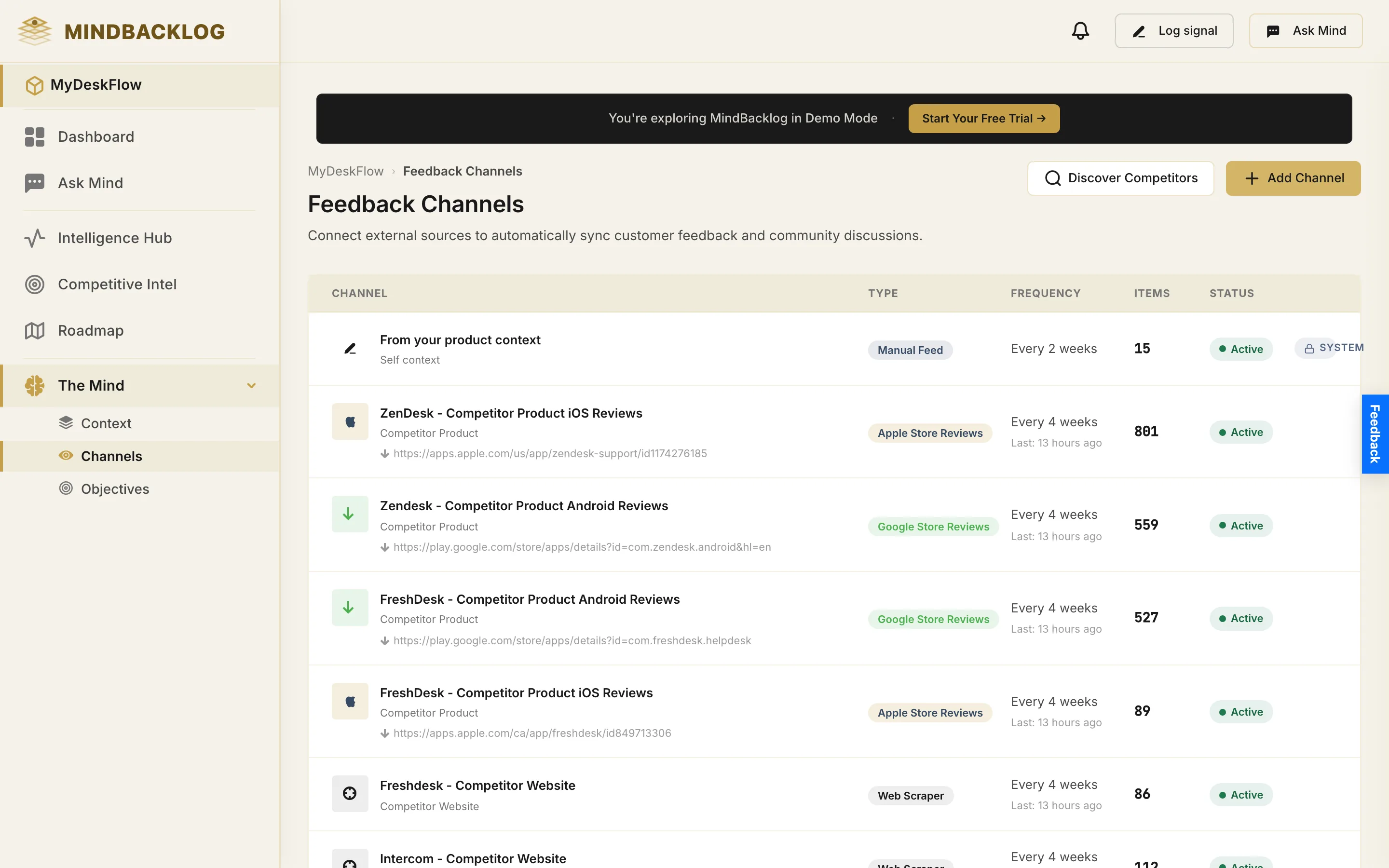
The MIND engine connects signals into intelligence.
This is the differentiator. Every signal compounds with every other one — sharpening the product context over weeks, months, years.
- Intelligence Hub — see what's trending: which themes are getting louder, which are new, which are shifting sentiment.
- Nightly cluster suggestions — the engine proposes features grouped from related signals. Accept with one click.
- Competitive Intelligence — a dedicated dashboard for competitor sentiment, gap matrix, and signal trends.
- Daily intelligence brief — pushed to your inbox. Not buried in a dashboard.
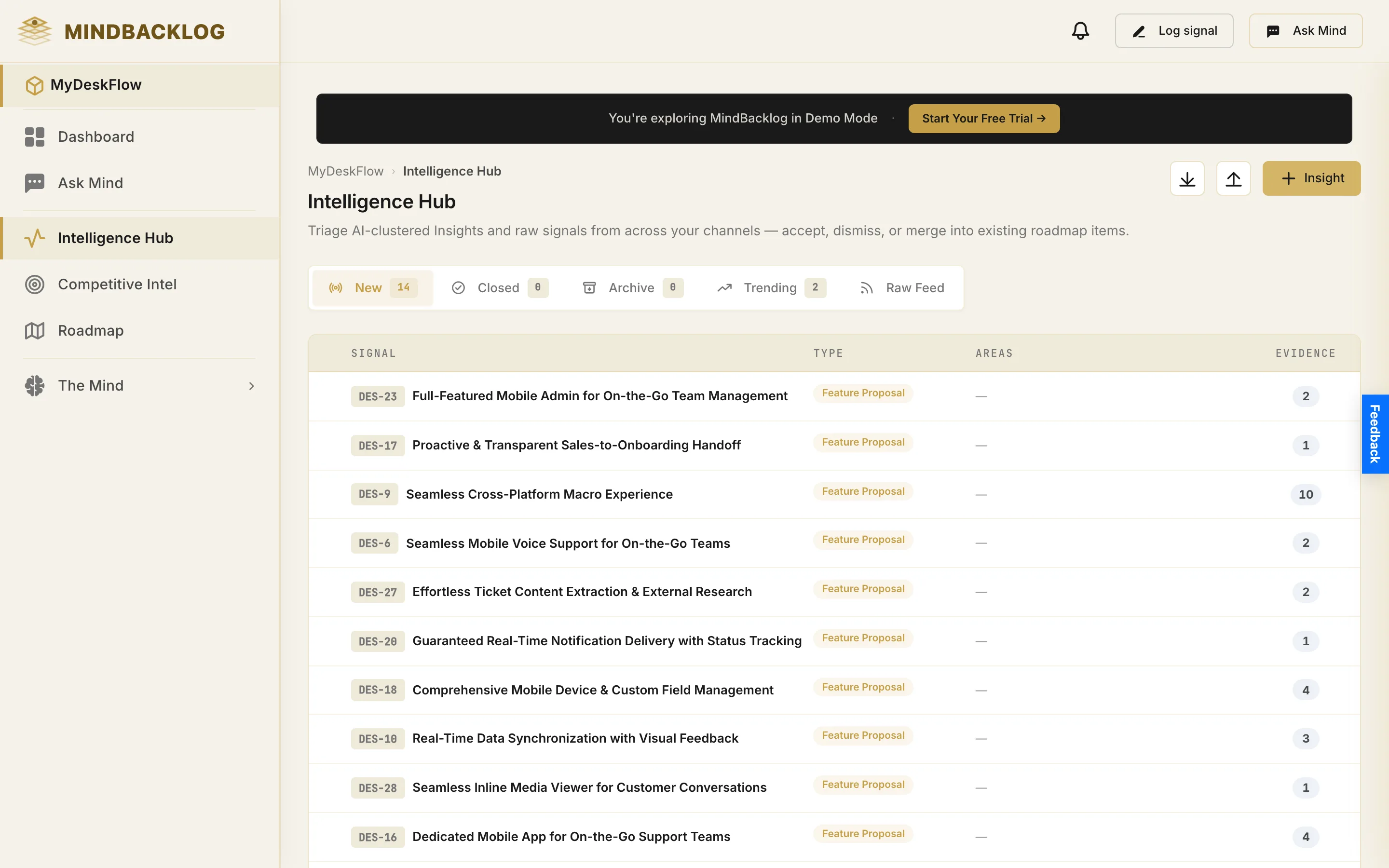
From intelligence to evidence-backed artifacts.
Living PRDs cite real signals. RICE scores trace back to evidence. Roadmap items defended by data. Jira sync (LIVE) keeps engineering in their flow.
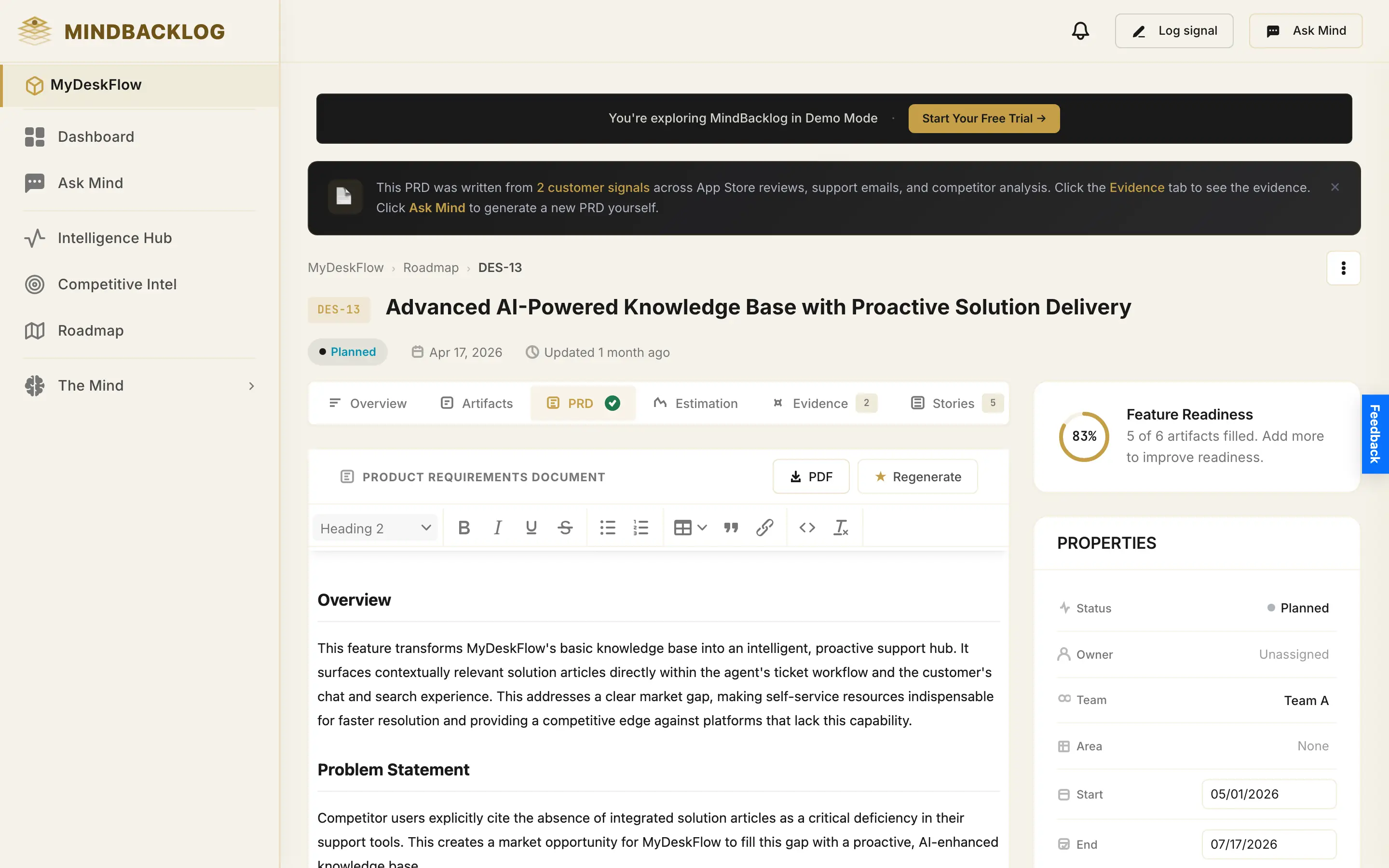
- Living PRDs — generated in under 30 seconds. Every claim cites a real signal. See one →
- RICE prioritization with AI estimation — backed by signal volume, sentiment, channel diversity. See RICE evidence →
- Roadmap with evidence on every card. Kanban, Gantt, list views. See the board →
- Jira sync (LIVE) — bidirectional, real-time. Engineers stay in Jira; product intelligence stays here.
- MCP server — query your product intelligence from Claude, Cursor, or ChatGPT. 20+ tools.
Compounds from day one. Sharpens with every signal.
Same question. Same product. Same Ask Mind. Different depth of evidence — because the engine has more signal to draw on.
"Based on your product context and the 14 signals received this week, onboarding friction is the strongest early theme. Two enterprise accounts mentioned it during setup."
"Search improvements should be #1. 47 signals across 4 channels mention search frustration — up 40% this month. Competitor X just shipped search filters and their reviews improved. RICE: 892. 3 enterprise customers specifically requested this. Here's the evidence trail."
Your week, on receipts.
Compounding from day one.
Product context in 2 minutes. Your first Living PRD in under 3. Competitive intelligence within 5.
How depth builds, by company size and signal volume.
The "30-second Living PRD" headline is real — value lands on day one. What deepens over time is the depth of evidence, and that tracks signal volume, not the calendar.
First Living PRD on day one. Full compounding once a few hundred signals are in.
Concept Mode covers the cold start. Connect a feedback widget and one chat channel, and the engine has enough to generate a citation-backed PRD within a day. Competitive Intelligence is useful immediately because the public review mining does not depend on your signal volume. Once a few hundred signals have flowed in, you have meaningful cross-channel weighting in RICE.
First useful Living PRD in the first afternoon. Sharpening with every signal that lands.
Connect three to five channels and the daily intelligence brief is useful from the first one. As a few hundred signals accumulate, the Intelligence Hub starts surfacing trending themes that were not obvious to the PM team. With enough sentiment history, the engine weights RICE inputs by direction (improving vs degrading) instead of just by volume.
Same-day value. At this volume the engine reaches full sharpness fast.
High signal volume accelerates everything. Cluster suggestions become useful almost immediately because the engine has enough signals to spot meaningful groupings. The competitive matrix populates faster (the gap-detection model needs both customer signals and competitor review data to compare against). At this volume the platform reaches steady-state intelligence depth quickly.
Immediate full-history value. Compounds from day one with 18-36 months of context.
Batch-importing historical signals via the REST API endpoint restores the full prior context. The pipeline reclassifies, deduplicates, and links every imported signal against your features automatically. Teams switching from Productboard, Canny, or internal spreadsheets typically have 18-36 months of signals reactivated within the first hour — and meaningful intelligence depth on day one.