Know what their users hate — before they fix it.
A dedicated dashboard: competitor sentiment cards, per-competitor signal feeds, a gap/opportunity matrix, and sentiment trends. Public reviews and forum threads — automatically mined and classified.
App Store · 32 mentions · 30d
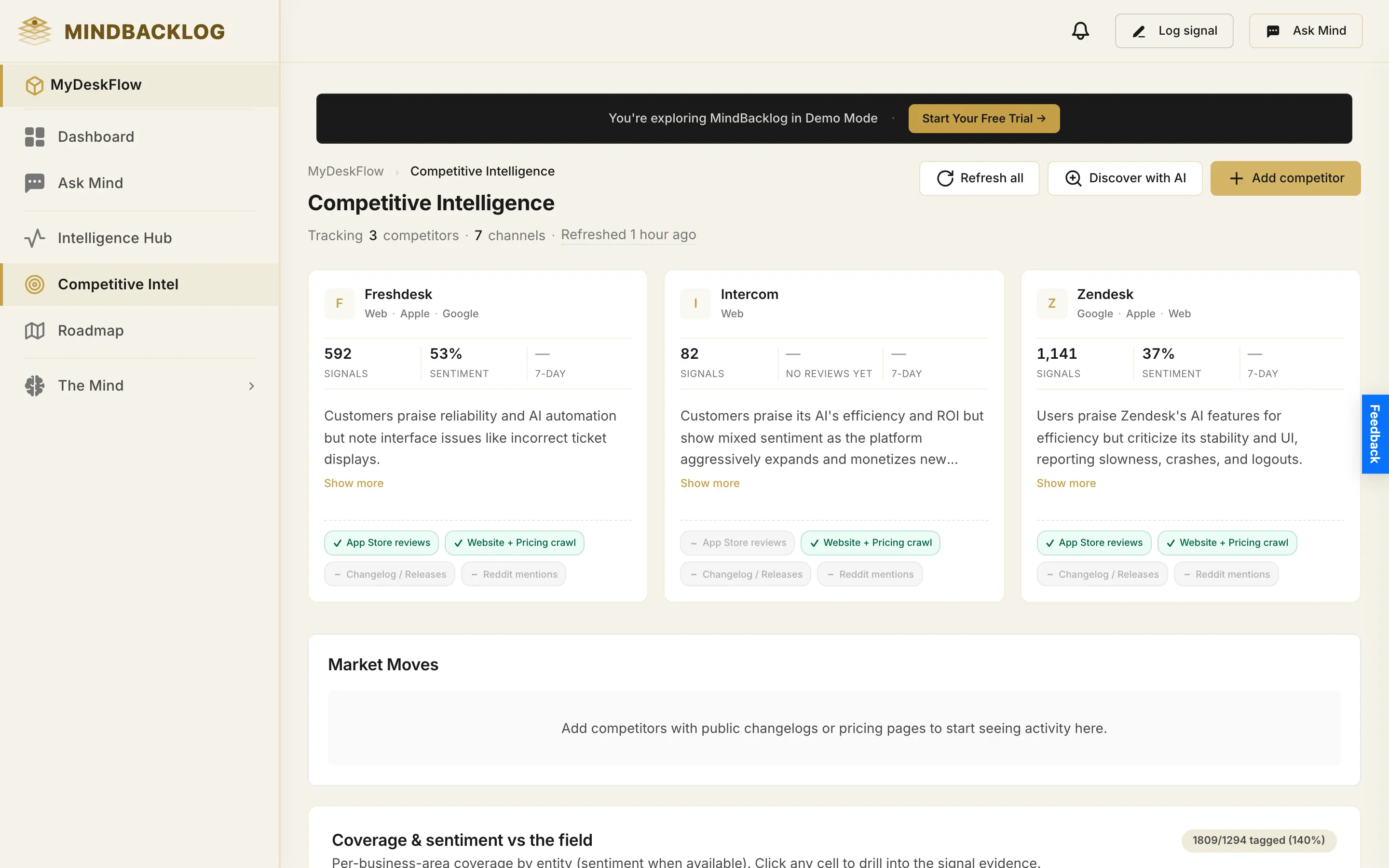
A dedicated competitor dashboard, not a slide deck.
Continuous mining of public sources, mapped to your themes, intersected with your roadmap.
Per-competitor sentiment cards with trend lines.
When a competitor ships, the dashboard catches whether their reviews moved +0.4★ or −0.3★ in the next 30 days. You know what worked and what landed badly — without an analyst doing teardowns twice a year.
Classified reviews + forum posts per competitor, searchable.
App Store, Google Play, and forum threads tagged against your own theme taxonomy. "Search filters" in their reviews maps to "search" in your roadmap — not a separate vocabulary you have to translate every time.
Where competitors fall short × your themes — pre-mapped opportunities.
A grid that shows where their weakness overlaps with your signal volume. The strategic opening is visible at a glance — instead of buried in a slide deck that goes stale by next sprint.
Competitor signals join the same intelligence layer — so Living PRDs include competitive context automatically.
Competitor intelligence is a slide deck nobody updates.
Marketing did a teardown six months ago. Sales engineers learn about competitor releases in deal reviews. Your team finds out a competitor shipped your roadmap feature when a board member forwards the changelog. Meanwhile, 214 App Store reviews in the last 30 days say exactly what their users hate — and nobody on your team has read them.
Four views into every competitor.
Competitor overview cards
Sentiment, review volume, signal trend, top three complaints — at a glance for every competitor you track. Acme Pro card: sentiment ↓12%, 214 reviews in 30 days, top complaint "search filters still missing after 2 years" cited 32 times on the App Store. Open the card, see the story in 10 seconds.
Per-competitor signal feed
Every classified review, forum post, and public complaint — searchable, filterable by sentiment, theme, source, and date. Drill from "32 mentions of search filters" to the actual 32 quotes in three clicks. The audit layer behind every gap-matrix call.
Gap/opportunity matrix
Themes mapped on two axes: where competitors fall short × where your own customers ask for it. The cell with "Competitor X weak, your signal volume high" is your strategic opportunity — visible in a grid instead of buried in a slide deck nobody updates.
Sentiment trends across releases
Watch competitor sentiment shift across each release. Competitor X shipped search filters in May — sentiment moved +0.4★ over the following 30 days. Competitor Y shipped a redesign in March — sentiment dropped −0.3★. You see what landed and what backfired before your team plans the same move.
Four moments when the dashboard earns its keep.
You do not open this dashboard daily. You open it the moments competitive context decides the call — and it has already done the analysis.
Competitor X shipped Friday — the dashboard caught it.
The Monday brief flags it: "Competitor X shipped search filters Friday. App Store reviews moved +0.4★ in 48 hours. 28 mentions of the new feature already. Your gap-matrix score on search: high — they just closed it." You open the dashboard, read the 28 reviews, decide whether to accelerate your own search work — all before standup.
Sales asks "what do Acme Pro users complain about?"
Open the Acme Pro card. Top three complaints: search filters missing (32 mentions), poor mobile experience (24), pricing changes (19). Share the card link in Slack. Sales walks into the next deal review citing 32 real App Store reviews — not guessing.
Roadmap review — leadership asks "isn't Acme Pro ahead of us on search?"
Pull up the gap matrix. Acme Pro's cell says the opposite: 32 unresolved search-filter complaints, their top complaint, still unshipped after two years. Their weakness crosses your highest signal volume — the strongest cell on the grid. You answer with evidence on screen, not opinion, and the review moves on.
Pre-launch concept needs validation.
Concept Mode + Competitive Intelligence: a new product idea with no customers yet still has three direct competitors and 1,200+ public reviews. The dashboard gives you the gap matrix on day one. You go into the leadership pitch with competitive evidence even before launch — not gut feel about who is doing what.
What flows in. What flows out.
Public sources mined continuously. Competitive context flows out to PRDs, scores, briefs, and Ask Mind.
App Store, Google Play, forums
Reviews and public threads mined on a continuous schedule, classified through the same pipeline that handles your own signals — theme-tagged, sentiment-scored, deduplicated in under a second. REST API lets teams add custom competitor inputs too.
See the pipeline →Living PRDs (competitive context)
Every Living PRD pulls the relevant competitive section inline — "Competitor X shipped this in May, reviews +0.4★; Competitor Y has 32 unresolved complaints." Engineers read a PRD that already knows the market context.
See Living PRDs →RICE scoring + Ask Mind
RICE's impact dimension factors in competitive gap weight. Ask Mind answers "what do Competitor X users hate?" by querying the dashboard directly. The competitive layer is part of the same intelligence graph every score and answer draws on.
See RICE scoring →Competitor signals join the same graph as your customers' signals.
Acme Pro's 32 search-filter complaints and your customers' 47 search signals live in one graph — same taxonomy, same MIND engine, one body of evidence. Nothing to export, nothing to reconcile. How the MIND engine works →
Questions PMs ask about Competitive Intelligence.
Other capabilities the dashboard plugs into.
MIND Engine
The persistent intelligence layer where competitor signals live alongside your own — linked, classified, and trended together.
Read →Intelligence Hub
Trending themes view that surfaces competitor releases as trend events — so a sentiment shift after their launch lands in your daily brief.
Read →Living PRD Generator
Every Living PRD pulls competitive context inline from the dashboard — engineers read PRDs that already know the market.
Read →