Never miss what your customers are telling you.
9+ direct channels feed one AI pipeline. Plus unlimited sources via REST API, Zapier, and Make. Every signal classified, deduplicated, linked, and sentiment-scored — automatically, in under a second.
An inbox stores quotes. A pipeline produces intelligence.
Four passes in under a second — capture, classify, link, score — the moment a signal arrives from any channel.
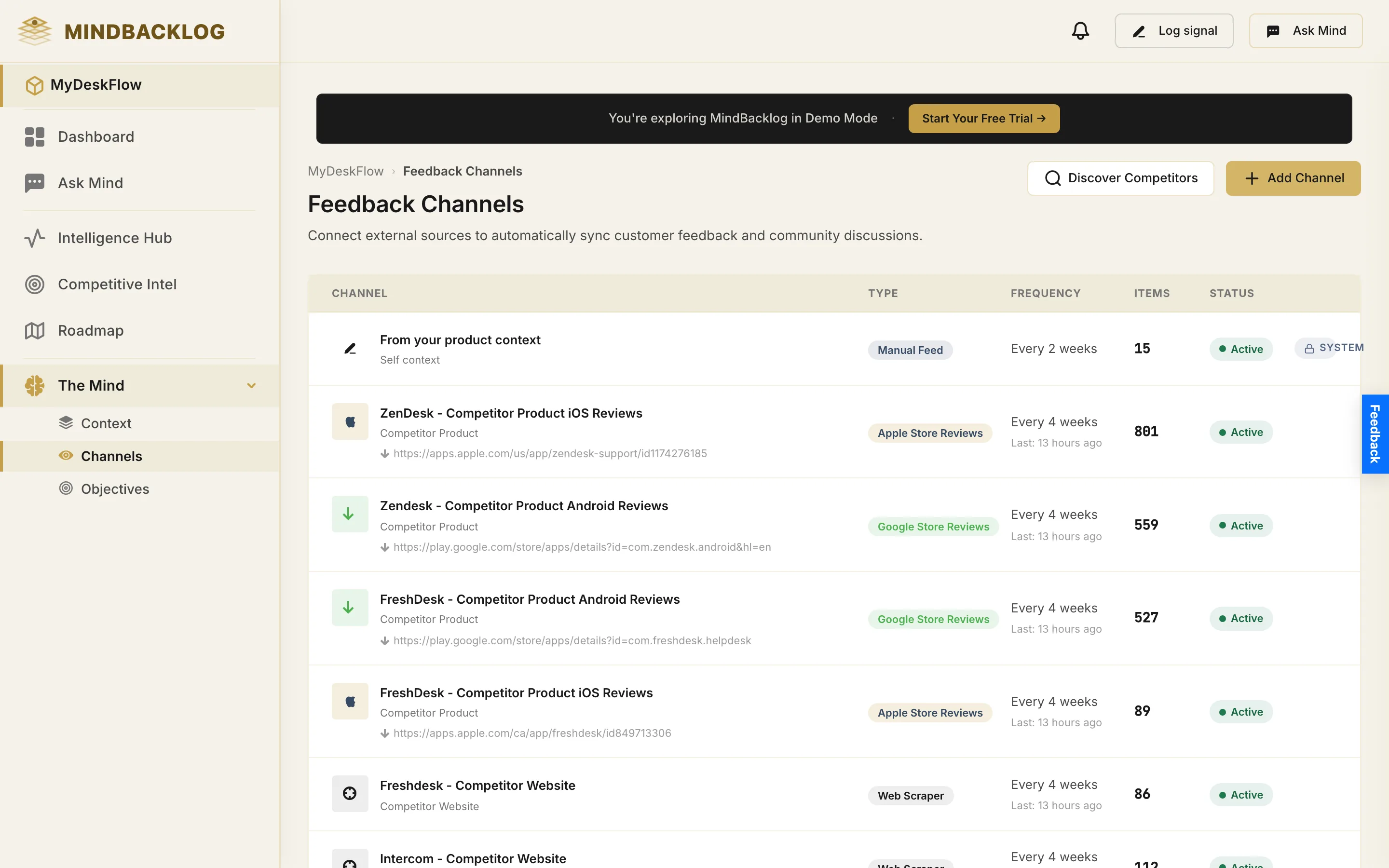
9+ channels native, plus REST API, Zapier, Make.
Slack, Email, App Store, Google Play, Public Portal, Feedback Widget, Web Scraper, Web Form, Reddit — connected out of the box. Anything else pipes in over REST, Zapier, or Make. No channel left as a silo.
Feature request / bug / praise / churn risk — sorted in under a second.
Every signal classifies the moment it arrives. No PM playing inbox triage on Monday morning. The synthesis step that used to take half a week happens upstream, automatically.
Connected to features, departments, customers, themes. Sentiment-scored. Deduplicated.
Each signal links to the right feature, customer, and theme. Sentiment polarity and urgency get scored. The same complaint from 12 channels collapses into one trend — with channel diversity preserved as evidence.
The pipeline turns 200 raw messages a week into one organized intelligence layer.
Customer feedback lives in nine places. None of them talk to each other.
Slack DMs from sales. Widget submissions from support. App Store reviews nobody read this week. Three Google Play complaints about the same bug. A Jira comment that should have been a signal. An email forward marked "FYI." Every PM has the same Monday morning — open nine tabs, copy-paste into a spreadsheet, manually tag what looks important, miss what arrived at 2am. By Wednesday the spreadsheet is stale, by Friday the engineer asks "did a customer actually ask for this?" and the honest answer is "I think so, let me check." The synthesis loop is broken at the input layer.
One pipeline. Four passes. Under a second per signal.
The synthesis happens before the signal hits your screen — not after.
Classify the type
Feature request, bug, praise, churn risk — sorted automatically. A 2am App Store review saying "love the new dashboard but please add filters" gets split: praise on dashboard, feature request on filters. Two signals, one quote, both attributed.
Link to features, customers, themes
Every signal is connected to the right feature, the originating customer or account, the affected department, and the relevant theme. The Slack message from Acme's CFO and the App Store review from Beta Inc end up on the same feature card — with the enterprise account weight preserved.
Score sentiment, urgency, velocity
Sentiment polarity (positive/negative/neutral), urgency markers (churn language, blocker tone), and trend velocity (signals per week, accelerating or stable). A complaint trending up 40% week-over-week looks different from a stable one — the score reflects it.
Dedupe semantically across channels
"Add date filter to exports" in Slack, "why no date range on CSV" in App Store, "filter exports by month please" in the widget — same complaint, three different phrasings. The pipeline collapses them into one trend showing 12 signals across 4 channels, not 12 duplicate tickets.
9+ direct integrations. Unlimited via API.
Channels are not capped at 8 — that is the count of pre-built native integrations. Anything you can pipe in via REST API, Zapier, or Make becomes a channel too.
Monday brief to Friday review — the pipeline runs while you sleep.
Concrete moments where the pipeline pays for itself.
The weekend's signals arrive pre-sorted.
Over the weekend, 47 signals arrived across 6 channels. Each was classified on arrival — type sorted, feature linked, sentiment scored — and the duplicates collapsed into trends before you woke up. What you read Monday is not 47 unread items; it is three movements: search complaints accelerating, onboarding praise steady, one new churn-risk signal from Globex. Ninety seconds. Zero triage.
Sales pings you about a "huge enterprise ask."
Old way: search Slack, search Email, hope the threads connect. But the linking pass already did the connecting — the account's 8 signals from Slack, Email, and Portal sit on one feature card because the pipeline resolved each to the same customer the moment it arrived. You answer Sales in 10 seconds with the full cross-channel record, not a "let me check."
App Store review storm hits.
A bug ships and 23 reviews land in two hours. The pipeline classifies each as a bug, links all 23 to the same feature, and dedupes them into a single high-urgency cluster — so engineering sees one accelerating trend, not 23 separate tickets. The storm is legible while it is still forming, and the fix ships Friday morning.
The week's 142 signals reconcile themselves.
142 signals flowed through the pipeline this week. You corrected two: a "bug" that was really a pricing complaint, and one misattributed feature link. Those overrides tune the classifier to your product's vocabulary — every signal after them is read more accurately. The other 140 classified, linked, deduplicated, and scored themselves. The spreadsheet you used to rebuild every Friday no longer exists.
The pipeline is the foundation. Everything else pulls from it.
Signals flow in. Intelligence flows out.
Classified signals cluster into themes.
Every classified signal lands in the Intelligence Hub, where it joins trending clusters, daily briefs, and the nightly cluster suggestions. A signal arriving Monday at 2am is in a trend cluster by 8am.
Every score traces back to source signals.
Evidence-based RICE scores draw Reach from signal volume, Impact from sentiment intensity, Confidence from channel diversity. Click any number on the scorecard, see the pipeline-classified signals that produced it.
Citations come from the pipeline.
Every citation in a Living PRD and every claim from Ask Mind traces to a pipeline-classified signal. No hallucinations. No fabricated quotes. The pipeline is the source of truth — the artifacts are how it gets surfaced.
Four steps. Under a second per signal.
Classify
Feature request, bug, praise, churn risk — sorted automatically.
Link
Connected to features, departments, customers, themes.
Score
Sentiment polarity. Urgency. Trend velocity.
Dedupe
Same complaint from 12 channels collapses into one trend.
Classification is where the compounding starts.
The pipeline is the intake of the MIND engine. Each classified signal sharpens the next pass — dedup gets stricter, linking gets surer, sentiment baselines settle. The 2,000th signal is read with everything the first 1,999 taught the engine.
Questions PMs ask about the Signal Pipeline.
What the Signal Pipeline powers next.
Intelligence Hub
Classified signals cluster into trending themes, daily briefs, and nightly cluster suggestions — the synthesis layer above the pipeline.
Read →Evidence-Based Prioritization
RICE scores drawing Reach, Impact, and Confidence from real pipeline-classified signal volume, sentiment, and channel diversity.
Read →Ask Mind
Persistent side panel that answers any product question with citations to the exact pipeline-classified signals — no hallucinations.
Read →