AI Feedback Analysis
Any AI generates from a blank prompt. This one generates from your product's evidence — a trend report on your real signal feed: themes, sentiment shifts, emerging patterns. The complaints customers did not say out loud but the signals reveal.
47 signals · all channels
12 signals · 3 channels
The value is in patterns you have not yet heard.
Three criteria for analysis that beats a louder version of your inbox.
What's said the most.
Themes ranked by volume and channel diversity — not by which complaint shouted loudest in your inbox. A pattern with 47 signals across 4 channels beats one with 200 signals from a single noisy account. Every theme links back to source quotes so engineers and leadership verify the customer language themselves.
Where mood is changing.
Subtle sentiment drift detected before it turns into churn — a feature whose mentions go from neutral to negative over six weeks, a customer segment whose tone hardens after a pricing change. The pipeline reclassifies as the signal mix shifts, so the trend you see today is the trend that is actually happening today.
New patterns before critical mass.
A theme at 8 signals across 3 channels — caught before it grows to 47 signals and an angry blog post. The engine spots emerging clusters the moment they cross a velocity threshold. That is the pattern detection your human attention cannot do at scale.
Feedback analysis is not a one-shot report. It is a living intelligence stream that compounds in sharpness with every signal that flows in.
What separates feedback synthesis from feedback summarization.
Summarization tells you what was said. Synthesis tells you what it means and what to do about it. Five rules separate the two.
Synthesize across channels, not within them.
A complaint that appears in 3 Slack threads, 8 App Store reviews, and 12 portal posts is one theme — not three small ones. Most teams analyze each channel in isolation: support tickets in one dashboard, App Store reviews in another, Slack screenshots pasted into a Notion doc. Single-channel analysis misses cross-channel patterns. The loudest signal is rarely in any one inbox; it is in the overlap. Great feedback analysis collapses the channels into themes first, then keeps channel attribution as metadata for weighting and follow-up.
Weight by account, not by message count.
14 messages from one frustrated customer is not the same as 14 messages from 14 different accounts. Account-level reach matters more than raw signal count for prioritization purposes. A theme with 28 signals from 22 accounts beats a theme with 80 signals from 4 accounts — the first is a market pattern, the second is a few power users. Great feedback analysis deduplicates by account, then by user within account, before counting volume. Otherwise the noisiest customer wins the roadmap.
Watch the sentiment trend, not the latest message.
A single negative review is noise. 60 days of declining sentiment is signal. The strongest analysis looks at rolling sentiment windows, not point-in-time snapshots. A theme whose sentiment drops 0.4 stars over two months is the early warning; the angry tweet on day 75 is the result, not the cause. PMs who react to the latest message keep firefighting; PMs who watch the trend get ahead of churn while the slope is still gentle.
Distinguish themes from individual asks.
"Add a dark mode" is one ask. "The UI feels heavy and outdated" is a theme that dark mode is one expression of. Themes are roadmap inputs; individual asks are story inputs. They live at different altitudes. Great feedback analysis surfaces both layers and keeps the relationship between them visible — the theme up top, the contributing asks underneath. Conflate them and the roadmap becomes a wishlist; separate them and the roadmap becomes a strategy with proof.
Pair the analysis with action paths.
Feedback analysis that does not end in "what should we do" is reporting. The strongest output names the theme, sizes the affected accounts, recommends a response (build / fix / educate / accept), and shows the evidence for each. A theme without a recommended path becomes a deck slide that nobody acts on. A theme with a path becomes a decision in next week's planning. Action paths are what convert a synthesis into a roadmap input.
A feedback analysis that does these five things turns customer voice into product strategy — not a slide deck.
Why most feedback analyses produce themes nobody acts on.
The failure modes are predictable. Avoid these five and the synthesis lands in the room with weight.
Counting messages instead of themes.
"We got 200 pieces of feedback" is volume. "We got 7 recurring themes" is intelligence. Raw counts are misleading because they double-count the same complaint phrased ten ways — and they reward the most prolific complainer rather than the most representative pattern. The unit of analysis is the theme, not the message. Reports that lead with message counts pad the numbers without sharpening the conclusion.
Equal weight on every channel.
A complaint from a $50K ARR enterprise account is not the same as one from a free-tier user. Channels also carry signal: in-app widget submissions tend to be highest-intent; portal posts skew toward power users; App Store reviews are loudest but often least targeted. Analysis that treats every channel as a uniform stream loses the texture of who is saying what — and prioritizes whichever channel is noisiest, not whichever is most informative.
Recency bias.
Last week's loud complaint outranks the steady drip of 30 portal posts over the prior quarter. Analysis weighted by recency alone misses the persistent themes that compound over time. The strongest synthesis looks at both — the new spike and the old baseline — and reports them as separate signals. Recency without baseline is a news feed, not a strategy document.
Tagging without linking.
"Tagged as 'search'" tells you the feedback is about search. It does not tell you whether the customer fixed it themselves, whether the same customer complained twice, or whether the complaint connects to a feature on the roadmap. Tags without linking are just colored stickers. The best analyses link every signal to a feature, an account, a sentiment trajectory, and a status — so the tag becomes a doorway to the rest of the story rather than the end of it.
No closing the loop with customers.
Feedback analysis that stays inside the PM's head is wasted work. The strongest workflows route the synthesis back to support, sales, and the customer themselves — "you mentioned this, here is what we are doing about it" — which compounds trust with every closed loop. Customers who hear back submit again. Customers who do not stop telling you anything. The loop is not optional; it is the mechanism by which feedback volume keeps growing in the first place.
What a real feedback trend report actually looks like.
Themes ranked by volume and channel diversity. Sentiment shifts month over month. Emerging-pattern callouts. Every claim cited to the signals behind it.
Feedback Trend Report — 30 day window
v6 · signals refreshed 1h ago1 · Top themes by volume
Search frustration — 47 signals across 4 channels (Slack, Widget, App Store, Portal). Volume ↑40% versus prior 30-day window. Bulk export limits — 28 signals across 3 channels. Mobile session drop — 21 signals, App Store dominant. 47 signals +7 themes
2 · Sentiment shifts (90-day baseline)
App Store sentiment ↓0.4★ over 60 days, driven primarily by search frustration cluster. Widget resolution-time sentiment ↑12% — agents shipping faster. Public Portal upvote concentration shifted toward enterprise asks (3 of top 5 now from accounts >$50K ARR). App Store Widget
3 · Emerging patterns (new this window)
"API rate limit" theme — 8 signals across 3 channels in 14 days. Did not exist 30 days ago. Mostly enterprise. Velocity ↑200% week-over-week. Likely the next "search frustration" if unaddressed. "Onboarding too long" theme — 6 signals, all from trial users in week one. Conversion correlation flagged. NEW
4 · What users did not articulate
The pipeline detected 14 signals mentioning "slow" or "laggy" across 3 channels — but no single user filed an explicit performance complaint. The pattern only emerges in aggregate. Three enterprise customers are quietly degrading their usage frequency (signal velocity ↓35% over 60 days) without filing a ticket — silent churn risk. Pattern detection
5 · Recommended actions
3 prioritiesGenerate PRDs for search filters and API rate limits. Investigate silent-churn pattern before next QBR. → Living PRD
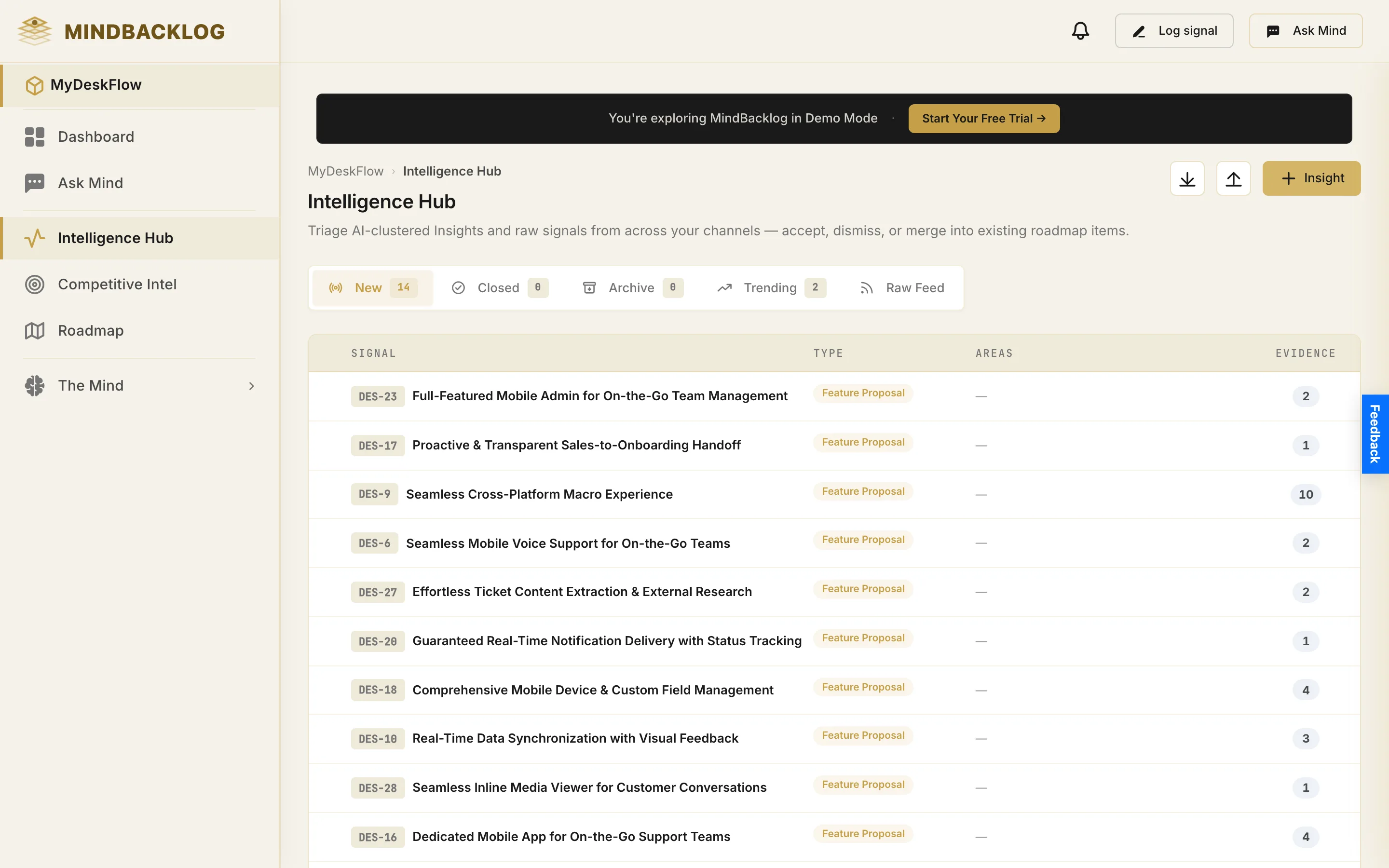
Every citation chip opens the source signal in the Intelligence Hub. Theme cards expand to the full signal list. Emerging patterns push to the daily intelligence brief automatically.
Same prompt. Different category of pattern detection.
General AI analyses whatever you paste in. This one watches every signal continuously.
No persistent product memory
ChatGPT forgets every signal when the conversation ends. The MIND engine keeps every signal it has ever processed — each one classified, every theme tracked, every sentiment shift logged. Ask Mind "what is new this week?" and the answer draws on the full history, not a 200-token prompt.
No signal citations
Even with RAG and uploaded docs, general AI produces plausible-sounding themes with no audit trail. Every theme in a MindBacklog report carries a citation chip pointing to the exact signals behind it — channel, date, account, quote. Engineers click through to verify. Leadership audits in real time. Nobody asks "is this a real pattern or a hallucination?"
No competitive context
General AI does not mine public reviews of your competitors continuously. Competitive Intelligence does — so when an emerging theme in your own feedback maps to a known competitor strength (or weakness), the trend report flags it. "Search frustration up 40% — and competitor X shipped search filters in May with a +0.4★ review delta." Context, not just trends.
No multi-channel ingest
A trend report informed only by support tickets misses the enterprise asks in Slack. The signal pipeline ingests across 9+ channels (plus REST API, Zapier, Make) and weights every theme by both volume and channel diversity — so an 8-signal theme spanning 3 channels ranks higher than a 28-signal theme stuck in one inbox.
From scattered signals to trend report in 30 seconds.
Four steps. Three run on their own as signals arrive. You only touch the fourth.
Connect your channels.
Slack, Email, App Store, Google Play, Public Portal, Feedback Widget, Web Scraper, Web Form, Reddit — with REST API, Zapier, and Make covering anything custom. Setup takes minutes, not a project. From the first signal onward, every theme keeps its channel attribution — the count of channels behind a pattern is part of the analysis, not decoration.
Every signal classified, clustered, and counted.
The pipeline classifies signal type, links to existing features and themes, scores sentiment, deduplicates against prior signals, and detects velocity shifts. Nightly trend detection runs against the 90-day rolling baseline so emerging patterns surface the moment they cross a threshold.
"What is trending this month?"
Open Ask Mind from the persistent side panel — available on every page. Type the request in plain English. The engine pulls the current theme rankings, sentiment shifts, emerging patterns, and silent-churn risk indicators, then assembles the narrative report with citations attached.
Report delivered in 30 seconds.
The trend report lands with theme cards, sentiment trends, emerging pattern callouts, and recommended actions. Every citation chip clickable. Edit anything. The next regeneration preserves your manual edits and refreshes only the signal layer underneath.
Five PM workflows where the trend report earns its keep.
Real scenarios where a theme with a count settles the question.
Monday morning — what changed last week?
Open the daily intelligence brief at your desk. "Search frustration up 40%. New theme detected: API rate limits, 8 signals across 3 channels." The PM walks into planning with the week's top three signals already mapped. No catching up on the inbox. No "what did I miss?" The trend report drives the agenda.
A pattern emerges before it becomes a crisis.
At 8 signals across 3 channels, the report flags a new theme as emerging. The PM ships a fix or starts customer dev before the same pattern becomes 47 signals and an angry blog post. The public complaint never happens because the cluster was caught at velocity ↑200% week-over-week.
Board needs the customer narrative.
Generate the trend report for the quarter. Theme volumes, sentiment shifts, emerging patterns, silent-churn indicators — all in one document. Paste sections into the board deck with citation chips intact. The CEO defends customer focus with numbers, not anecdotes. Board reads the same report sales does.
Enterprise customers quietly disengaging.
The pipeline detects three enterprise accounts whose signal velocity dropped 35% over 60 days — no support ticket, no formal complaint, just declining usage. The trend report flags silent-churn risk before renewal conversations start. Customer success gets a heads-up six weeks before the contract conversation, not six weeks after the churn.
CEO asks "what are customers saying?"
Pull up the report. Top three themes by volume, sentiment direction, the emerging pattern from the past two weeks, and three named accounts driving the loudest cluster. The CEO walks into investor updates with a customer narrative grounded in 247 cited signals — not the three Slack complaints they happened to read.
Living PRDs anchored in a real trend.
When a theme crosses 30+ signals across 3+ channels, the trend report recommends generating a Living PRD. One click and the PRD lands with every cited signal already attached, sentiment trend visible, competitive context pulled in. The trend report becomes the input to evidence-backed roadmap planning, not just a passive dashboard.
The trend report is a window onto the intelligence layer — not a standalone tool.
Every trend report draws from the same persistent intelligence layer that powers the Intelligence Hub, Ask Mind, Living PRDs, RICE default scoring, and Competitive Intelligence — signals across 9+ channels classified in under a second, with 90-day rolling sentiment baselines, channel-diverse theme weighting, and silent-churn detection. The report is the artifact; the layer underneath is what makes the pattern detection credible. It compounds from day one.
Questions PMs ask about feedback analysis.
Other artifacts built on the same counted themes.
Living PRD Generator
Full PRDs with signal citations and competitive context — generated in 30 seconds from the same evidence base that powers trend reports.
Read →Feature Brief Generator
When a theme's count justifies action, the one-page brief makes the case — problem, evidence, options, recommendation.
Read →Competitive Analysis
Mine competitor reviews, forums, and public signals into a strategic teardown. Sentiment, gap matrix, your opportunity.
Read →Go deeper on the category and the synthesis.
What is product intelligence?
Feedback analysis is one capability of the broader product intelligence category — the layer that turns scattered signals into compounding decisions over time.
Read pillar →Intelligence Hub
The live view of what is trending across all your feedback channels — clusters, sentiment, account reach. The home of the synthesis between reports.
See feature →Glossary
Signal, MIND Engine, Intelligence Hub, Compounding Intelligence — the vocabulary of feedback synthesis, defined in one place.
Browse terms →Deeper reading on the craft.
Build what's right. Prove why.
Your first feedback analysis, from your URL.
Explore a sample workspace →