AI Competitive Analysis
Any AI generates from a blank prompt. This one generates from real user signals — App Store reviews, public forum threads, and product critiques, auto-classified and sentiment-scored into a strategic brief. Know what their users hate before they fix it.
An analysis is only as sharp as its source data.
Three criteria separate real competitive intelligence from a model-written guess.
Reviews, forums, public signals.
App Store reviews, Google Play complaints, Reddit threads, G2 entries, public forum posts — auto-mined continuously. Not generated from a stale training set. Every claim links to the actual review or thread, with the quote visible. Engineers and leadership click through and verify themselves.
What competitors' users hate.
Every competitor has a complaint cluster their team cannot fix this quarter — 32 mentions of slow search, 21 of poor onboarding, 14 of a missing API. Those are the gaps you can target. The matrix surfaces them ranked by mention volume so positioning, pricing, and roadmap conversations move from gut to data.
Watch their releases land.
Review delta after a known ship date, complaint clusters disappearing, sentiment shifting plus or minus after a feature release. The mining layer catches what your team would miss reading reviews manually — and tells you which of their bets are working before their next earnings call.
A real competitive analysis is not a one-shot deck. It is a standing watch on the competitor's review base — one that gets sharper with every review mined.
What separates competitive intelligence from competitive guessing.
Competitive analysis is a discipline, not a deliverable. Five rules separate intelligence that drives roadmap decisions from a slide deck that sits in a shared drive.
Track what their users hate, not what their marketing says.
A competitor's landing page is their best-case story — the headline they paid a copywriter to craft, the screenshot taken on the one workflow they polished, the testimonial picked from a thousand. Their App Store reviews, G2 comments, and Reddit threads are reality. The gap between marketed value and reviewed value is where your differentiation lives. A competitive analysis that quotes the homepage is competing with the marketing team. One that quotes the reviews is competing with the actual product. The first never moves a deal; the second routinely closes them.
Watch sentiment delta after their releases.
A competitor shipping a feature is data. The 30 days of review sentiment after the ship is more data. If sentiment went up, the feature worked and the gap closed; if it went flat, the gap remains open for you to attack. Most PM teams notice the release and stop there — they file the changelog entry and move on. The teams that win pair the release with the sentiment trend, because a shipped feature that did not move sentiment is functionally equivalent to a feature that was never shipped. That is a strategic opening.
Look for the silence, not just the noise.
Competitors do not talk about what they cannot do. The features missing from their changelog for 18 months are often the features that would move the market — they have been internally debated, deprioritized, blocked on architecture, or written off as too expensive. Public review complaints about missing capabilities are the loudest signal of where to ship. When 32 reviews ask for the same feature and a competitor has stayed silent for two release cycles, that absence is a strategic gift. The analysis that maps the silence is more valuable than the one that maps the noise.
Map the gap, then map the cost.
Knowing competitor X lacks bulk export is half the analysis. The other half: how much engineering would you need to ship the same feature first, and would your customers actually pay for it? Competitive intelligence becomes useful when paired with internal RICE math — Reach times Impact times Confidence divided by Effort. Without that pairing, every competitive insight reads as urgent and the roadmap becomes a reaction stack. With it, the team can rank which gaps are worth closing and which to leave open because the customer-side reach is too thin to justify the build.
Refresh continuously, not quarterly.
A "competitive landscape doc" written quarterly is stale by week two. Competitors ship, reviews accumulate, sentiment shifts, pricing pages get edited, and the doc keeps reporting the world as it was in week one. The strongest competitive analysis runs continuously — public reviews mined every day, changelogs monitored, sentiment trended over rolling windows, with the human PM checking the trends weekly instead of generating the entire doc from scratch each quarter. The cadence changes the discipline: from project work to operating system.
Competitive analysis is a continuous discipline, not a quarterly project. Teams that treat it as the former compound their advantage with every review the mining layer processes.
Why most competitive decks become decoration.
Competitive decks fail in predictable ways. Sidestep these five and the teardown earns its place in roadmap reviews and live deals.
Reading their marketing site, not their reviews.
Marketing tells you what they want to say. Reviews tell you what their users actually experience. A competitive analysis that quotes the marketing site is reporting brand, not capability. When a deck says "Competitor X offers effortless onboarding" because their homepage says so, the deck is doing free PR work for the competitor. The deck that quotes 27 App Store reviews complaining about a 12-step onboarding flow is doing the actual job.
One-shot, never refreshed.
The PM does a "competitive deep dive" once and treats it as truth for the next year. Competitors ship, sentiment shifts, gaps open and close. Static competitive docs lose accuracy every week they are not touched. By month three the document is misleading the team in subtle ways — referencing pricing tiers that no longer exist, missing features that shipped last quarter, citing complaints that were addressed two releases ago. Set the cadence to weekly or kill the document.
Cataloging features instead of analyzing gaps.
"They have feature A, we have feature A, they don't have feature B" is a checklist. The analysis is: what does the absence of B cost their users, and is that pain worth selling against? A feature matrix without the customer-pain layer is a procurement document, not strategy. The real question is never "who has more checkboxes" — it is "where is the largest pool of frustrated users your product could acquire by next quarter."
Ignoring competitor pricing context.
Pricing pages are competitive data. A competitor charging 3x your price for less capability is a positioning gift — your sales motion gets sharper, your marketing comparison page writes itself. A competitor undercutting you by 50% is a different problem entirely — you need a defensible "why pay more" story or a pricing response. Both belong in the analysis. Most competitive decks omit pricing because PMs treat it as marketing's problem; the strongest ones treat it as part of the gap matrix.
No recommendation, just observations.
"Competitor X is doing Y" is observation. "Competitor X is doing Y, which costs us deals in segment Z, and we should respond by [decision]" is analysis. The latter is what teams actually use. A competitive analysis that ends without a recommendation is a research report — interesting, possibly accurate, never acted on. The recommendation can be wrong and still be valuable, because it forces the room to either agree or articulate the counter-position. Observation without recommendation is the slow path to organizational drift.
What a real competitor teardown actually looks like.
Sentiment cards, top complaints with cited quotes, gap matrix versus your product, and your opportunity — all anchored in the mined review base.
Acme Pro — Competitor Teardown
v3 · reviews refreshed 6h ago1 · Sentiment snapshot (90 days)
Apple App Store: 3.6★ across 412 reviews · trend ↓0.3★ over 90 days. Google Play: 3.4★ across 287 reviews · trend ↓0.2★. Reddit r/productmanagement: net negative sentiment, 34 threads mention Acme Pro by name. App Store Google Play Reddit
2 · Top complaints (cited)
Search filters still missing — 32 mentions across reviews. "Why can't I filter by date in 2026?" — App Store · 2★. Slow dashboard at scale — 21 mentions. "Loads for 8 seconds with 50 projects" — Reddit thread. No API for enterprise teams — 14 mentions, mostly in G2. +7 themes
3 · Gap matrix vs your product
Search filters: we have, they do not — 32 mentions worth. Dashboard speed: we have, they do not — 21 mentions worth. REST API: we have (live), they do not — 14 enterprise mentions. Mobile app polish: they have, we do not — gap on our side, 18 reviews praise theirs. Full matrix
4 · Your opportunity
Three of Acme Pro's top complaint clusters (search filters, dashboard speed, API) map directly to features you already ship. Marketing has a credible "switch from Acme Pro" angle backed by 67 real review mentions. Sales objection-handler should reference these three. The mobile polish gap is your own risk — 18 reviews praise theirs.
5 · Recent ship detection
Apr 2026CSV export shipped — review sentiment +0.4★ in following 30 days. Complaint cluster "export limits" dropped from 28 mentions to 6. Changelog · Reviews
Every citation chip opens the source review or forum thread. Sales and product verify the quote in real time. Up to 5 competitors tracked in parallel.
One prompt. A different class of teardown.
General AI writes a teardown from training data. This one mines the live review base.
No persistent product memory
ChatGPT forgets every competitor query when the conversation ends. The MIND engine maintains a continuously updated competitive intelligence layer — track up to 5 competitors, mine reviews daily, detect ship events, watch sentiment shifts month over month. Ask Mind "what changed at Acme Pro this quarter?" and get a real answer.
No signal citations
General AI produces plausible-sounding competitor complaints you cannot verify. In a MindBacklog teardown, every complaint cluster opens to the exact review behind it — App Store reviewer name where public, date, star rating, full quote. Sales reps quote the actual review in objection-handling. Marketing cites it on the comparison page. No invented complaints.
No competitive context
Generic AI does not connect competitive intelligence to your own customer signals. Competitive Intelligence does — the same complaints your customers send Slack become the same gap matrix shown against competitors. Where your product wins, where it loses, where the market is shifting — all in one connected layer.
No multi-channel ingest
An analysis mined from only the App Store misses Reddit and G2. The mining layer spans Apple App Store, Google Play, Reddit threads, public forums, G2 and Product Hunt where available, and competitor changelogs — plus your own 9+ customer channels for context. Plus REST API, Zapier, Make for any custom feed you want to add.
From competitor URL to teardown in under five minutes.
Four steps. Two-minute setup, then the analysis runs continuously in the background.
Drop in a URL or App Store ID.
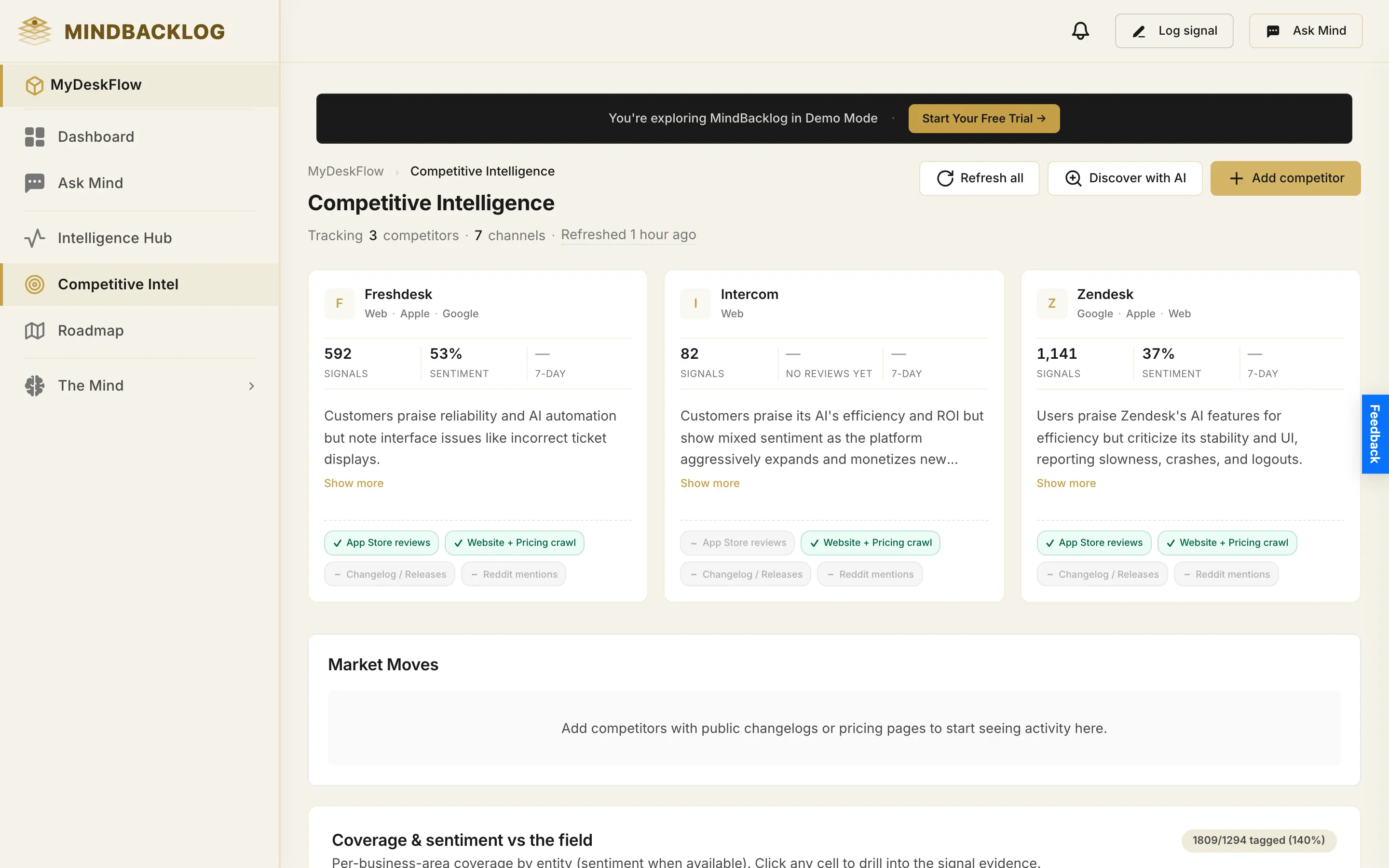
Add up to 5 competitors at once — web URL, Apple App Store ID, or Google Play ID. Setup takes under two minutes per competitor. Once added, the mining layer pulls the historical review base and starts watching for new reviews continuously.
Every review sorted in under a second.
The same pipeline that handles your own customer signals classifies each competitor review by feature area, sentiment, severity, and theme. Complaints cluster automatically — "search filters" complaints across 32 reviews become one trackable theme, not 32 stray mentions.
"Write a teardown for Acme Pro."
Ask Mind lives in the side panel, one click from any screen. Ask for the teardown in plain English. The MIND engine pulls every classified competitor review, ranks the loudest complaints, builds the gap matrix versus your product, detects recent ship events, and writes the opportunity statement.
Teardown delivered in 30 seconds.
The teardown lands with sentiment cards, cited top complaints, gap matrix, opportunity statement, and ship detection. Every citation clickable. Edit any section — your changes persist, and the next regeneration refreshes only the mined review base underneath.
Five PM workflows where competitor teardowns earn their keep.
Real scenarios where mined review data beats invented analysis.
Leadership asks why this matters strategically.
Pull up the gap matrix. "Acme Pro has 32 review mentions complaining about missing search filters — a feature we already ship. That is the easiest switch-pitch we have." Strategy becomes evidence-backed instead of arm-waved. The room stops debating whether competitors matter and starts debating which gap to amplify first.
Reps need objection handlers that hold up.
Ship the teardown to sales. Every objection handler now quotes a real App Store review — "here is what Acme Pro's own users are saying" beats "we think they have problems with X." Reps walk into competitive deals carrying receipts. Marketing pages cite the same source data so the story is consistent.
A competitor closed one of your gaps.
Ship detection fires automatically — Acme Pro shipped CSV export in April 2026, the "export limits" complaint cluster dropped from 28 to 6 mentions, review sentiment moved +0.4★. The PM sees this in the daily intelligence brief, not three months later when a prospect mentions it during a demo.
Living PRD needs competitive grounding.
When you generate a Living PRD for a feature, the competitive context appears inline automatically — "Competitor X shipped this in May, public review sentiment improved +0.4★, gap closed." Engineers reading the PRD see what the market already validated. No more PRDs that ignore what competitors quietly proved last quarter.
Board needs the competitive landscape in one slide.
Generate teardowns for all 5 tracked competitors. The single comparison view shows sentiment trends, top complaints across the field, and where your gap matrix stands. Board reads one slide instead of asking the CEO to defend competitive positioning from memory. Numbers replace narrative.
Evaluating an adjacent category before building.
Drop in 3 incumbents from the new category. The teardown shows what their users hate, where the market is underserved, what features are table stakes versus differentiators. Market-entry decisions become research-backed in a day instead of a quarter of analyst interviews.
The teardown is one lens on the intelligence layer — not a standalone report.
Every teardown reads from the persistent layer behind Ask Mind, the Intelligence Hub, Living PRDs, RICE defaults, and the Competitive Intelligence dashboard. Competitor reviews from the App Store, Google Play, Reddit, and forums sit beside your own signals from 9+ channels — each classified in under a second, each feeding the gap matrix and sentiment trends. The picture compounds with every review mined, and every PRD and roadmap defense inherits it.
Questions PMs ask about competitive analysis.
More artifacts drawn from the same review base.
Living PRD Generator
Full PRDs that arrive with the competitive context inline — the gap your teardown found, cited in the spec.
Read →Feature Brief Generator
The one-page case for closing a competitor gap — problem, evidence, options, recommendation.
Read →Feedback Analysis
The same mining discipline pointed inward — theme clusters, sentiment swings, and patterns forming in your own signal feed.
Read →Go deeper on competitive intelligence as a discipline.
What is product intelligence?
The category that includes competitive intelligence as one of six core capabilities.
Read pillar →Competitive Intelligence Dashboard
The full feature page — gap matrix, sentiment trends after competitor releases, public review mining.
See feature →Glossary
Definitions of Signal, MIND Engine, Competitive Intelligence, and related category vocabulary.
Browse →Deeper reading on the craft.
Build what's right. Prove why.
Your first competitor teardown, from your URL.
Explore a sample workspace →