Every signal makes the next decision sharper.
The MIND engine is the persistent layer that connects every signal to every feature to every competitor — building context that gets sharper with every signal it processes.
Ask Mind · 11:42 am
Persistent contextYou ask
"What changed in customer sentiment this month?"
Mind responds
Search sentiment shifted negative — down 18%. New theme emerged around bulk export — 12 signals. Onboarding stable. Competitor X shipped search filters — relevant.
The persistent intelligence layer underneath every capability.
Not a model. Not a chatbot. The structured, time-aware layer that compounds context from day one.
Every signal stored, every link remembered.
Signals from 9+ channels join a permanent graph with full metadata. Nothing flushes at session boundaries. Nothing decays when a tab closes. The intelligence layer is the system of record, not your memory.
Signals connect to features, competitors, customers.
Every signal classifies against your features and competitors in under a second. Every feature ties to themes. Every theme traces back to customers. Two clicks from a quote to a RICE score.
A few thousand signals in, the engine holds what no team member could.
Sentiment and signal velocity tracked over rolling 7, 30, 90 day windows. Trends surface before anyone notices. The more signals it processes, the sharper every artifact gets.
MIND is the layer everything else depends on — Living PRDs cite it, Ask Mind reads it, RICE scores trace back through it.
Every other PM tool is stateless. The intelligence has nowhere to compound.
ChatGPT forgets every conversation. Productboard organizes feedback but does not learn. Jira tracks tickets with no idea why. Notion stores synthesis that goes stale the moment you close the tab. The PM ends up as the persistence layer — and your memory does not scale to 47 signals across 4 channels with sentiment trends and competitive context attached.
One engine. Four jobs. Endless compounding.
Persistent context, never flushed
Every signal, customer quote, feature, and competitor stored permanently with full metadata — channel, account, sentiment, timestamp. A signal captured in March still informs the Living PRD you generate in August. Two thousand signals in, the engine knows the 412 your team forgot they ever read.
Linked relationships, traversable
Signals link to features. Features link to competitors. Competitors link to your gap matrix. Customers link to accounts. Themes link to trends. Two clicks from a customer quote in Slack to the RICE score it influences and the Living PRD that cites it — because the relationships are stored, not inferred at query time.
Trend memory across 7, 30, 90 days
"Search complaints up 40% this month" exists because the engine remembers every month before. Sentiment shifts, signal velocity, channel diversity — tracked continuously across rolling windows. The Intelligence Hub draws from this. So does Ask Mind. So does every RICE score with a trend chip attached.
Sub-second classification at ingest
Every signal hits the pipeline in under a second — classified by type, linked to existing features, sentiment-scored, deduplicated against prior signals. By the time you open the Hub on Monday morning, weekend signals are already organized, weighted, and ready to surface. No queue. No backlog. No manual tagging.
Four moments when the engine earns its keep.
The engine runs in the background. You only notice it when an artifact lands sharper than memory could ever produce.
The brief lands with weekend context.
Daily intelligence brief: "27 new signals captured over the weekend. Search frustration up 40% week-on-week. Acme Corp escalated bulk export twice in Slack. Competitor X review sentiment dropped 0.4★ after their Friday release." The engine processed everything overnight — you walk in already three steps ahead of the standup.
Engineer asks "why is search ranked #1?"
Open Ask Mind from the side panel. The engine answers with 47 signals across 4 channels, RICE 892, sentiment trend down 18%, 3 enterprise accounts cited by name. Engineer clicks the citation chip, reads the actual App Store review, drops the objection. Two minutes — not two hours of digging through inboxes.
Sales pushes a feature your data doesn't support.
Generate the Living PRD anyway. The engine produces it honestly — 3 signals, 1 channel, no sentiment trend, no competitive gap. The absence of evidence is visible in the document itself. The conversation shifts from "PM versus sales" to "what evidence would change this score?" Receipts decide, not seniority.
Roadmap review, evidence trail in hand.
Every feature on the board has a Living PRD with a citation count, a sentiment trend, and a competitive gap mapped. Leadership stops debating priorities and starts debating sequencing. You leave with the roadmap intact — and three engineers messaging "this is the cleanest PRD I have read in a year."
Same question. Different depth of evidence.
"Based on your product context and the 14 signals received this week, onboarding friction is the strongest early theme."
"Search improvements should be #1. 47 signals across 4 channels — up 40% this month. Competitor X shipped search filters. RICE: 892."
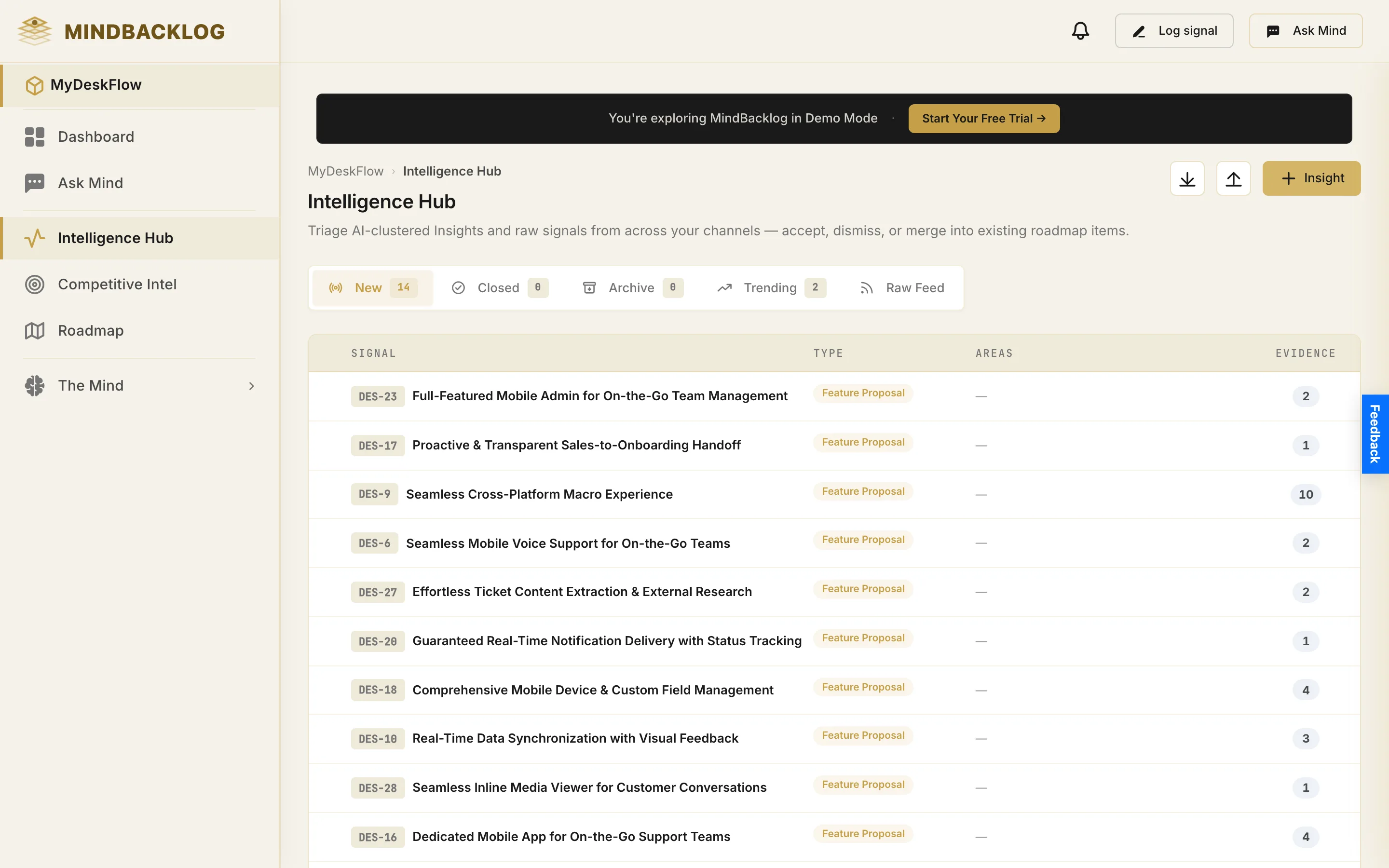
What flows in. What flows out.
The engine is the layer. Signals flow in through the pipeline. Artifacts and answers flow out to every other capability.
Signal pipeline (9+ channels)
Slack, Email, App Store, Google Play, Public Portal, Feedback Widget, Web Scraper, Web Form, Reddit — plus REST API, Zapier, Make. Every signal classified, deduplicated, and linked in under a second before it lands in the engine.
See the pipeline →Ask Mind (persistent side panel)
The co-pilot reads directly from the engine. Ask "what changed this month?" and the answer draws on the full signal graph — sentiment trends, channel diversity, competitor moves, the lot.
See Ask Mind →Living PRDs & RICE scoring
Every Living PRD cites the signals the engine has linked to the feature. Every RICE score is backed by signal volume and sentiment velocity the engine tracks. Without the engine, both collapse back into prompts.
See Living PRDs →The MIND engine is the layer every other capability is a window onto.
MIND is built to compound — every signal it processes makes the next PRD, score, and answer sharper. That is the premise of product intelligence as a category.
Questions PMs ask about the MIND engine.
Other capabilities the engine powers.
Intelligence Hub
Where compounding shows up — trending themes, nightly cluster suggestions, raw signal feed, daily brief pushed at 9 am.
Read →Competitive Intelligence
Dedicated dashboard for competitor sentiment, signal feeds, gap matrix — built from the same engine, mined from public reviews.
Read →Evidence-Based Prioritization
RICE scoring by default, AI-estimated, every score backed by the signal volume and sentiment trend the engine tracks.
Read →