Estimates that get sharper with every feature.
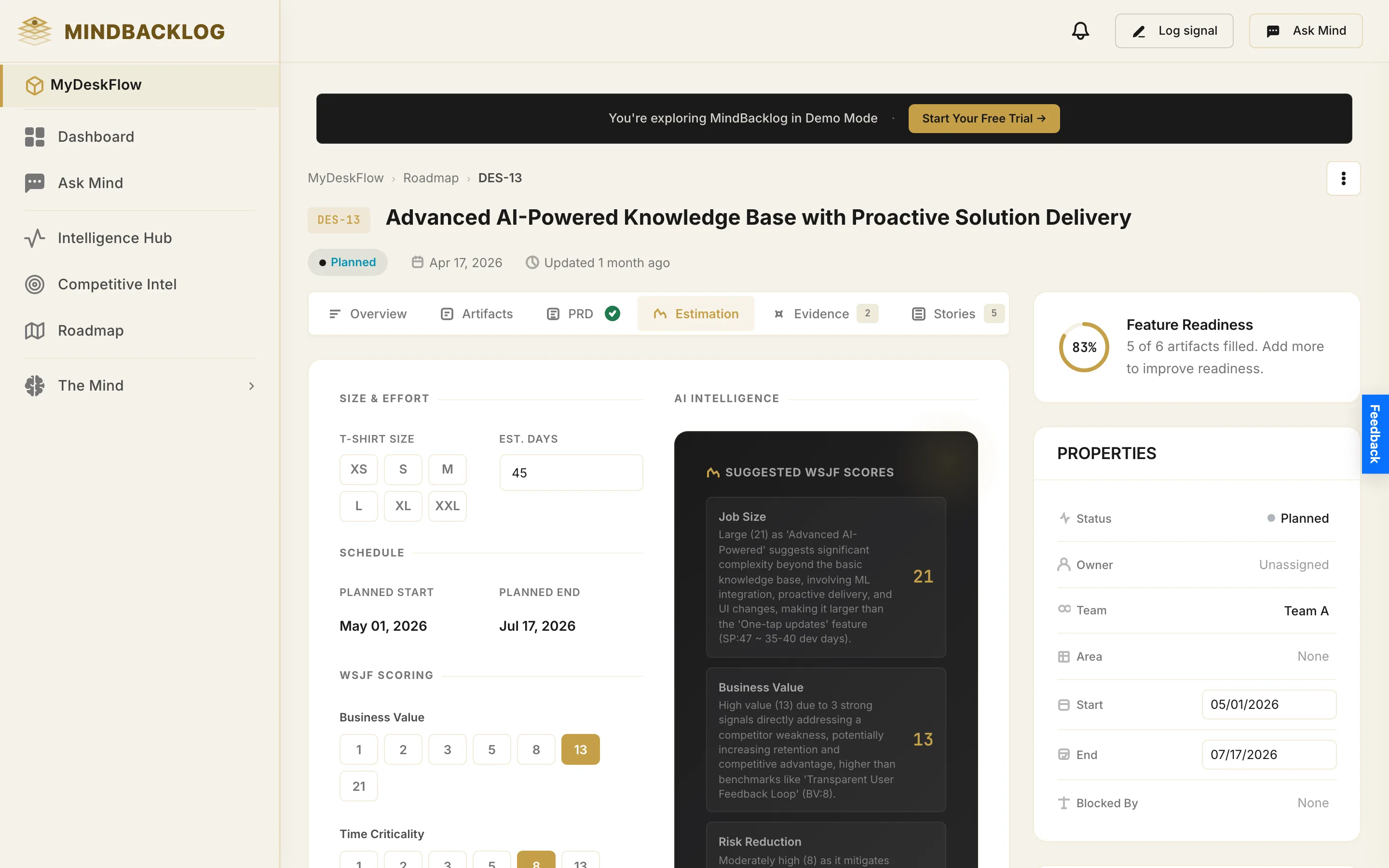
One-click impact and effort estimates — proposed from signal volume, sentiment, channel diversity, and the actual time-to-ship of comparable past features. The more your engine has compounded, the sharper they get.
Every number traces to a source you can click.
Reach, Impact, Effort — each resolves to a different evidence type, none of them a guess in a Tuesday meeting.
Unique customers and accounts mentioning the theme — counted, not guessed.
Repeat complainers count once. Enterprise and active-MAU accounts weighted higher because raw volume misrepresents business impact. Reach 4,200 means 4,200 — not a whiteboard average.
Frustration weight + enterprise asks bump impact upward.
Sentiment intensity on the signal cluster. Explicit enterprise asks. Churn language. The score reflects which signals carry weight — not which stakeholder spoke loudest.
Compared against similar past features and their actual time-to-ship.
Your team's last four search features took 2-3 weeks, not 1. The engine watched. The Effort number reflects how your engineers actually ship — not the optimism of a Tuesday meeting.
Estimates start plausible and end calibrated — not with time, but with every signal processed and every feature shipped. The engine remembers what you shipped.
Estimation meetings produce numbers nobody can defend.
Three PMs voting on reach is consensus, not estimation. Engineering pads effort because the last sprint went sideways; sales inflates impact because their biggest deal asked. The deeper problem is that every input is a guess, not a measurement — reach was never counted, impact was never weighed, effort was never benchmarked against anything the team actually shipped. So when leadership asks why this beat that, the score gets argued away. Numbers built from guesses cannot be defended with evidence.
Every number derived. Every derivation auditable.
Reach, impact, confidence, effort — each component resolves to a different evidence source. Click the number to see the trail.
Reach from unique customers and accounts
Reach counts unique customers and accounts who mentioned the theme — never raw signal volume. One Acme employee complaining 12 times counts as one account. Enterprise accounts and high-MAU customers are weighted higher so the number reflects business impact, not the loudest voice. Click any reach figure to see the full account list, channel-by-channel.
Impact from sentiment plus enterprise asks
Impact is the sentiment-weighted score across the signal cluster, then bumped by the count of explicit enterprise asks. "This is the worst part of my week" weights heavier than "would be nice." Three tier-one customer requests bump impact more than thirty mid-tier asks. The number resolves to a 1–3 scale on the scorecard but you can see every signal that contributed underneath.
Effort from comparable shipped features
Effort estimates compare the proposed feature against the closest matches in your own ship history — code surface area, integration count, engineers involved — and reference the actual time-to-ship of those past features. A new search feature is benchmarked against the last four search features your team shipped. The estimate is calibrated to your team, not a generic SaaS velocity curve.
Confidence scored, not assumed
Every estimate carries a confidence value derived from signal density, channel diversity, and how closely the feature matches your ship history. A feature with 47 signals across four channels and three comparable shipped features lands at 85% confidence. A feature with three signals from one channel and no comparables lands at 30%. The scorecard surfaces both — so a high RICE with low confidence does not pretend to be defensible.
Concrete moments where the derivation earns its keep.
Estimation stops being a meeting and starts being a step in the workflow.
Scope a new feature. The estimate arrives derived.
Intelligence Hub surfaces a cluster — 47 signals on bulk export filters across 4 channels. You accept it and the scorecard fills itself: reach 4,200 counted from unique accounts, impact 3 from sentiment weight, effort 2 weeks benchmarked against comparable past ships, confidence 85%. Scoping took 12 seconds, not a meeting.
Four enterprise asks land. The estimate re-derives itself.
A new tier-one customer files four asks on bulk export filters in the same week. The RICE score moves from 740 to 892 and the change log shows exactly what moved — impact +0.4 from enterprise weighting, reach +600 from the new account. Nobody re-estimated. The evidence did.
Roadmap review. The audit trail does the defending.
"How did effort land at two weeks?" You click the number. The trail expands: the last four search features your team shipped, each with its actual time-to-ship. Click reach: 47 unique accounts, channel by channel. The score survives because every input is a measurement with a source. The meeting moves to sequencing.
Effort calibration converges on your actual velocity.
The engine has logged actual time-to-ship against its original estimate for every one of those fourteen features. Backend work ran consistently 1.4x estimate, so the next backend estimate starts pre-adjusted. You did not retrain anything. Calibration compounds with every ship.
Estimation sits in the middle of the pipeline.
Signals flow in from the intelligence layer. Scores flow out to roadmap, PRDs, and Jira.
Signal Pipeline & Intelligence Hub
9+ channels classified in under a second by the pipeline land in the Intelligence Hub as themed clusters. The reach count, sentiment weight, and account list are already attached. Estimation reads from this directly — no separate input step.
RICE Prioritization & Roadmap
Reach, impact, confidence, and effort feed the RICE formula directly (RICE is the default scoring framework). The roadmap shows the score and the evidence trail underneath. When the signal layer shifts, the score updates without manual re-scoring.
Living PRDs & Jira sync
Every Living PRD carries the RICE block at the bottom with the full derivation. Jira tickets sync the score and link back to the evidence. Engineers see the "why" attached to the ticket — not a number disconnected from context.
Estimates calibrate on evidence, not the calendar.
AI estimation reads continuously from the MIND engine — reach from the live account list, impact from the sentiment trend, effort from the ship-history log. New signals move the estimate the moment they land. It compounds from day one.
Questions PMs ask about AI estimation.
Capabilities that share the same evidence trail.
RICE Prioritization
RICE is the default scoring framework. Every score traces back to the AI estimate underneath.
Learn more →MIND Engine
The persistent intelligence layer that compounds every signal and ship history into sharper estimates.
Learn more →Intelligence Hub
Where signal clusters land with reach, sentiment, and account lists already attached for estimation.
Learn more →