What is product intelligence?
The category that solves the synthesis gap between scattered customer feedback and confident roadmap decisions. A definitive guide to what it is, how it differs from feedback management, and why it compounds over time.
"Product intelligence is the layer that turns every customer signal into a decision your team can defend with evidence."
- What is product intelligence?
- The synthesis gap (the problem this category exists to solve)
- Product intelligence vs feedback management vs roadmap tools
- How product intelligence compounds
- What's inside a Product Intelligence Platform
- Why this category exists now
- Who needs product intelligence
- How to get started
- FAQ
What is product intelligence?
Product intelligence is the discipline of synthesizing every customer signal — across channels, time, and source — into a persistent layer that informs product decisions with evidence.
It is what happens when the scattered feedback in your Slack channels, support widget, app reviews, customer portal, sales calls, and competitor reviews stops being a collection of inboxes and starts being a single source of truth about what customers want, what they hate, and what your competitors are about to ship.
A team practicing product intelligence does not say "customers want this." They say "47 signals across 4 channels — Slack, App Store, Portal, Widget — sentiment trending down 18% over 60 days, 12 affected accounts including three above $50K ARR." The first is opinion. The second is the start of a roadmap conversation that will not get re-litigated in two weeks.
The category exists because the work of synthesizing signals into decisions is real, recurring, and currently done in human memory or spreadsheets — both of which are unreliable substrates. A Product Intelligence Platform externalizes that synthesis into software that does it consistently, citably, and continuously.
The problem this category exists to solve.
Every product team has roughly the same Monday morning. Open Slack — 14 messages from sales asking about feature requests. Open the support inbox — 23 unread tickets, half of them complaints about the same flow. Open the App Store — 6 new reviews, three are negative. Open the customer portal — 8 new posts since Friday. Open Notion — 4 sales call notes from last week that nobody linked to anything. Open the spreadsheet where you copy-paste the important ones. Realize the spreadsheet is from March.
The signals are all there. What is missing is the layer that connects them — that says "the sales request from #cs-acme on Monday is the same complaint that appeared in the App Store review on Wednesday and the portal post on Thursday and got mentioned in the QBR notes from two weeks ago." Without that layer, the PM is doing the synthesis in human memory. Which means it is being done inconsistently, partially, and forgotten by Friday.
This is the synthesis gap. The data is captured. The connections between data points are not. As a result, the team ships from whichever signals were loudest the week the roadmap got decided, not from a faithful representation of what customers are saying across the full population.
Three failure modes follow:
- Recency bias. The complaint heard at Friday's sales call ranks above the 30 portal posts over the prior quarter.
- Volume blindness. A single loud customer feels louder than ten quiet ones. The roadmap reflects who shouted, not who was right.
- Cluster blindness. "Search is broken" in Slack, "filters don't work" in App Store, and "can't find anything" in the portal are the same complaint. Without synthesis, they look like three separate small issues instead of one large theme.
Every feedback management tool ever built has tried to solve this by being a better inbox. Product intelligence solves it by being a synthesis layer.
Product intelligence vs feedback management vs roadmap tools.
Three adjacent categories. Different jobs. Frequently confused.
| Category | Primary job | Source of truth | Tools (examples) |
|---|---|---|---|
| Feedback management | Capture, tag, route customer feedback into a single inbox | The inbox itself | Canny, UserVoice, Harvestr |
| Roadmap tools | Plan and communicate what the team will build | The PM's intent | Productboard, Aha!, Craft.io |
| Product analytics | Track what users do inside the product | Event streams | Pendo, Amplitude, Mixpanel |
| Product intelligence | Synthesize everything customers say into decisions | The intelligence layer itself | MindBacklog |
A team can use all four. They are not in competition for the same job. A roadmap tool is not a worse product intelligence platform; it is a different product. The mistake is using one to do the job of another.
Where the confusion happens: feedback management tools claim to do roadmap planning by stapling a roadmap view onto the inbox. Roadmap tools claim to do feedback management by adding a "feedback" tab to the planner. Neither does the synthesis work — both still leave the PM as the synthesis layer. A Product Intelligence Platform is the category that takes synthesis off the PM's plate.
For deeper category comparisons, see our breakdowns of vs Productboard, vs Canny, vs Pendo, and vs Aha!.
Why product intelligence compounds.
A spreadsheet of feedback stays flat. The thousandth row makes it no more useful than the tenth — actually less, because half of it is stale. A product intelligence layer does the opposite. Every signal captured today increases the value of every signal captured tomorrow.
Four mechanisms drive the compounding:
1. Deduplication gets smarter.
Every new signal is checked against the entire history. "Search is broken" in March, May, and September stops looking like three issues and starts looking like one persistent theme.
2. Sentiment trends become real.
A single negative review is noise. 60 days of negative reviews trending steeper is a roadmap input. Trend analysis requires history; the system that has been listening longer produces better trends.
3. Account-level reach densifies.
"3 customers complained" becomes "12 distinct accounts, 4 of them above $50K ARR, all mentioning the same flow." Account attribution gets richer as accounts produce more signals over time.
4. Competitive context accumulates.
Public reviews of competitors are mined continuously. Early on, the matrix shows "Competitor X exists." With more review cycles mined, it shows "Competitor X shipped a search redesign in May and review sentiment moved +0.4★ in the 30 days following." The gap matrix tightens with every batch of reviews mined.
This is the single biggest reason product intelligence is a distinct category from feedback management. An inbox does not compound. A synthesis layer does. The longer it runs, the sharper every artifact it produces becomes — Living PRDs cite more signals, RICE scores carry higher confidence, Ask Mind answers with deeper context, the daily brief surfaces patterns that would have been invisible in the first handful of signals.
The system is useful from the first session. With thousands of signals behind it, it's a different category of useful.
What's inside a Product Intelligence Platform.
Six capabilities that distinguish a synthesis layer from a fancy inbox.
Multi-channel signal capture.
9+ direct channels — Slack, Email, App Store, Google Play, Public Portal, Feedback Widget, Web Scraper, Web Form, Reddit — plus unlimited via REST API, Zapier, and Make. The bar is "anything a customer can say, we ingest." A platform with one channel is not a product intelligence platform.
Automatic classification & linking.
Every signal classified in under a second by signal type, linked to existing features, scored for sentiment, deduplicated against prior signals, and attached to workspace + account metadata. Without this, the platform is still a sorting problem for the PM.
Living PRDs with citations.
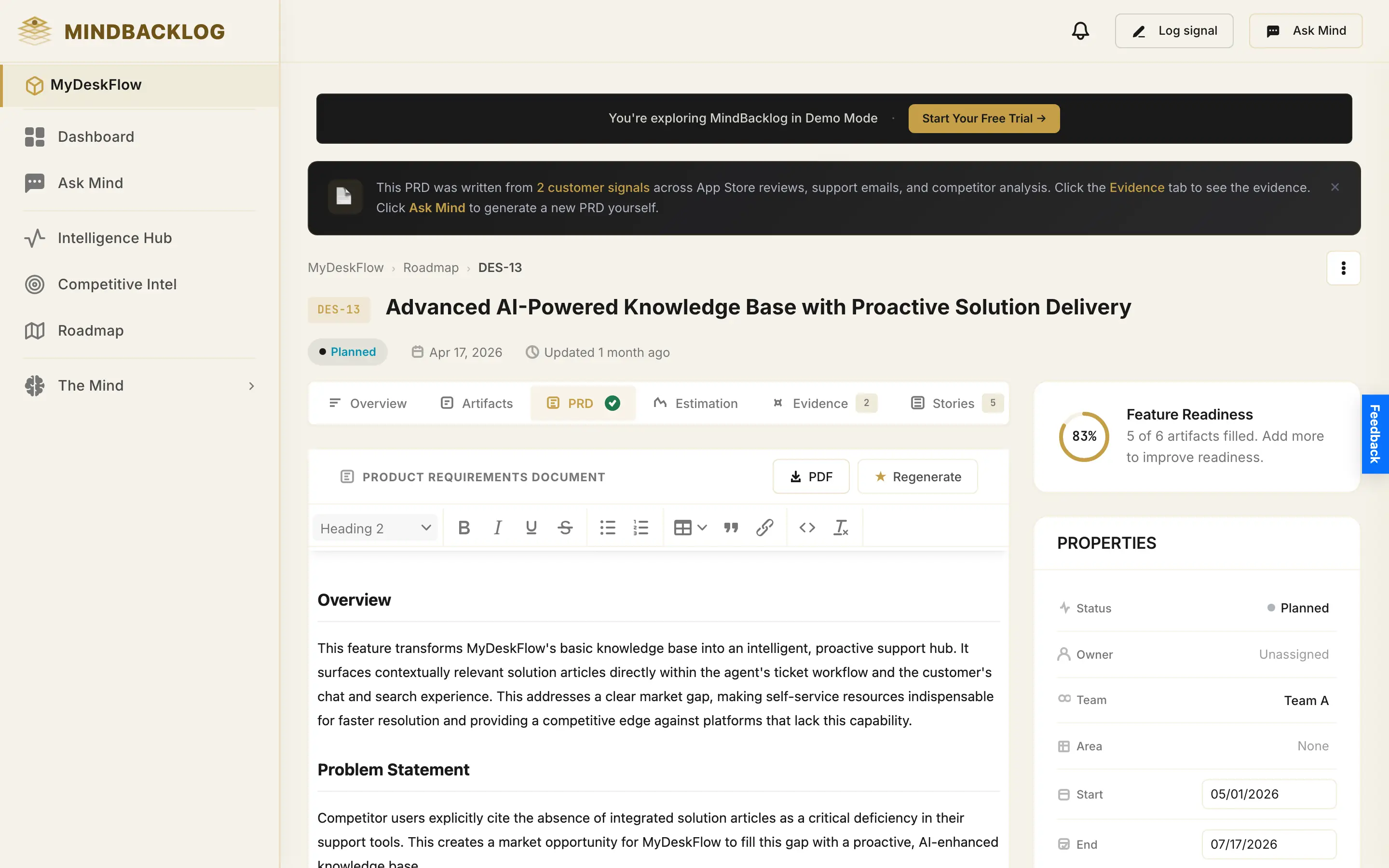
Documents generated from the signal layer, with citation chips on every paragraph linking to source channels. The PRD refreshes as new evidence arrives. Without citation-rich documents, the intelligence layer cannot be operationalized in engineering's workflow.
Evidence-backed prioritization.
Scoring frameworks (RICE default, WSJF available) where the Reach, Impact, and Confidence inputs trace back to specific signals. The score is auditable. A score without an evidence trail is a number the team will re-litigate every quarter.
Competitive intelligence.
Continuous mining of competitors' public reviews, changelogs, and feature pages. Gap matrix, sentiment delta after their releases, what their users hate. Most intelligence is internal; competitive intelligence completes the picture.
Natural-language query.
A persistent side panel (Ask Mind) that answers any product question — "what are customers saying about export?" "should we ship feature X this quarter?" — with cited evidence and explicit confidence. The intelligence layer is only useful if you can interrogate it in seconds.
A platform missing any of these six is missing a load-bearing capability. A platform that has them all is a Product Intelligence Platform. For the mechanism in detail, see the MIND Engine and how it all fits together.
Why this category exists now.
Three things had to be true at the same time for product intelligence to become a viable category.
1. Signal volume crossed a threshold. In 2018, a typical B2B SaaS company captured customer feedback in two places: an inbox and a Salesforce comment field. In 2026, the same company has feedback fragmenting across Slack, support widgets, app stores, public portals, sales calls, Notion, customer success notes, and at least three other places that vary by team. Manual synthesis was tractable at low volume. It is not tractable at current volume.
2. Classification got cheap. Until recently, classifying a customer signal — "is this a feature request, a bug, a competitive comparison, a praise note?" — required either a human or brittle keyword rules. Modern language models classify with a one-second latency and accuracy that approaches a human's. The technical substrate that makes product intelligence economically viable did not exist in this form three years ago.
3. Roadmap defensibility became table stakes. The era of "trust me, I'm the PM" decisions is over in most B2B SaaS organizations. Leadership wants to see the math. Engineering wants to see the customer quote. Sales wants to verify the deal will close. The synthesis-in-someone's-head approach used to be defensible. Now it is the thing that loses the roadmap review.
Put those three together and product intelligence becomes inevitable — not a nice-to-have. The teams that adopt the category early get a multi-year head start on the compounding curve.
Who needs product intelligence.
Roles and team sizes where the synthesis problem is most acute.
Technical founders.
You built the product. The synthesis is the part you don't want to do but cannot escape. Product intelligence is a multiplier — the synthesis happens in the system instead of your head.
Solo / first PMs.
You are wearing three hats. The intelligence layer is the substitute for the analyst and the customer researcher you would hire if you had headcount.
Growth / PM leads.
You are responsible for a team's decisions being defensible. Product intelligence is the substrate that makes "every PM evidence-backed" actually true instead of aspirational.
20-200 person SaaS teams.
You have enough signal volume to make manual synthesis impossible. You don't yet have a dedicated research function. Product intelligence sits in the gap.
How to adopt product intelligence.
Three steps, in order. Skipping ahead breaks the compounding.
Connect your loudest channels.
Start with the two or three channels where most of your current signal lives. For B2B SaaS that is usually Slack, the support widget, and email. Get the pipeline classifying signals on real data. Resist the urge to connect everything on day one — depth beats breadth in the first week.
Operationalize the artifacts.
Generate Living PRDs for the next two features in the roadmap. Use RICE scores from the intelligence layer in the next prioritization conversation. Open Ask Mind during the next stakeholder question. The point is to substitute the system's output for the spreadsheet's output in real workflows.
Add the remaining channels & competitors.
Bring in App Store reviews, Google Play, the public portal, web scraper for competitor sites. Set up Daily Intelligence Brief email. Once your channels are flowing, the system is doing the synthesis you used to do on Monday mornings — and starting to surface patterns you would have missed.
The shortcut: see what the platform looks like at full signal volume — populated workspace, every artifact in its sharpest form — in the live demo. No signup. No card. The fastest way to evaluate a category you've never used is to see it at maturity, not empty.
Common questions about product intelligence.
Go deeper.
Glossary
The vocabulary of product intelligence — Signal, MIND Engine, Living PRD, Intelligence Hub, Evidence-Based Prioritization, Compounding Intelligence.
Read →The MIND Engine
The technical substrate that makes synthesis possible — classification, deduplication, linking, sentiment scoring, all in under a second per signal.
See feature →How it works
Three stages — Capture, Compound, Prove. The full mechanism from a signal arriving in your channel to a Living PRD in engineering's hands.
See pipeline →AI PRD Generator
The flagship artifact of product intelligence — Living PRDs cited by real customer signals. With a 1,500-word guide on how to write a great PRD.
Read tool →Competitive Intelligence
The dashboard that mines competitor reviews, sentiment shifts after their releases, and feature gaps you can ship into.
See feature →Compare
Honest comparisons to every major feedback management, roadmap, and analytics tool. Where each fits — and where it doesn't.
See all →Keep reading on the blog.
The death of the spreadsheet backlog
Why AI-native tools are replacing the spreadsheet backlog for good.
Read on the blog →The rise of the AI product manager
How AI is redefining the PM role in 2026 — and what stays human.
Read on the blog →Best AI product management tools in 2026
Ranked by AI depth, not marketing — how the category actually compares.
Read on the blog →See product intelligence in action.
Open the live workspace, see what compounding intelligence looks like at full signal volume. No signup. No card.