
Find out what's true before you build.
Mind drafts your thesis, who it's for and the beliefs to test, each with its quote, and marks every belief "no evidence yet".
14 days free. No card needed.
Building before anyone has shown they want it.
Everyone has told you to talk to users. Nobody said how, or what counts, so the idea goes into a builder first.
Friends say it sounds great, and that reads as validation. A one-shot idea report says the market is large, and that reads as demand. MindBacklog treats the idea stage as a list of beliefs with no evidence yet, and a week of work to change that.
Customer discovery for founders, one move at a time.
Each step is a place in the app. Mind drafts and asks; you decide.
- Onboarding
Start from an idea
Onboarding asks which side is harder for you: finding customers, or turning the idea into a product.
- The first research
Your market, with sources and dates
Mind researches your market on public pages; every item shows its source and date, and none of it counts as evidence.
- Learn · Questions and People
Find the people, test the beliefs
Your first week gives you one search per kind of customer, the places they gather, and an email Mind wrote that you send yourself.
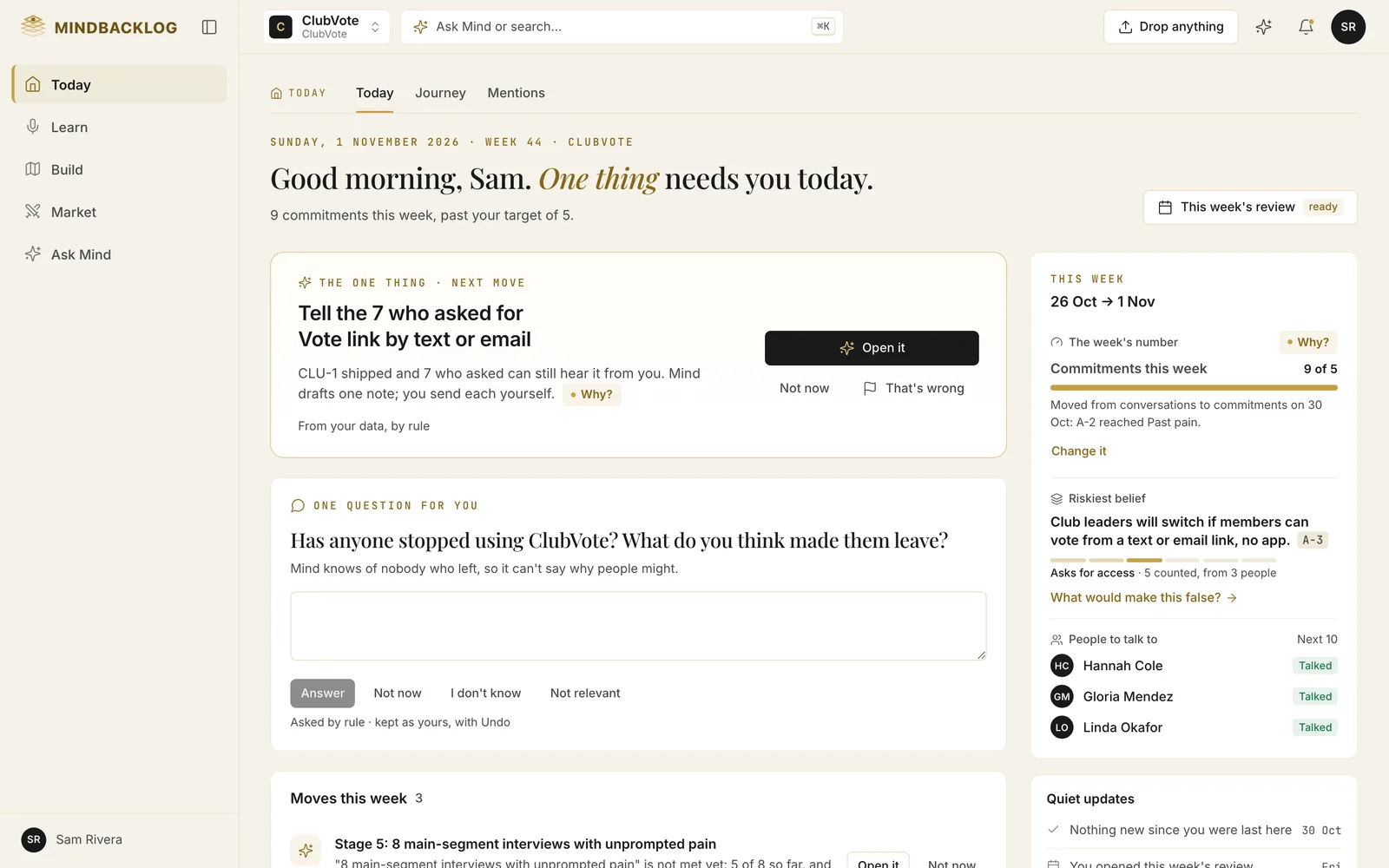
- Today · Journey and Check-in
Where you are on the way to product-market fit
The first gate counts people describing the pain unprompted, from your conversations, and Mind never moves a stage for you.
- Learn · Tests
A pre-sale with a line you can't move
Set the pass line before the test starts; results can't be edited afterwards.
Validate a startup idea by what people did.
Each belief sits on the evidence ladder: Praise, Past pain, Asks for access, Gives time, Makes an intro, Pays. A card moves right only when someone did something.
- One belief is flagged Riskiest: if it is false, the rest does not matter.
- "I'd pay for that" is Praise. Your own words never count as evidence.
- Drop a transcript and record consent: Mind pulls their exact words, leaves out yours.

Know what you don't know.
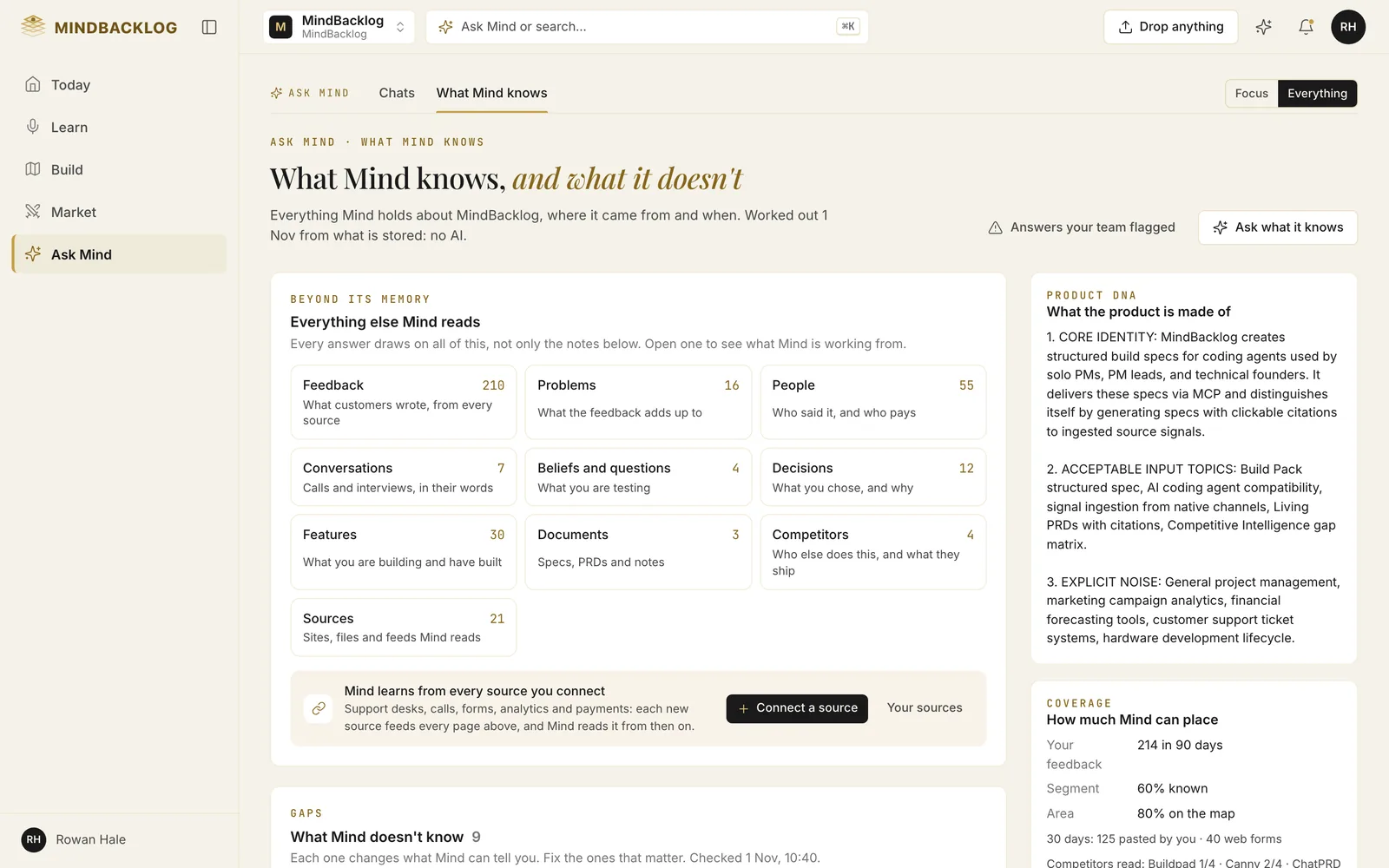
What Mind knows keeps the list of gaps: beliefs with no evidence, people you never asked. When your data has nothing on a question, Mind says so, and what would change the answer.
Before you start, Mind shows what it knows about your product, and what it doesn't.
What leaves your workspace
Mind's searches carry only your product's name, its category and short phrases from your drafts, never anything from your customers.
What never trains anything
Your data is never used to train AI models. Learning across customers is off.
I have no users. What can Mind draft from?
Five short answers: who has the problem, what they do today, the worst part, how often, and why you. Skip any one and Mind marks it as the first thing to find out. Mind drafts fewer things rather than guess.
Does the market research count as evidence?
No. Mind researches your market on public pages: who else does this, who else buys it, your industry, and where your people gather. Every item shows its source and date, and none of it counts as evidence.
How do I find people to talk to?
Your first week gives you one LinkedIn search per kind of customer you named. It lists the places where those people gather. It drafts the email asking for 20 minutes; you send it yourself. Nobody is looked up or enriched.
Can I run a pre-sale before building?
Yes. Set the pass line before the test starts; results can't be edited afterwards. A pre-sale test can read payments from a Stripe Payment Link, each counted once. MindBacklog keeps the payment's id, time and amount, never the payer's name or email.
Start with the beliefs, not the build.
Five questions, a first look at your market with sources, and a week to find people who have the problem.
- 14 days free
- No card needed
- Viewers are free
