
See whether product-market fit holds, and for whom.
PMF health by segment, revenue, retention and the channels that bring customers who stay. Read-only from your own Stripe.
14 days free. No card needed.
One blended chart hides the segment that leaves.
MRR goes up. Somewhere inside it, one kind of customer is quietly cancelling in month three, and another kind is expanding enough to cover it.
Feedback and revenue live in different tools, so nobody knows which open problem costs the most. Grow puts PMF health, revenue, retention and channels beside your problems, by segment, with the n on every number.
From your Stripe to the next initiative.
Each step is a place in the app. Every reading is by rule, from your own data, with its source and n.
- Settings · Connections
Connect Stripe
Connect Stripe with a restricted key and see who pays, without giving us a secret key.
- Grow · Revenue
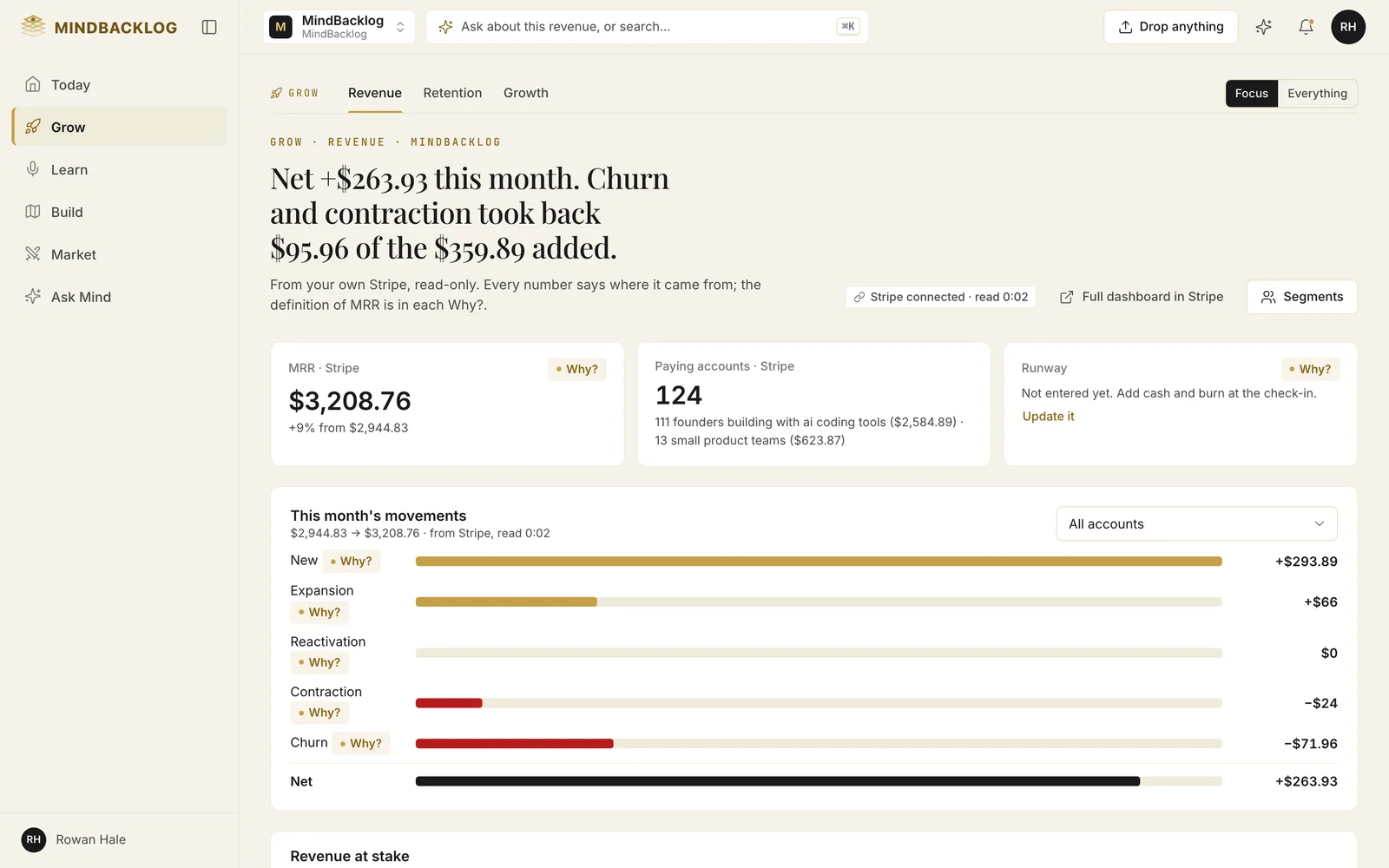
Revenue, movements and what's at stake
MRR, paying accounts by segment and this month's movements.
- Grow · Growth
Which channel brings customers who stay
Each channel's share of new paying accounts by first touch, its month-3 retention, and what your paid channels pay back on your own spend.
- Today · Health
Four checks, every morning, per segment
Honest about small numbers: under the threshold it says "Not enough data" instead of a verdict.
- Build · Initiatives and Results
The next initiative, with a prediction
MindBacklog checks your prediction against what happened, from the source you chose, and you decide.
Which problem costs the most, in your own MRR.
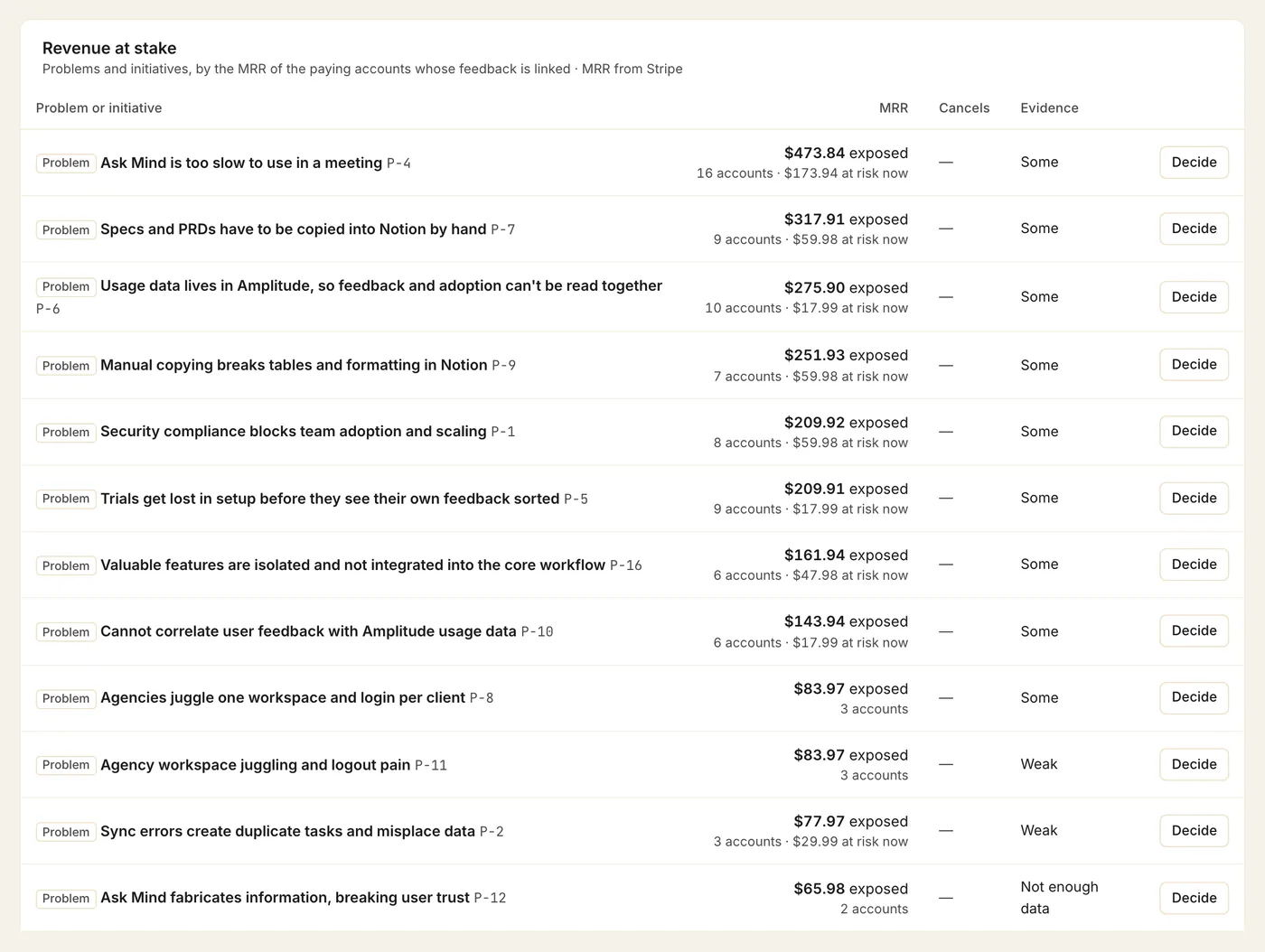
Revenue at stake ranks your open problems and initiatives by the MRR of the paying accounts whose feedback is linked to them. A problem with no linked paying account says so; it is never estimated.
- Segments are rules over your own Stripe: plan, metadata value or seat count.
- Every number has a Why: what it counts, its n, when it was read.
- Account names are fetched live from Stripe; Grow doesn't store them.
SaaS retention by segment, and the product-market fit survey.
Who still pays each month, one row per segment. It says when the average hides the segment that leaves.
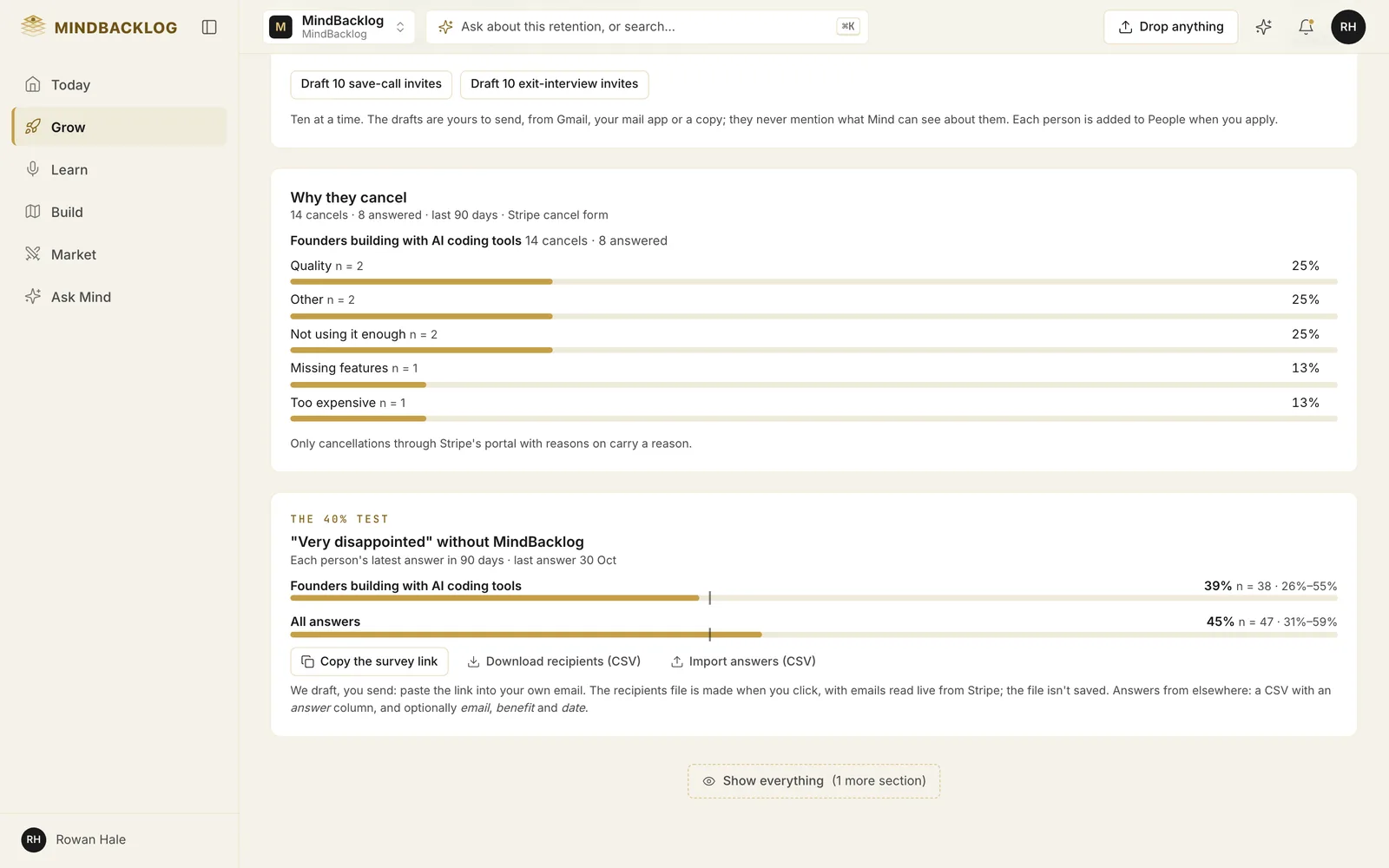
The 40% test
Mind makes the survey form; you copy the link into your own email. From 30 answers it decides: 40% or more "very disappointed" holds. Under 10 it says "Not enough data" with the n.
Your revenue data stays yours.
What we keep, what we never keep, and what is not confirmed yetWhat Mind's AI sees
Mind's AI gets a key like C-12, never a name or email from People; words people wrote reach it as written. Save-call drafts never mention usage, logins, MRR, seats or payments.
Personal details
Stripe customers become people, keeping only the email, first name and last initial, plan and payments. Never kept: the full last name, address, phone, tax id or card. Personal details can be cleared.
Does Grow replace my Stripe or PostHog dashboards?
No. Grow reads your own Stripe read-only and your own PostHog with counting queries, and every number says where it came from. Full dashboard in Stripe and Full analytics in PostHog open the tools themselves.
What does the Stripe key need?
Connect Stripe with a restricted key and see who pays, without giving us a secret key. A secret key is refused. For a product sold per use, two read permissions are enough: Customers and Charges. A key missing a permission names it.
We sell per use, not by subscription. Does it still read?
Yes. Grow reads your Stripe payments: revenue by month, new and repeat customers, and who hasn't come back. Nothing ever says "MRR $0". If you also sell subscriptions, your MRR stays MRR, and the one-off extras show on their own line.
What is the 40% test?
A one-question product-market fit survey: how would you feel if you could no longer use the product? From 30 answers it decides: 40% or more "very disappointed" holds. Under 10 answers it says "Not enough data" with the n.
When does Grow appear?
Once your product is past PMF or has 10 paying accounts. Past PMF, Today › Journey becomes Today › Health at the same address, and your Journey history is kept.
See whether it holds, segment by segment.
Connect a restricted Stripe key. Grow reads it, and tells you where the n is too small to call.
- 14 days free
- No card needed
- Viewers are free
