
MindBacklog vs Productboard: ranked by your users, built with the why.
Productboard centralises feedback and links insights to features (their homepage, read 1 Nov 2026). MindBacklog ranks problems by your own users and hands each feature to your coding agent.
14 days free. No card needed.
Where they're similar
- Both keep customer feedback in one searchable place and tie it to the features it asks for. Productboard calls this "Centralize feedback from any source" (their homepage, read 1 Nov 2026).
- Both draft specs with AI. Productboard says Spark helps turn ideas into specs and tracks post-launch results (their homepage, read 1 Nov 2026). MindBacklog drafts PRDs from evidence, and Results checks your prediction against what happened.
- Both have a public portal for feature ideas and a roadmap for stakeholders. Productboard names a portal and roadmaps on its homepage (their homepage, read 1 Nov 2026); MindBacklog has a public portal and a view-only roadmap link.
- Both offer an MCP server so AI tools can read your workspace. Productboard links to an API and an MCP server (their homepage, read 1 Nov 2026). MindBacklog's AI tools over MCP are on Growth and Scale.
What it does, in its own words.
Organising feedback is step one. These four are the rest of the loop.
Evidence behind every claim
Every piece of feedback, sorted into problems ranked by who has them, with the quotes behind each. Your users rank first. Public posts and competitor reviews are shown, never counted. Under 30 pieces of feedback, Mind says "Not ranked" and why.
The build handoff with the why
Your coding agent pulls the Build Pack: why it matters, who it's for, the metric, and the must-haves with acceptance criteria. Every section names its source, and the only numbers are counts. Your coding agent writes the product map. MindBacklog never reads your code.
The loop after launch
When it ships, tell the people who asked: Mind drafts a note to each, with their own words. You send it. Did it work? MindBacklog checks your prediction against what happened, from the source you chose. You decide.
Mind pushes back
Mind shows you what argues against you before it agrees. When your data has nothing on a question, Mind says so, and what would change the answer. Every competitor read is dated and sourced; if it isn't in their docs, Mind says so.
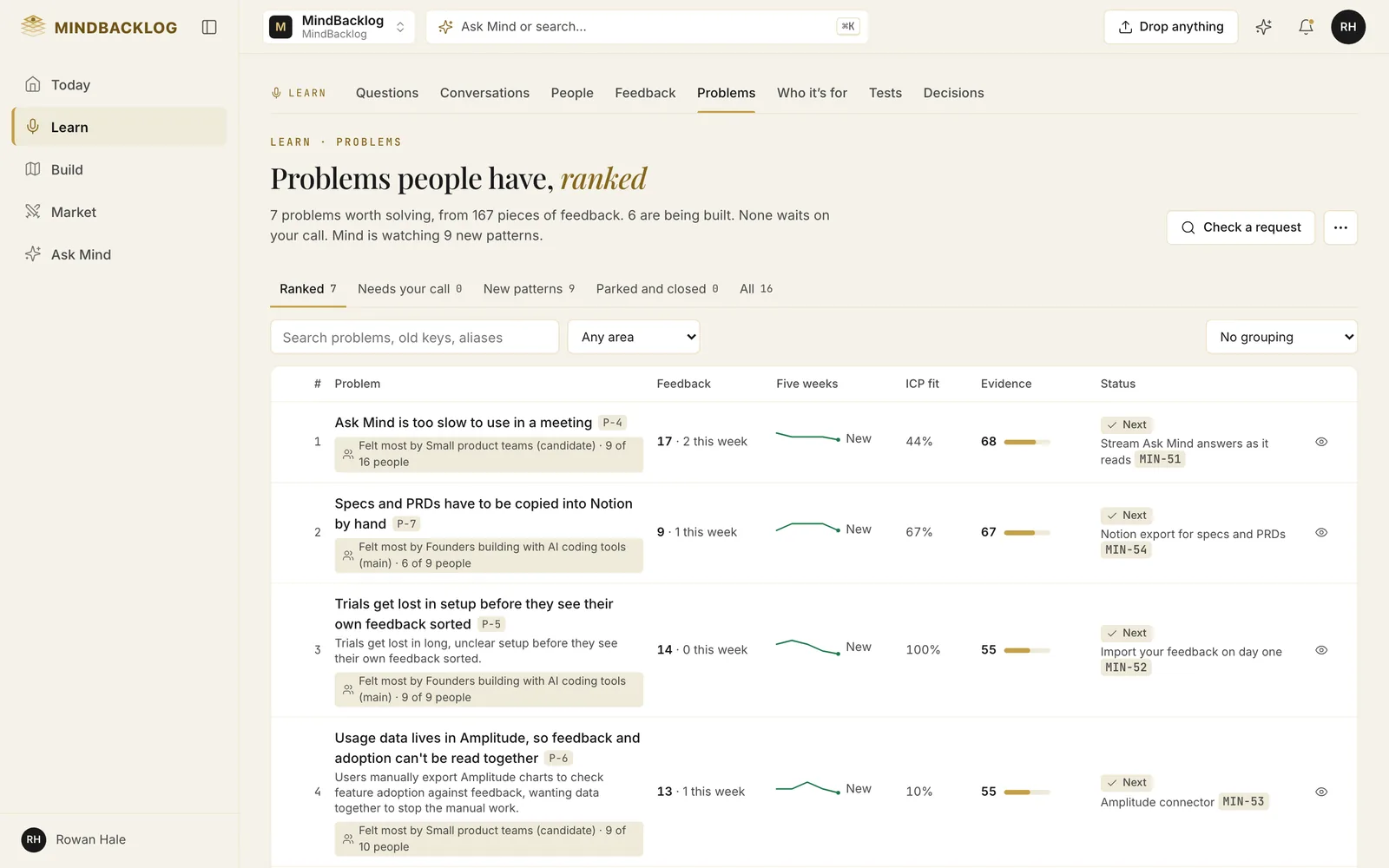
Side by side, as of 1 Nov 2026
The Productboard column quotes their own homepage, dated. Where it is silent, we say so.
| Capability | MindBacklog | Productboard |
|---|---|---|
| Collecting feedback | Wherever your users talk to you: a widget, web forms, a public portal, inbound email, Slack, app-store reviews, a REST API, and Drop anything for a thread, a transcript or a CSV. | They say "Centralize feedback from any source" into one searchable repository. Their homepage, read 1 Nov 2026 |
| Ranking | Problems ranked by who has them, from your users' feedback: how many say it, how much from your main customers, who pays, the trend. Public posts shown, never counted. "Not ranked" under 30 pieces. | They say insights are detected within feedback and linked to related feature ideas. Their homepage, read 1 Nov 2026 |
| Quotes | In their words, exactly as written. Mind's AI gets a key like C-12, never a name or email from People. | Not stated on their homepage. Read 1 Nov 2026 |
| Beliefs and evidence | Track what you believe and how strong the evidence is: praise never counts as proof. | Not stated on their homepage. Read 1 Nov 2026 |
| Checking a request | Test a request against what your users actually said, for and against. The verdict is counted from people, never written by the model. | Not stated on their homepage. Read 1 Nov 2026 |
| Specs | One page from why to what to build: the evidence, who asked, Ready to build?, and the docs. Documents say whether feedback has arrived since they were last edited. | They say AI drafts specifications; Spark helps turn ideas into specs with citations. Their homepage, read 1 Nov 2026 |
| Roadmap and the why | Initiatives: the why above your features, a prediction written before you build, and one timeline across every initiative and its features. | They say interactive roadmaps to align stakeholders; priorities linked to product objectives and business goals. Their homepage, read 1 Nov 2026 |
| Handoff to the people who build | Your coding agent pulls the Build Pack. Copy it for Claude Code or Cursor, paste a short prompt into Lovable, or let your agent pull it over MCP. | They say "25+ native integrations", an API and an MCP server. Their homepage, read 1 Nov 2026 |
| After launch | Tell the people who asked, in their own words; you send. Did it work? The prediction against what happened, from the source you chose. | They say Spark tracks post-launch results; customer engagement shares what has launched. Their homepage, read 1 Nov 2026 |
| Competitors | Watch a competitor and Mind reads its site, pricing, help center, changelog, status page and app reviews. Every read is dated and sourced. | Not stated on their homepage. Read 1 Nov 2026 |
| Who it is built for | Founders and small product teams who build software, many with a coding agent. | They say product makers; "Trusted by Fortune 500 and high-growth companies"; an enterprise edition. Their homepage, read 1 Nov 2026 |
| Price | From $14.99 per seat a month billed yearly (Starter $14.99, Growth $24.99, Scale $39.99), or $17.99, $29.99 and $47.99 billed monthly. 14-day trial, no card. Viewers are free. | Not quoted here; read their pricing page. Our research of 6 Oct 2026 recorded only Spark's range, tagged mixed, so we leave it out |
Sources: Productboard's homepage (productboard.com), read 1 Nov 2026; our market research of 6 Oct 2026. MindBacklog's column describes the new MindBacklog as its in-app guides state it. We never say what Productboard lacks; "not stated" means their homepage did not mention it on the day we read it.
Pick by the job in front of you.
Who should pick Productboard
- You are a large product organisation with many teams, and you want portfolio-level planning and an enterprise edition (their homepage, read 1 Nov 2026).
- You need a long list of native integrations with the systems a big company already runs (they say 25+, read 1 Nov 2026).
- Your process is standardised across product teams, and you want product operations tooling for it (their homepage, read 1 Nov 2026).

Who should pick MindBacklog
- You are a founder or a small team and want problems ranked by your own users, with the quotes, and "Not ranked" when the data is thin.
- You build with Claude Code, Cursor or Lovable and want each feature handed over with the why, the evidence and what already exists.
- You want a prediction written before the build and checked on the date, not a roadmap that forgets what it promised.
- You want a price that fits before revenue, with viewers free.
Questions about MindBacklog and Productboard
Something else? Search the help center or email us.
Is MindBacklog a Productboard alternative for small teams?
For a founder or a small product team, yes. Problems ranked by your own users with their quotes, initiatives with a prediction, a feature page from why to what to build, and a Build Pack for your coding agent. Productboard says it is "built for product makers" and lists an enterprise edition (their homepage, read 1 Nov 2026). Larger organisations should read their page first.
Does MindBacklog have a portal and a roadmap I can share?
Yes. A public portal where users post and vote, and a widget on your own site. For outsiders, a view-only roadmap link. A view-only roadmap link shows no feedback, no names, no revenue and no quotes.
How does MindBacklog rank, if not by a score I set?
Every night Mind works out each problem's evidence strength from your users' feedback: how many say it, how much comes from your main customers, who pays, and the trend. The drivers are shown. Under 30 pieces of feedback, Mind says "Not ranked" and why, instead of inventing a ranking. You make the call on each problem, with a reason.
Can I move my feedback over?
Export it as CSV and drop it in. Drop anything takes a thread, a transcript or a CSV, and Mind shows where it'll go before filing it. Each CSV row is one piece of feedback.
How much does MindBacklog cost?
From $14.99 per seat a month billed yearly (Starter $14.99, Growth $24.99, Scale $39.99), or $17.99, $29.99 and $47.99 billed monthly. 14-day trial, no card. Admins and editors take a seat; viewers are free. AI use is bounded by a monthly AI allowance, with credits for the actions you start. There are no weekly caps. We don't quote Productboard's price here; read their pricing page.
Rank by your users. Build with the why.
Drop in your feedback. See which problems rank, and which say "Not ranked".
- 14 days free
- No card needed
- Viewers are free
