AI PRD Generator
Any AI generates from a blank prompt. This one generates from your product's evidence — citing real signals, linking to source channels, with competitive context built in. And it updates as new evidence arrives.
Search filters · Living PRD
v3 · evidence 2h agoProblem
Users cannot filter results. 47 signals · 4 channels
Evidence
Sentiment ↓18%. Globex Acme Beta Inc
Competitive
Competitor X shipped. Reviews +0.4★
RICE
892
A PRD is only as credible as its evidence.
Three criteria separate a PRD engineers defend from a PRD they defend against.
Cites real signals.
Every requirement traces back to a customer signal — not a prompt. The "Problem" section names channels and counts. The "Evidence" section quotes actual users by name and account. Engineers can see exactly which 47 signals across 4 channels produced the ask, instead of trusting a model wrote something plausible.
Engineers can verify the source.
Citation chips are clickable. Click one and the original quote opens — the Slack thread, the App Store review, the widget conversation, the portal post. No screenshots, no "trust me" handoffs. When engineering questions a requirement in refinement, the answer is one click away in the original channel.
Updates as evidence arrives.
A PRD written in March from January's data is stale by April. Living PRDs refresh citation counts, sentiment trends, and competitive context continuously. The doc you walk into Friday's roadmap review with reflects what customers told you Thursday — and what competitors shipped on Wednesday.
A Living PRD is not a one-shot artifact. It is a document that compounds in credibility with every signal that lands in your workspace.
What separates a PRD engineers trust from one they tolerate.
A PRD is a contract between PM, engineering, and design. The good ones survive scrutiny in refinement, in roadmap reviews, and in retros six months later. Five things separate one from a template-filled doc.
Start from the problem, not the solution.
"Bulk export filters" is not a problem statement. "Enterprise admins spend 45 minutes per week manually cleaning CSV exports because there is no date or status filter on bulk export" is. The first describes what to build; the second describes who is suffering, how often, and why. Engineers can argue with a solution. They cannot argue with a customer's pain. Open the PRD with the pain in the user's voice — then propose the build.
Cite evidence at the source.
"Customers want this" is unverifiable. "47 signals across Slack, App Store, Email, and Portal — sentiment trending down 18% over 60 days" is. A great PRD names the channels, counts the signals, and links each citation to a source the reader can open in one click. The absence of a citation is itself a signal — if a section has no citations, the section is opinion, not requirement.
Make acceptance criteria concrete.
"Users can filter exports" is interpretable in fourteen different ways. "Users can filter by date range AND owner AND status; the filter combination is persistable as a named view; exports respect active filters with no manual post-processing" is a specification. AC that survives sprint planning names the entity, the action, and the verification — not just the desired outcome. If QA cannot write a test from the AC as written, the AC is incomplete.
Include competitive context.
What competitors shipped in this area — and what their users said after they shipped — is the most undervalued section in most PRDs. It is also what stakeholders ask about in any review: "what does Competitor X do here?" If the PRD does not have the answer, the meeting goes off-script. Watching how public reviews move after a competitor ships (G2, Capterra, App Store, changelogs) costs little and answers the question before it is asked. A good PRD names the gap and shows whether the gap moved review sentiment.
Surface the goal alignment.
Every PRD should answer: which OKR does this serve, what is the estimated impact, and what is the confidence on that impact. The strongest PRDs include a RICE or weighted score in the header with the math visible — Reach × Impact × Confidence ÷ Effort. The score does not decide the priority. The conversation around the score does. A score with no math is a number nobody trusts; a score with the math visible invites the right argument.
A PRD that does these five things does not need to be defended every week. It defends itself.
Why most PRDs lose engineering's trust by page two.
The failure modes are predictable. Avoid these five and the document carries weight in the room.
Writing solution-first.
The PRD opens with "Add date filter to bulk export modal." Engineering reads it and proposes alternatives the PM did not consider. The conversation devolves into "wait, what problem are we actually solving?" Always lead with the user pain — then propose the build. If the problem statement is one sentence and the solution section is five paragraphs, the document is upside down. A Living PRD puts the problem section first and writes it from cited signals before any solution copy exists.
Quoting nobody.
"Multiple customers have asked for this." How many? Which? When? A PRD without numbers and named accounts cannot survive scrutiny. If a PM cannot quote at least three customers by account name with channel and date, the request is not yet evidence-backed — it is a hunch. Hunches are fine for exploration; they are not fine for sprint commitments. In a Living PRD the citations attach automatically — account, channel, date — so the receipts exist before anyone asks for them.
Vague success metrics.
"Improve the export experience" is not measurable. "Enterprise admins run the weekly compliance report with zero manual CSV cleanup" is. If the PRD shipped today, what number would tell the team it worked? That number belongs in the goals section. PRDs without measurable success criteria become unresolvable retros. A Living PRD maps each feature to an OKR in its goal-alignment section, with the estimated impact stated as a number, not an adjective.
Stale or static evidence.
A PRD that quotes a customer from 2024 is a museum piece, not a living document. The strongest PRDs link to the source channel so the reader can see "this conversation happened last week" or "this complaint is from eight months ago and has not been raised since." Recency matters. Staleness signals an outdated decision that nobody bothered to revisit. A Living PRD sidesteps this mechanically — citation counts and dates refresh as new signals arrive.
No alternatives considered.
"Add filter UI" is one answer to "users cannot filter." Other answers: let users save query strings, expose a CLI export, ship a separate report builder, partner with a BI tool. A PRD that does not name at least one alternative considered (and why it was rejected) signals that the PM did not actually think about the problem space. Engineering notices. A Living PRD mines competitive context in automatically, which puts one alternative — what the market already built — on the page by default.
What a Living PRD actually looks like.
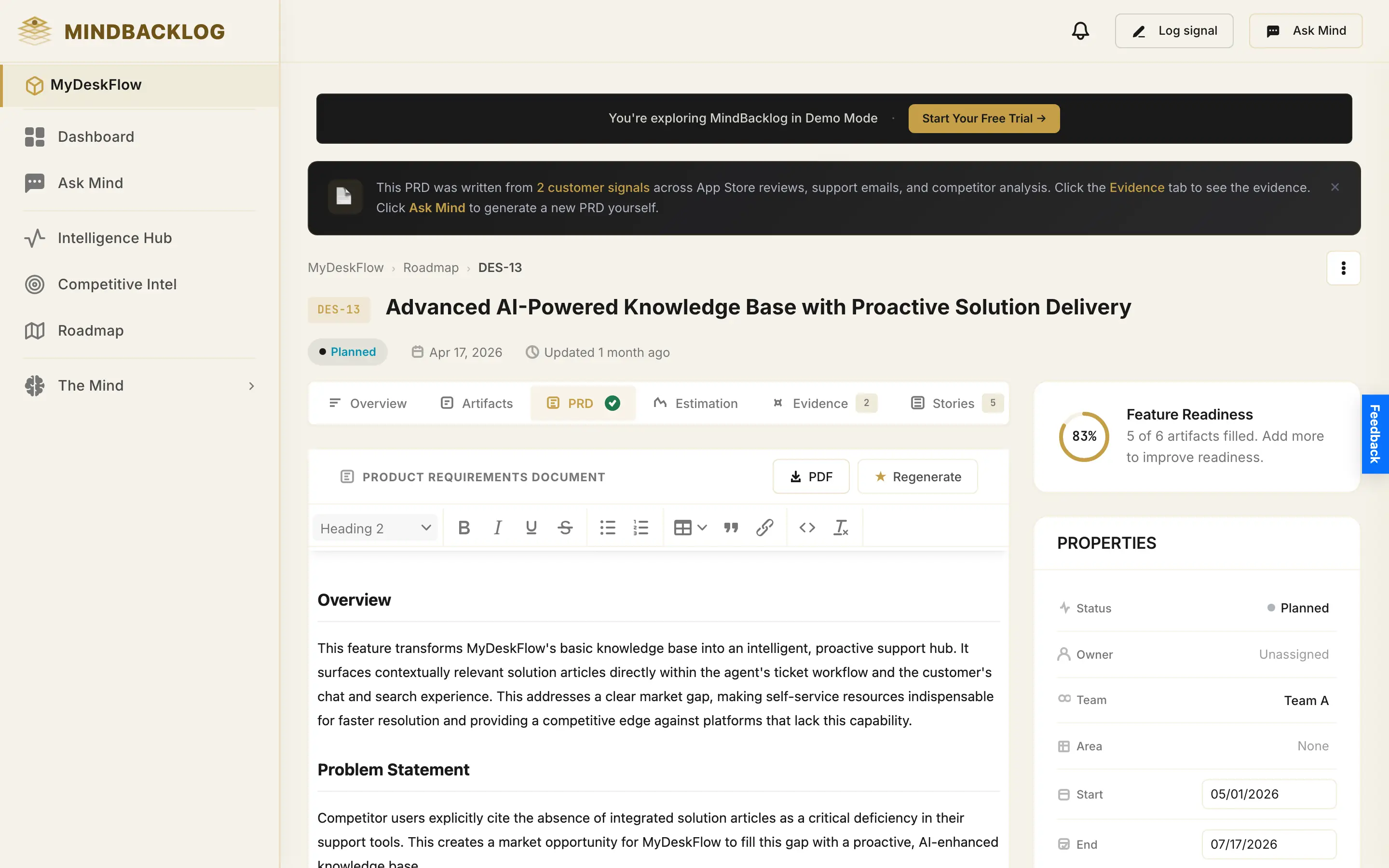
The complete document — six sections, citation chips, RICE score, competitive context. Edits stick. Evidence refreshes.
Bulk export filters — Living PRD
v4 · evidence refreshed 2h ago1 · Problem statement
Enterprise admins on multi-product workspaces cannot filter exports by date, owner, or status. They run weekly compliance reports manually — typically 45 minutes of CSV cleanup per report. 47 signals · 4 channels Sentiment ↓18%
2 · Evidence (cited)
"Genuinely the worst part of my week" — Portal · Acme Corp (CFO). "Why is there no date filter? Every other tool has this" — App Store review · Beta Inc. 3 enterprise accounts flagged this in QBR notes captured via Slack channel #customer-success. Acme Globex Beta Inc +11 more
3 · Competitive context
Competitor X shipped scheduled CSV filters in May 2026. Public review sentiment improved +0.4★ in the 30 days following ship. Competitor Y has filters but no date range — gap remains. Gap matrix · Competitive Intelligence
4 · Proposed solution & acceptance criteria
Add filter controls for date range, owner, status, and tag on the bulk export modal. Save filter combinations as named views per workspace. AC1: users can filter by date range and persist the view. AC2: exports respect active filters with no manual post-processing. AC3: saved views shareable inside the workspace.
5 · Goal alignment
Maps to Q3 OKR "Reduce enterprise admin manual workload by 30%." Estimated impact: 12 affected accounts, ~45min/week reclaimed per admin. OKR: Enterprise Retention
6 · RICE (default, AI-estimated)
892Reach 4,200 · Impact 3 · Confidence 85% · Effort 2 wks Evidence trail
Every citation chip is clickable in the live workspace — opens the source Slack thread, the App Store review, the widget conversation. Engineers verify the evidence themselves.
Same prompt. Different category of output.
General AI writes from imagination. The Living PRD generator writes from your signal layer.
No persistent product memory
ChatGPT forgets everything when the conversation ends. The MIND engine holds every signal your customers have ever sent — every channel, every sentiment shift. Ask Mind for a PRD and the answer draws on that full record, not a 200-token prompt.
No signal citations
Even with RAG and uploaded docs, general AI produces plausible-sounding requirements with no audit trail. Every paragraph in a Living PRD carries a citation chip pointing to the exact signal — name, channel, date, quote. Engineers can verify. Leadership can audit. Nobody asks "did a customer actually say this?"
No competitive context
General AI does not mine public reviews of your competitors continuously. Competitive Intelligence does — sentiment shifts, feature gaps, review delta after ship. Living PRDs pull this in automatically so the doc says "Competitor X shipped this and reviews moved +0.4★" instead of inventing a guess.
No multi-channel ingest
A PRD informed only by support tickets misses the enterprise asks in Slack. The signal pipeline ingests across 9+ channels (plus REST API, Zapier, Make) and weights every requirement against the full evidence base — not just whichever inbox the PM happened to remember.
From scattered signals to PRD in 30 seconds.
Four steps. The first three run continuously in the background. You only touch the fourth.
Connect your channels.
Slack, Email, App Store, Google Play, Public Portal, Feedback Widget, Web Scraper, Web Form, Reddit — plus unlimited via REST API, Zapier, and Make. Most teams complete setup in under five minutes. Once connected, every customer signal flows in continuously with channel attribution preserved.
Every signal sorted in under a second.
The pipeline classifies the signal type, links it to existing features, scores sentiment, deduplicates against prior signals, and attaches workspace + account metadata. By the time you open the PRD generator, the evidence is already there — organized, scored, and ready to cite.
"Write a Living PRD for [feature]."
Open Ask Mind from the persistent side panel — available on every page. Type the request in plain English. The engine pulls every signal classified against the feature, ranks them by recency and weight, mines competitive context, and assembles the six standard sections.
Document delivered in 30 seconds.
The PRD lands with every citation chip clickable, RICE score at the bottom, competitive context inline, and goal alignment mapped. Edit anything. The next regeneration preserves your manual edits and only refreshes the evidence layer underneath.
Five PM workflows where the Living PRD earns its keep.
Real scenarios from product teams shipping evidence-backed.
Engineering needs the PRD by Friday.
Friday-morning panic disappears. Open Ask Mind, request a Living PRD for the feature, share the link in the sprint channel. Engineers click citations to understand the "why" before refinement starts. No more "let me get back to you on whether a customer actually asked for this."
Leadership asks why this is ranked #1.
Pull up the Living PRD. RICE score 892, signal count 47, sentiment trend down 18%, three enterprise accounts cited by name, competitive gap shown. The room stops debating priorities and starts debating sequencing. The receipts win.
Sales wants a feature your data does not support.
Generate the Living PRD anyway. If the signal layer is thin, the PRD shows it — "3 signals, 1 channel, no sentiment trend." That conversation with sales becomes easier when the absence of evidence is visible in the document itself, not just in the PM's head.
You are doing three people's jobs.
Writing five PRDs a quarter from scratch is two days of work. Generating them from the signal layer is two hours of editing. Write the synthesis once — into the system — and every PRD after it inherits the same quality bar.
Retro on what shipped and why.
Every shipped feature has a Living PRD with an evidence trail. Quarterly review becomes "look at the 14 features we shipped — here is the signal volume behind each, the sentiment shift after launch, the customer accounts cited." No reconstruction from memory.
Ramping a new hire in week one.
Hand them the Roadmap. Every item has a Living PRD with full evidence trail. They read 12 PRDs and have more product context than three weeks of meetings would deliver. Compounds from day one, not month four.
How a Living PRD evolves from 14 signals to 2,000.
A Living PRD compounds. The version you walk into refinement with on day one is already useful. Two thousand signals later it is sharper — because evidence accumulated, not because time passed. Same feature. Same generator. Different depth.
Already useful.
- · 8 signals across 2 channels
- · Sentiment: insufficient data
- · Competitive: 1 competitor surveyed
- · RICE: 612 · confidence 62%
- · Cited accounts: 3
Engineering aligns on intent. Refinement can start.
The evidence base widens.
- · 23 signals across 3 channels
- · Sentiment: ↓12% over 30 days
- · Competitive: Competitor X shipped, +0.3★ review sentiment
- · RICE: 740 · confidence 78%
- · Cited accounts: 9
Strong enough for roadmap sequencing decisions.
Two thousand signals of compounding.
- · 47 signals across 4 channels
- · Sentiment: ↓18%, stable downward
- · Competitive: 3 competitors compared, full gap matrix
- · RICE: 892 · confidence 91%
- · Cited accounts: 14
Leadership defense. Sprint planning. Retro reference.
The artifact is the same. The evidence is two thousand signals deeper. This is what compounding intelligence looks like at the document layer.
The PRD generator is a window onto the intelligence layer — not a standalone tool.
Every Living PRD draws from the same intelligence layer that powers the Intelligence Hub, Ask Mind, RICE default scoring, and Competitive Intelligence — signals across 9+ channels classified in under a second and linked to features, competitors, and sentiment trends. The PRD is the artifact; the persistent signal layer underneath is what keeps the citations current as new evidence arrives. It compounds from day one.
Questions PMs ask about the Living PRD generator.
Other artifacts that pull from the same signal layer.
User Story Generator
INVEST-aligned stories with acceptance criteria — generated from the same signals that back the parent PRD.
Read →Release Notes Generator
Three voices — changelog, blog, in-app banner — anchored in the signals that prompted each shipped change.
Read →Feature Brief Generator
One-page briefs for leadership review — same evidence layer, shorter format, faster decision loop.
Read →Go deeper on the category and the comparison.
What is product intelligence?
The category that powers Living PRDs — what it is, how it differs from feedback management, and why it compounds over time.
Read pillar →Living PRD vs ChatPRD
Both write PRDs with AI. Only one writes from your actual signal layer with verifiable citations and compounding evidence.
Compare →The MIND Engine
How the signal pipeline classifies, deduplicates, scores sentiment, and links signals to features in under a second.
See feature →Deeper reading on the craft.
How to write a PRD in 2026
The definitive guide to modern PRDs — structure, evidence, and what separates a spec people use from one they ignore.
Read on the blog →How GenAI is changing PRD writing
Where AI actually helps the PRD — and the templates that keep the output grounded in real product context.
Read on the blog →Build what's right. Prove why.
Your first Living PRD, from your URL.
Explore a sample workspace →