The AI that's been listening to your customers.
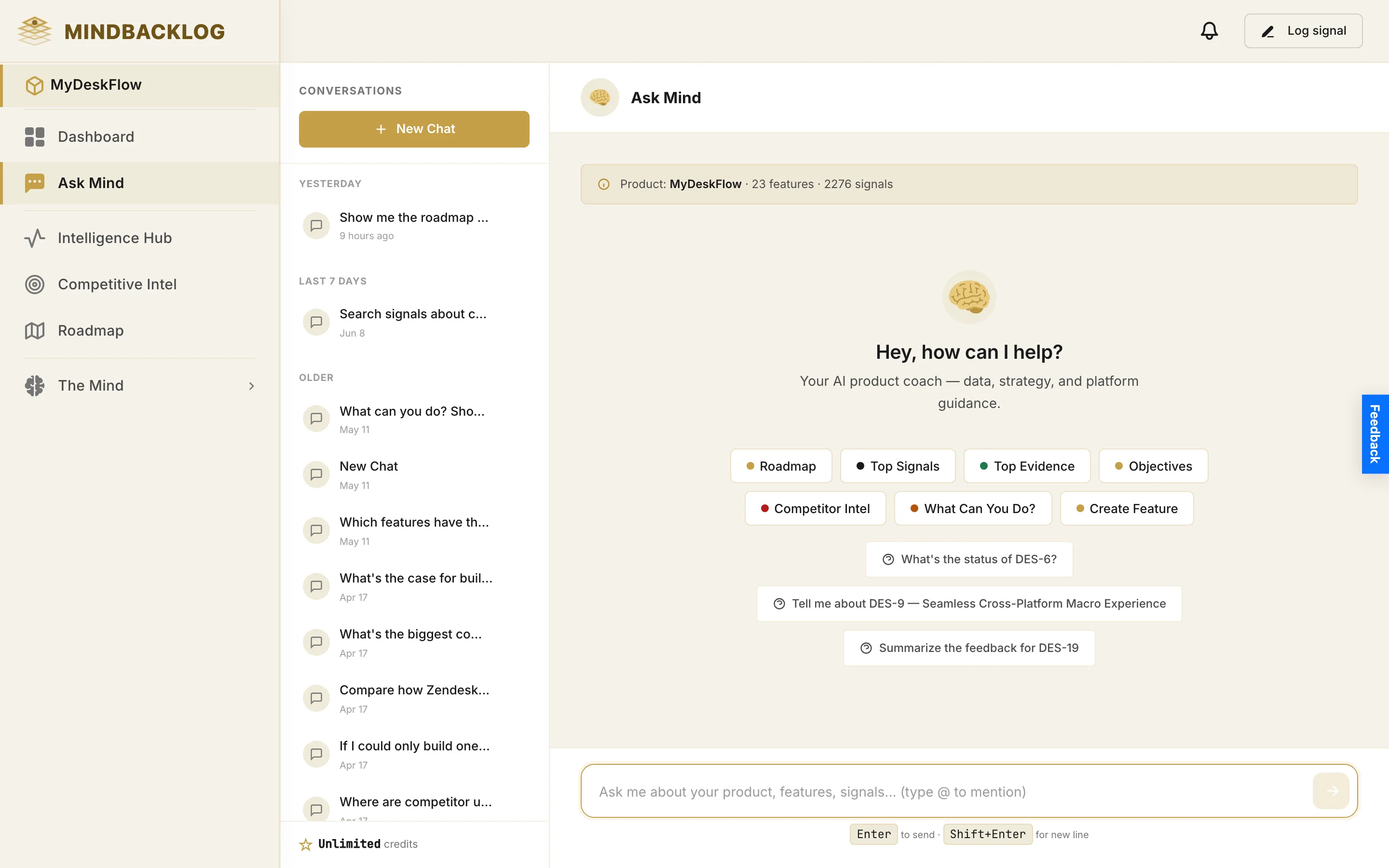
Ask Mind is the persistent side panel — open it from any page. It knows your product, your customers, and your competitors — and now reads your Confluence wiki live. Every answer cites real evidence. No hallucinations. No re-pasting context.
A persistent side panel that knows your product.
Same intelligence layer as RICE and Living PRDs — open from any page, never starts from zero.
Persistent memory of every signal, feature, customer, competitor.
Every pipeline-classified signal. Sentiment trends. Competitive context. Account history. And now, beyond that memory, it reads your Confluence wiki live — citing the real page. You stop re-pasting context — because the context is the product itself.
Every answer links to source signals — auditable, not hallucinated.
Citation chips next to every claim — channel, customer, date, quote, clickable. The hallucination risk that breaks general AI in roadmap reviews disappears.
Persistent side panel. Open from any page. Never starts from zero.
Roadmap, Living PRD, Intelligence Hub, Settings — same brain, every page. The conversation context is aware of where you opened it. No tab juggling, no paste cycles.
ChatGPT starts from zero every conversation. Ask Mind has been listening to your customers for months.
ChatGPT forgets your product every conversation. Your PM workflow pays the cost.
The PM opens ChatGPT, pastes the product context, pastes three customer quotes from memory, asks the question, gets an answer that mixes real reasoning with invented quotes. Five minutes later they open a new conversation and start the paste cycle over. The AI cannot remember last week's conversation, last month's churn signals, or which competitor shipped a similar feature in May. The PM ends up as the human synthesis engine the AI was supposed to replace — moving context in and out by hand, fact-checking outputs, deleting the hallucinations. The time saved over a manual workflow is real, but smaller than promised, and the credibility cost of acting on a hallucinated quote is much larger than the hours saved.
What no general AI has.
The reasons Ask Mind cannot be replicated by a smarter prompt.
Knows your product
Persistent context — features, pipeline-classified signals, OKRs, competitors, customer accounts. Ask "what is blocking enterprise adoption?" and the answer draws on every signal ever captured from your enterprise tier, ranked by recency and account weight. ChatGPT cannot do this — the context window resets every conversation.
Cites real signals — clickable
Every claim links to a source — Slack thread, App Store review, widget submission, portal post — with channel, customer, date, and quote. Citation chips are clickable; one tap opens the original. If the signal layer cannot support a claim, Ask Mind says "I have only 3 signals on this — not enough to answer with confidence" rather than fabricating.
Always there — every page
A persistent side panel that opens from any page in the workspace. Roadmap, PRD, Intelligence Hub, Competitive dashboard, Settings — same brain, different surface. The conversation context follows the page: open from a feature card and Ask Mind already knows which feature you are asking about. No tab-switching, no re-pasting.
Backed by a signal layer that compounds
Every Ask Mind answer is the MIND engine surfacing what it has been quietly compounding — pipeline-classified signals across 9+ channels, sentiment trends, competitive context, customer account history. A few thousand signals in, the same question produces a richer answer — not because time passed, but because the evidence accumulated.
Reads your live tools — not just piped-in signals
Beyond the signals piped into MindBacklog, Ask Mind can now reach out into your own systems of record and read them live over MCP — starting with Confluence. Ask "what does our wiki say about the onboarding redesign?" and it searches your team wiki the moment you ask, citing the real page. No index, no copy of your wiki. Confluence is live today; Amplitude is next; it's an open connector platform.
Four moments where Ask Mind saves the meeting.
The side panel earns its keep across the PM's actual day.
"What's blocking enterprise adoption?"
The engineering lead asks at standup. The PM opens the side panel without leaving the dashboard — no new tab, no context paste. Seconds later: three blockers, ranked, each with a citation chip. SSO and permissions, 8 signals from 4 enterprise accounts. Bulk export, 12. Audit log, 6. One click opens the original thread. Standup moves on.
"Write a Living PRD for bulk export."
The PM opens Ask Mind from the bulk-export card — the conversation already knows which feature. One prompt. Thirty seconds later a Living PRD lands: 12 cited signals, sentiment trend, competitive context, RICE score attached. The PM tightens the acceptance criteria and shares the link. Engineering reads the evidence before refinement, not after.
"What did Acme Corp complain about last quarter?"
Sales has a renewal call at 4pm. Five minutes before, the PM asks the side panel. Acme filed 14 signals last quarter — most on bulk export, sentiment up since the May release, two issues still open and both on the roadmap. Every line carries a clickable citation. Sales walks in with evidence, not recollection.
"Why is search filters ranked #1?"
Leadership challenges the top priority mid-review. The PM opens Ask Mind from the search-filters card — it already knows the feature. The answer: RICE 892, 47 signals across 4 channels, sentiment down 18%, Competitor X shipped in May. The PM taps a citation and the original review opens in front of the room. The roadmap holds.
Ask Mind is the surface. The intelligence layer is the engine.
Every answer pulls from the same source of truth that powers every other artifact.
Citations come from classified signals.
The Signal Pipeline classifies, links, and sentiment-scores every signal across 9+ channels. Ask Mind reads from that structured layer — which is why every citation chip is real, clickable, and traceable to a source.
Generate Living PRDs from a single prompt.
"Write a Living PRD for [feature]" is the most-used Ask Mind prompt. The Living PRD generator is the Ask Mind workflow with structured output — same engine, same evidence trail, formatted as a document.
Open from the Roadmap for one-tap answers.
Open Ask Mind from any Roadmap card and the conversation context already knows which feature. "Why is this ranked here?" returns the RICE breakdown, signal evidence, and competitive context in one answer.
ChatGPT starts every conversation from zero. Ask Mind never does.
Ask Mind is one window onto the MIND engine — the same compounding layer that scores RICE, drafts Living PRDs, and ranks the Roadmap. No answer is retrieved from a cold start. Two thousand signals later, the same prompt returns a sharper answer.
Questions PMs ask about Ask Mind.
The other windows onto the same intelligence layer.
Signal Pipeline
The 9+ channel pipeline that classifies and links every signal Ask Mind cites — the structured layer beneath every clickable citation chip.
Read →Living PRD Generator
The most-used Ask Mind workflow with structured output — six sections, citation chips, RICE breakdown, in 30 seconds.
Read →Roadmap
Open Ask Mind from any roadmap card and the side panel already knows which feature you are asking about — one-tap defense in any review.
Read →