AI Feature Brief Generator
Any AI generates from a blank prompt. This one generates from your product's evidence — a one-page decision document with problem, evidence, three options, and a recommendation. The artifact that wins the build/no-build conversation.
Brief · Bulk export
1 page · decision-readyProblem
Enterprise admins want bulk export. 12 signals · 3 channels
Recommendation
Build in Q3. Effort 2wk. Sentiment ↓18%. Competitor X shipped May.
A brief wins or loses build/no-build in one page.
Three criteria for briefs leadership actually reads — and trusts.
Decision-ready, not novel-length.
Leadership has ten minutes between calls, not an hour for a full PRD. The brief delivers the problem, the evidence, and the recommendation in a format that fits on a screen — and is structured so a VP can scan it in 90 seconds and walk into the room with the call already made.
Recommendation backed by signal volume.
The build/no-build call is traceable. Every claim links to source signals across 9+ channels — 47 signals from 12 enterprise accounts, sentiment trending down 18%, competitor X shipped in May. When the VP asks "how do we know this?" the answer is one click away, not a templated guess from the model.
Always presents alternatives.
A real brief surfaces build / defer / discover — with effort estimates and trade-offs for each path. Leadership is not picking yes-or-no; they are picking between three real moves. The generator that defaults to a single recommendation is leaving the decision conversation half-formed.
A feature brief is a decision document, not a recap. It earns its place on the planning table by being defensible the moment it lands.
What separates a brief leadership approves from one they table.
A feature brief is a PM's argument compressed onto one page. The good ones get a decision in the meeting they were written for. Five things separate one from a wall of context with no conclusion.
One page, one decision.
A feature brief is a tool for leadership to decide build / don't-build / defer. If it takes more than one page to convey the decision, it is becoming a PRD — and the PRD is a different artifact for a different room. The brief's job is to compress. Strip the framing context, strip the implementation detail, strip the side considerations. What remains is the problem, the evidence, the options, and the recommendation. If a section does not move the decision forward, it does not belong in the brief.
Lead with the customer pain in numbers.
"47 customers across 4 channels report this" beats "we have heard customers want this." Leadership reads briefs in 90 seconds; the lead paragraph carries the weight. Counts, channels, account names, and sentiment trends do work that adjectives cannot. "Many users" is unfalsifiable and forgettable. "12 enterprise accounts citing this in QBR notes, sentiment trending down 18% over 60 days" is specific enough to argue with — which is exactly what makes it credible.
Show the gap and the cost.
The two questions leadership always asks: "what happens if we don't ship?" and "what does it cost in engineering time?". Answer both in the brief — don't make them follow up. The cost of inaction is the renewal exposure, the competitive gap, the support load. The cost of action is the engineering weeks, the migration risk, the opportunity cost against the next candidate. A brief that names both numbers shortens the meeting by twenty minutes because the obvious questions are already answered on the page.
Include the competitive context.
"Competitor X shipped this in May, their review sentiment moved +0.4★" is the kind of context that changes a meeting. If the brief skips competitive context, leadership will assume there is none — and prioritize accordingly. Public review mining across G2, Capterra, App Store, and changelogs is mechanically cheap and consistently informative. A brief that names the competitor, the ship date, and the market reaction reframes the decision from "is this important?" to "are we okay being behind?"
Recommend a decision.
Feature briefs that say "options A, B, C with pros and cons" pass the decision back to the room. Strong briefs end with "we recommend A because [evidence]." The brief is not neutral reporting; it is a PM's argument backed by signals. Naming the recommendation is the moment the PM takes a position — and positions are what leadership wants from product. Leadership can override a recommendation in five seconds. They cannot override an absence of one.
A brief that does these five things gets a decision in the meeting it was written for — not punted to the next QBR.
Why most feature briefs get tabled instead of approved.
The failure modes are predictable. Avoid these five and the document carries weight in the room.
Three pages disguised as one.
The brief sprawls to 8 paragraphs and 3 charts. Leadership skims, then asks for "the short version." If the brief did not fit on one screen, it was not a brief — it was a PRD wearing a different hat. The discipline of compression is what makes the artifact work. Every paragraph that survives the cut earns its place. The paragraphs that get cut were not load-bearing in the first place.
Buried customer signal.
The customer pain shows up on page 2 in a "supporting evidence" section. It belongs in paragraph 1, in numbers. Leadership decides based on the first 60 seconds of reading. If the pain is buried, the decision defaults to "table it" because the brief did not give them a reason to act. Lead with the count, the channels, the named accounts. The framing context can wait — or be cut entirely.
No alternatives considered.
Briefs that argue for one path without showing what was rejected look like advocacy, not analysis. Naming the two alternatives and why they were dropped is what makes the recommendation credible. "We considered deferring to Q4 and discovery-first; here is why we rejected both" demonstrates the PM thought through the problem space. A brief with no alternatives reads like the PM started with the answer and worked backward.
Engineering effort is hand-waved.
"Medium effort" is not a number. Engineering hates this. Estimate in weeks at minimum, with a sentence on what drives the estimate (e.g., "schema change required, no migration risk"). A brief that hand-waves effort signals the PM did not loop engineering in before writing — which means the recommendation is missing a load-bearing constraint. Two weeks with caveats beats "medium" every time, even if the two weeks turns out to be three.
Recommendation hedged into uselessness.
"We could do this, or we could not, depending on priorities" is not a recommendation. Pick one, defend it, accept that being wrong is part of the job. Leadership respects a clear position more than a hedged one — and the hedge usually signals the PM did not want to commit because the evidence was not strong enough to defend. If the evidence is thin, that is itself the recommendation: "defer until we have more signal."
What a real feature brief actually looks like.
One page. Five sections. Citation chips throughout. The complete artifact you walk into a build/no-build meeting with.
Bulk export filters — Feature Brief
1 page · evidence refreshed 2h ago1 · Problem
Enterprise admins on multi-product workspaces cannot filter bulk exports by date, owner, or status. Three named accounts run weekly compliance reports manually — typically 45 minutes of CSV cleanup per report. The pain shows up in Slack, App Store reviews, and QBR notes. 12 signals · 3 channels Sentiment ↓18%
2 · Evidence (cited)
"Genuinely the worst part of my week" — Acme Corp (CFO) · Public Portal. "Why is there no date filter? Every other tool has this" — Beta Inc · App Store review · 2★. 3 enterprise accounts flagged this in QBR notes captured via Slack channel #customer-success. Acme Globex Beta Inc
3 · Three options
A · Build now — 2 week effort, ships Q3. Resolves all 12 signals. RICE 892. B · Defer to Q4 — bundle with reporting overhaul. Risk: Competitor X shipped May 2026, gap widens. C · Discover more — 2 week customer dev sprint before building. Cost: 3 enterprise renewals up next quarter. RICE comparison
4 · Recommendation
Build now (Option A). 12 signals across 3 channels with sentiment trending ↓18% over 60 days. Competitor X shipped scheduled CSV filters in May 2026 and public review sentiment improved +0.4★. Three enterprise accounts cited this in QBR — combined ARR exposure $187K. Two-week effort fits Q3 sprint plan. Evidence trail
5 · Effort & RICE
892Reach 4,200 · Impact 3 · Confidence 85% · Effort 2 wks RICE default
Every citation chip is clickable in the live workspace — opens the source Slack thread, the App Store review, the widget conversation. Leadership verifies the evidence in real time.
Same prompt. Different category of recommendation.
General AI writes a brief from imagination. This one writes from your signal layer.
No persistent product memory
ChatGPT forgets everything when the conversation ends. The MIND engine keeps every signal your customers have sent — every channel, every sentiment shift, every named account. Ask Mind for a brief and the recommendation draws on the full classified record, not a 200-token prompt.
No signal citations
Paste context into a general AI and you still get an unauditable answer — plausible, uncited, impossible to verify in the room. A MindBacklog brief attaches a citation chip to every claim: account, channel, date, quote. The audit happens during the meeting, not after it.
No competitive context
A general model has no view of what your competitors just shipped. Competitive Intelligence watches their public reviews continuously — sentiment shifts, feature gaps, how the market reacted after a launch. Briefs pull this in automatically so the recommendation reads "Competitor X shipped this in May and reviews moved +0.4★" instead of "competitors might be doing something similar."
No multi-channel ingest
A brief informed only by support tickets misses the enterprise asks in Slack. This one weighs its recommendation against the whole evidence base — 9+ channels plus REST API, Zapier, and Make — not whichever inbox the PM checked the morning of the meeting.
From scattered signals to a one-page brief in 30 seconds.
Four steps. The first three run continuously in the background. You only touch the fourth.
Connect your channels.
Slack, Email, App Store, Google Play, Public Portal, Feedback Widget, Web Scraper, Web Form, Reddit — and anything custom via REST API, Zapier, and Make. Setup takes minutes. From then on every customer signal arrives with its channel attached, which is the attribution your next brief will cite.
Every signal sorted in under a second.
Each signal is typed, linked to the feature it concerns, scored for sentiment, deduplicated, and stamped with workspace and account metadata. A brief never starts from a blank page — by the time you ask for one, the evidence section has effectively assembled itself.
"Write a feature brief for [feature]."
Ask Mind sits in the side panel on every page — one plain-English sentence is enough. The MIND engine gathers every signal classified against the feature, weighs recency against volume, pulls the competitive picture, then frames three options and takes a position.
One-page brief delivered in 30 seconds.
The brief lands with every citation chip clickable, RICE score inline, three options compared, and recommendation written. Edit anything before the meeting — your changes hold through regeneration while the evidence underneath stays live.
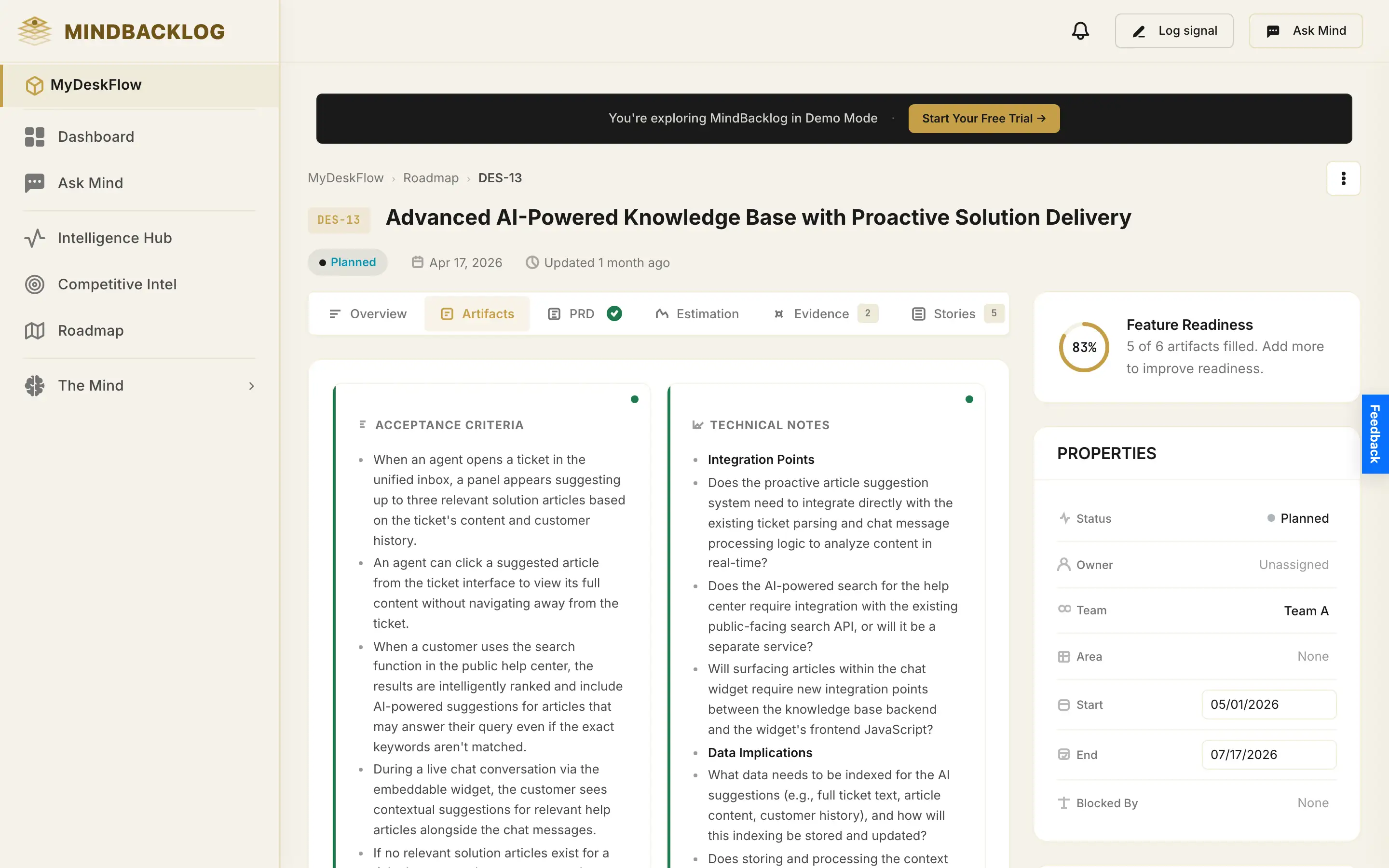
Five PM workflows where the feature brief earns its keep.
Real scenarios from product teams making evidence-backed decisions.
VP asks if this is worth two weeks of engineering.
Walk in with the brief. 12 signals across 3 channels, sentiment down 18%, three named enterprise accounts cited, competitor shipped in May. The recommendation is on the page — not in the PM's head. The conversation ends in ten minutes because the evidence answered the questions before anyone asked.
Twelve candidates competing for eight slots.
Generate a brief for each candidate in 30 seconds apiece. Side-by-side comparison becomes a 20-minute exercise instead of a two-week scramble. Every candidate carries its own evidence trail — RICE scores comparable, signal counts visible, competitive gaps mapped. Leadership picks eight with confidence.
Sales pushes a feature your data does not support.
Generate the brief anyway. If the signal layer is thin, the brief shows it — "3 signals, 1 channel, no sentiment trend." That conversation with sales becomes easier when the absence of evidence is visible in the document itself. The "no" is now a recommendation with receipts, not a PM opinion.
You are doing three people's jobs.
Writing 8 briefs a quarter from scratch is a full week of work. Generating them from the signal layer is a few hours of editing. The synthesis happens once, in the system — so the eighth brief of the quarter is as sharp as the first, no matter who asked for it.
CEO needs three slides on next quarter.
Generate a brief for each major bet. Paste the recommendations into the deck — they already carry signal counts, sentiment trends, and competitive context. The board reads three pages instead of asking the CEO to defend the roadmap from memory. The PM looks like an analyst, not a guesser.
Defending why a feature gets shelved.
The brief shows option B — defer or kill — with the evidence. "Only 3 signals over 90 days, sentiment flat, no enterprise accounts citing this, competitor shipped 18 months ago with no market response." The kill decision becomes a documented call, not a political loss.
The brief is a window onto the intelligence layer — not a standalone tool.
The same intelligence layer that powers the Intelligence Hub, Ask Mind, RICE default scoring, Living PRDs, and Competitive Intelligence writes your briefs — signals from 9+ channels, classified in under a second, already linked to features, competitors, and sentiment trends. The one-pager is the visible surface. What wins the meeting is the layer underneath, and it gets sharper with every signal it processes.
Questions PMs ask about the feature brief generator.
Other artifacts that pull from the same signal layer.
Living PRD Generator
Full PRDs with signal citations, competitive context, and RICE scores — generated in 30 seconds from the same evidence base.
Read →Competitive Analysis
Mine competitor reviews, forums, and public signals into a strategic brief. Sentiment, gap matrix, your opportunity.
Read →Feedback Analysis
Trend report on your signal feed — themes, sentiment shifts, emerging patterns. The Intelligence Hub as an artifact.
Read →Go deeper on the category and the vocabulary.
What is product intelligence?
The category that turns feature briefs from PM hunches into evidence-backed arguments.
Read pillar →Living PRD Generator
Once the brief is approved, generate the full Living PRD from the same signal layer.
Read →Glossary
Definitions of Signal, MIND Engine, Compounding Intelligence, and related category vocabulary.
Read →Deeper reading on the craft.
Build what's right. Prove why.
Your first feature brief, from your URL.
Explore a sample workspace →