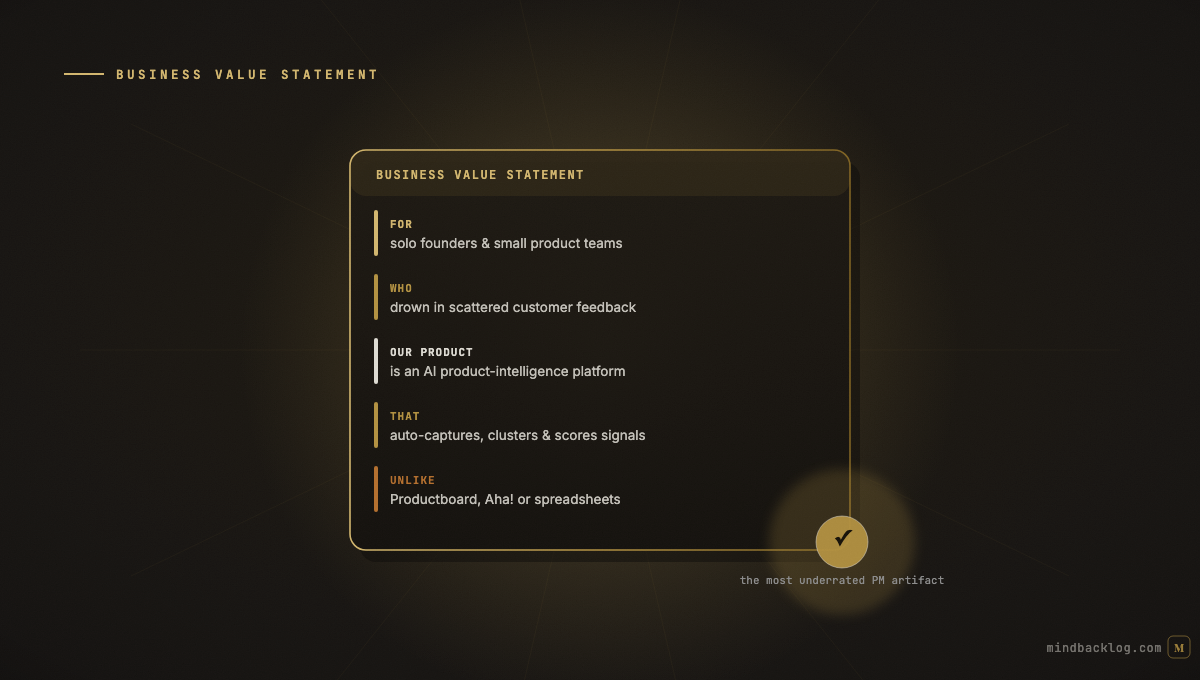
Every feature on your roadmap should be able to answer one question in two sentences: why should we build this instead of something else? The business value statement is the artifact that provides that answer. It is a concise, structured articulation of who benefits from a feature, what problem it solves, how much impact it will have, and how success will be measured.
Despite its simplicity and power, the business value statement is the most commonly skipped artifact in product management. PMs write PRDs, user stories, and acceptance criteria — all of which describe what to build. They rarely write a concise document that explains why to build it. The result is features that exist on the roadmap without a clear, defensible rationale — which makes prioritization subjective, stakeholder conversations difficult, and post-launch evaluation impossible.
The Four-Part Framework
An effective business value statement answers four questions in a specific order. Who benefits? This identifies the customer segment, user persona, or internal team that will be impacted. Be specific — ‘enterprise customers managing more than 50 accounts’ is useful; ‘users’ is not.
What problem does it solve? This describes the current pain point or opportunity in concrete terms. Reference customer evidence: signal counts, representative quotes, and severity indicators. The problem statement should make a reader who is unfamiliar with the feature understand immediately why it matters.
How much impact will it have? This quantifies the expected effect — revenue at risk, retention improvement, cost reduction, efficiency gain, or competitive positioning improvement. Where quantification is difficult, describe the impact qualitatively but concretely: ‘This addresses the most frequently reported enterprise pain point, cited by 23% of accounts in their renewal feedback.’
How will we measure success? This defines the specific metric or metrics that will indicate whether the feature achieved its intended value. The metric should be measurable with your current analytics infrastructure and should have a clear baseline and target.
Why the BVS Matters More Than the PRD
A provocative claim, but defensible: the business value statement is more important than the PRD. The PRD describes what to build. The BVS explains why to build it. If the ‘what’ is wrong, the team wastes some sprints. If the ‘why’ is wrong, the team builds features that should never have been started.
The BVS serves as a filter before the PRD is even written. If you cannot write a compelling BVS for a feature — if you cannot articulate who benefits, what problem it solves, and how you will measure success — the feature should not proceed to specification. It needs more research, more customer evidence, or a clearer connection to strategic objectives.
The BVS also serves as a communication tool that the PRD cannot. A PRD is a detailed technical document read primarily by the development team. A BVS is a concise strategic document that can be shared with executives, sales, customer success, and anyone else who needs to understand why a feature is being built without reading a ten-page specification.
AI-Assisted BVS Generation
AI is well-suited to generating first-draft business value statements because the inputs are already available in a well-maintained product management system. The ‘who benefits’ comes from the feature’s target product area and the user segments associated with linked signals. The ‘what problem’ comes from synthesizing the linked customer signals. The ‘how much impact’ comes from the signal volume, the customer value of requestors, and the strategic alignment score. The ‘how we’ll measure’ comes from the feature’s connection to strategic objectives and their key results.
An AI-generated BVS draft might read: ‘Improving user search performance benefits customer success managers at enterprise accounts managing 50+ users (representing 340 accounts and $4.2M ARR). These users report that finding specific users takes 3-5 minutes and disrupts their daily workflow, based on 47 signals across email, support, and web form channels. We expect this improvement to reduce average lookup time to under 30 seconds, which will be measured by tracking the 30-day activation rate for enterprise CSM users and monitoring the search-related support ticket volume.’
The PM refines this draft — adjusting the impact framing, validating the metric against measurement capabilities, and adding strategic context that the AI may have missed. But the heavy lifting of evidence synthesis is done. The PM spends ten minutes on a BVS instead of thirty, and the result is more thorough because the AI consulted every linked signal, not just the ones the PM remembered.
Framing Value for Different Stakeholders
The same feature creates different types of value for different audiences, and the BVS should be adaptable to each. For executives, frame the value in business terms: revenue protection, competitive positioning, strategic alignment. For engineering, frame the value in terms of technical improvement: reduced complexity, better architecture, elimination of workarounds. For sales, frame the value in terms of deal impact: objection removal, competitive differentiation, contract expansion. For customers, frame the value in terms of workflow improvement: time saved, frustration eliminated, capability gained.
The underlying evidence is the same. The framing shifts to resonate with each audience’s priorities. AI can generate audience-specific versions of the same BVS, saving the PM from rewriting the justification four times for four different contexts.
|
MindBacklog generates business value statements grounded in real customer evidence — signal counts, sentiment data, and strategic alignment scores. Stop building features without a clear ‘why.’ Start at mindbacklog.com. |
Ready to put your product intelligence on autopilot? Start your 14-day free trial at MindBacklog.com — no credit card required.


