Acceptance criteria are the contract between what the PM intends and what the engineer builds. When they are clear, specific, and testable, development proceeds smoothly and the delivered feature matches the PM’s expectations. When they are vague — ‘the feature should work correctly,’ ‘the search should be fast,’ ‘users should have a good experience’ — they create a gap that is filled by the engineer’s best guess, which may or may not match what the PM had in mind. The rework that follows a mismatched guess costs more than the time it would have taken to write clear criteria in the first place.
The irony is that most PMs know their acceptance criteria should be better. They just do not have a reliable method for writing them consistently, especially under time pressure. AI-assisted generation solves the consistency problem — producing structured, testable criteria from feature context — but understanding what makes criteria good is essential for reviewing and refining the AI’s output.
The Given/When/Then Format
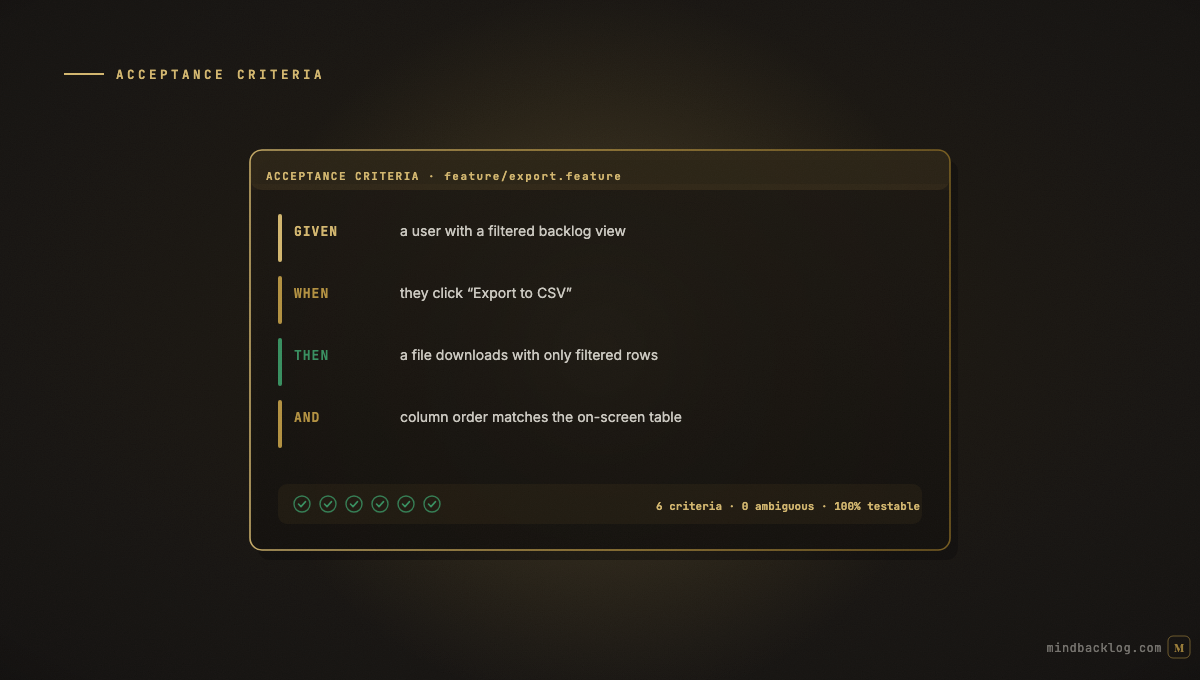
The most effective acceptance criteria format is Given/When/Then, borrowed from behavior-driven development (BDD). Given describes the precondition — the state of the system before the action occurs. When describes the action — what the user does. Then describes the expected outcome — the observable result.
Example for a search improvement feature: ‘Given the user is on the account directory page and has more than 100 accounts. When the user enters a search term and applies the Account Tier filter. Then the results display only accounts matching both the search term and the selected tier, within 2 seconds, sorted by relevance.’ This criterion is specific (references a real page and real filter), testable (the engineer can verify every element), and performance-bounded (the 2-second threshold is measurable).
Each story should have three to seven acceptance criteria: one for the primary happy path, one to two for the most important error states or edge cases, and one to two for non-functional requirements (performance, accessibility, security) where relevant.
Five Common Criteria Mistakes
Mistake one: untestable criteria. ‘The search should be intuitive’ cannot be verified by an engineer or a QA team. Replace with specific, observable behaviors: ‘Search results update as the user types, with debounced input at 300ms.’ Mistake two: implementation prescriptions. ‘Use a dropdown for the filter’ specifies implementation rather than behavior. The criterion should describe what the user experiences, not how it is built: ‘The user can select a filter value from the available options.’ The dropdown is a design decision, not a requirement.
Mistake three: missing error states. Criteria that only cover the happy path leave the engineer guessing about error handling. ‘Given the user enters a search term that matches no accounts. Then the system displays a clear empty state message with a suggestion to broaden the search.’ Mistake four: missing performance bounds. ‘Search should be fast’ is meaningless. ‘Search results display within 2 seconds for datasets up to 10,000 accounts’ is a testable performance requirement.
Mistake five: excessive detail. Acceptance criteria should define what, not how. Twenty criteria covering every pixel and interaction of a simple feature create so much specification overhead that the engineering team ignores them and builds based on conversation instead. Three to seven well-written criteria convey more useful information than twenty overly detailed ones.
How AI Generates Better Criteria
AI-generated acceptance criteria solve the consistency problem that plagues manual writing. Given a feature description and its context — the product area, the target users, the linked customer signals, and the patterns from previously accepted criteria — the AI produces a structured set of criteria in Given/When/Then format that covers the happy path, the primary error state, and relevant non-functional requirements.
The AI’s consistency is its primary advantage. Every set of criteria follows the same format. Every story gets error state coverage. Every performance-sensitive feature gets performance thresholds. The PM reviews and adjusts the AI’s output — adding domain-specific edge cases, adjusting performance bounds based on actual system capabilities, and removing criteria that are not relevant — but starts from a complete, well-structured draft rather than a blank page.
Criteria as Communication, Not Documentation
The best acceptance criteria are not just documentation — they are conversation starters. When the engineer reads ‘Given the user has more than 100 accounts’ and asks ‘what about users with 10,000 accounts? Does the performance requirement change?’ — that is exactly the kind of conversation criteria should provoke. The criteria surface the questions that need to be answered, even when they do not contain all the answers themselves.
This is why criteria should be reviewed in refinement sessions, not just published in the backlog. The engineering team reads the criteria, asks clarifying questions, and the team jointly resolves ambiguities. The criteria become sharper through this collaborative process, and the team builds a shared understanding that no document alone can provide.
|
MindBacklog generates acceptance criteria in Given/When/Then format from your feature context and customer signals. Consistent structure, testable conditions, complete coverage. Start at mindbacklog.com. |
Ready to put your product intelligence on autopilot? Start your 14-day free trial at MindBacklog.com — no credit card required.


