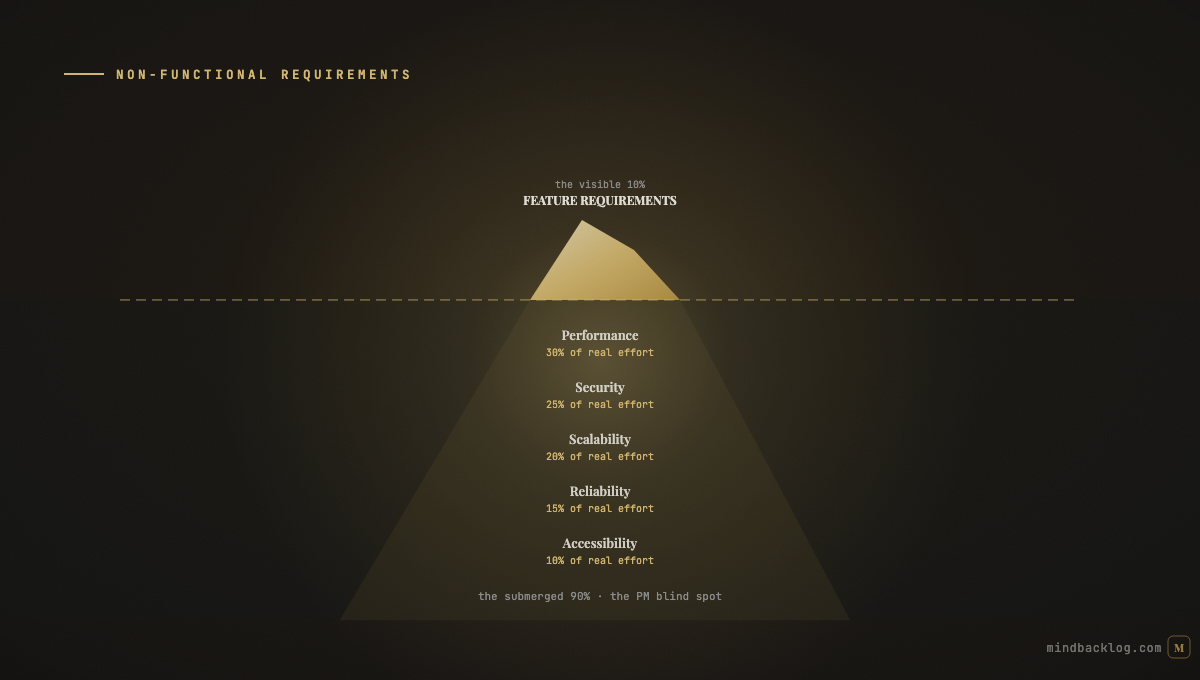
Product managers spend the majority of their specification effort on functional requirements — what the feature does. The search returns results. The report shows data. The form saves input. These are essential, but they are only half the specification. Non-functional requirements — how the feature performs — determine whether users actually have a good experience with the functionality the PM specified.
A search that returns results in fifteen seconds is functionally correct and experientially terrible. A report that shows data but crashes when the dataset exceeds 1,000 records is functionally correct and practically useless. A form that saves input but is unusable with a screen reader is functionally correct and inaccessible. In every case, the functional requirement was met. The non-functional requirement was not — because it was never defined.
The Six NFR Categories PMs Should Care About
Performance defines how fast the feature operates. Response time thresholds (pages load in under 2 seconds, search results appear in under 1 second), throughput limits (support 100 concurrent users, process 1,000 records per minute), and resource constraints (memory usage, bandwidth) fall into this category. Performance requirements should be specific and measurable — ‘fast’ is not a requirement; ’95th percentile response time under 2 seconds’ is.
Security defines how the feature protects data and access. Authentication requirements (which roles can access this feature), data protection (encryption at rest and in transit, PII handling), and input validation (preventing injection attacks, sanitizing user input) fall here. PMs do not need to specify the security implementation — that is engineering’s domain — but they need to define the security expectations and constraints.
Accessibility defines how the feature serves users with disabilities. WCAG 2.1 AA compliance is the standard baseline. Specific requirements might include keyboard navigability, screen reader compatibility, color contrast ratios, and alternative text for visual elements. Accessibility NFRs are both an ethical obligation and, increasingly, a legal requirement.
Reliability defines how the feature handles failure. Error handling expectations (graceful degradation vs. full failure), data integrity guarantees (transactions that cannot be partially completed), and recovery behavior (what happens after a crash or timeout) fall here. PMs should define what happens when things go wrong, not just what happens when things go right.
Scalability defines the limits within which the feature must perform. Maximum user count, maximum data volume, maximum concurrent operations. These limits should be derived from current usage data plus a reasonable growth projection. Specifying ‘must support 10 million users’ when you have 500 is wasteful over-engineering. Specifying ‘must support 500 users’ when you are growing 20 percent monthly is under-engineering.
Compliance defines the regulatory and policy constraints the feature must satisfy. GDPR data handling, SOC 2 audit requirements, HIPAA protections, and industry-specific regulations all produce NFRs that constrain how the feature is built. The PM identifies the applicable compliance requirements; engineering and legal determine how to satisfy them.
The PM’s Role: Define Thresholds, Not Implementations
PMs should define non-functional thresholds — the measurable standards the feature must meet — without specifying how those standards should be achieved. ‘Search results must return in under 2 seconds for datasets up to 50,000 records’ is a PM requirement. ‘Use Elasticsearch with 3 shards and a 512MB heap’ is an engineering implementation. The PM defines the user experience standard. Engineering decides how to deliver it.
This division of responsibility keeps the PM focused on what matters to users (speed, reliability, accessibility) while preserving engineering’s autonomy to choose the best technical approach. It also prevents the PM from inadvertently constraining the solution by specifying an implementation that is not optimal.
How AI Generates NFR Suggestions
AI can suggest non-functional requirements based on the feature type, the product area, and the patterns from previous features. A feature that involves data display should include performance thresholds for load time and pagination. A feature that handles user input should include validation and security requirements. A feature that creates a new public-facing interface should include accessibility requirements.
The AI generates these suggestions automatically when producing user stories or PRDs, ensuring that NFRs are not forgotten during the specification process. The PM reviews the suggestions, adjusts the thresholds to match the product’s specific standards, and removes any that are not relevant to the particular feature. The result is consistently complete specifications where NFRs are a standard component, not an afterthought.
Making NFRs Part of the Definition of Done
NFRs should be explicitly included in the team’s definition of done. A story is not complete when the functional requirements pass — it is complete when both functional and non-functional requirements pass. This means performance testing against the defined thresholds, security testing for the defined protections, and accessibility testing for the defined standards.
Without this inclusion, NFRs become aspirational rather than mandatory. The feature ships, the functional tests pass, and the non-functional issues are discovered by users in production — where they are dramatically more expensive to fix and significantly more damaging to the user experience.
|
MindBacklog’s AI story generation includes non-functional requirements automatically — performance thresholds, accessibility standards, and security considerations based on your product context. Complete specs, not just functional ones. Start at mindbacklog.com. |
Ready to put your product intelligence on autopilot? Start your 14-day free trial at MindBacklog.com — no credit card required.