One pipeline. Every signal. Every PM.
Multi-product SaaS organizations capture signals across every channel into one intelligence layer — and every PM, from Growth to Platform to Enterprise, ships Living PRDs that engineers trust.

Multi-product SaaS teams where product context lives in silos.
Three traits define the role. If two of these land, this page is for you.
Multi-product SaaS. 200+ employees.
Series C or D. $30M-$150M ARR. 3-8 distinct product surfaces. 4-15 PMs across pods — Core, Growth, Platform, Mobile, Enterprise, Admin. A VP of Product reports to the CPO or CEO.
Coordinating PMs across products.
Engineering, marketing, and support all need PM context — usually right now. Reconciling priority spreadsheets from three pods. Cross-product alignment meetings where two PMs realize they shipped conflicting things.
PRD quality lottery. Visibility broken.
Each PM has their own spreadsheet. RICE means different things on different sheets. Signals from a Core customer asking about Mobile never reach the Mobile PM. The constraint is shared visibility, not headcount.
One pipeline. Every signal. Every PM evidence-backed.
The multi-product SaaS coordination tax.
- "PMs across products do not see the same signals. A customer churns and three different PMs are surprised."
- "Each pod has its own prioritization spreadsheet. Leadership compares apples to oranges every quarter."
- "Engineering teams ping-pong between PRDs of wildly different quality — some have 30 citations, some have 3."
- "Roadmap reviews are basically political. Whoever defends best wins, regardless of evidence."
- "Cross-product themes get missed. By the time someone notices, 8 customers have escalated and the pattern is obvious in hindsight."
- "Marketing and support each have their own AI tools — and pull from different (and often outdated) product context. Launches go out misaligned."
One brain. Every PM. Every product.
Multi-product workspaces
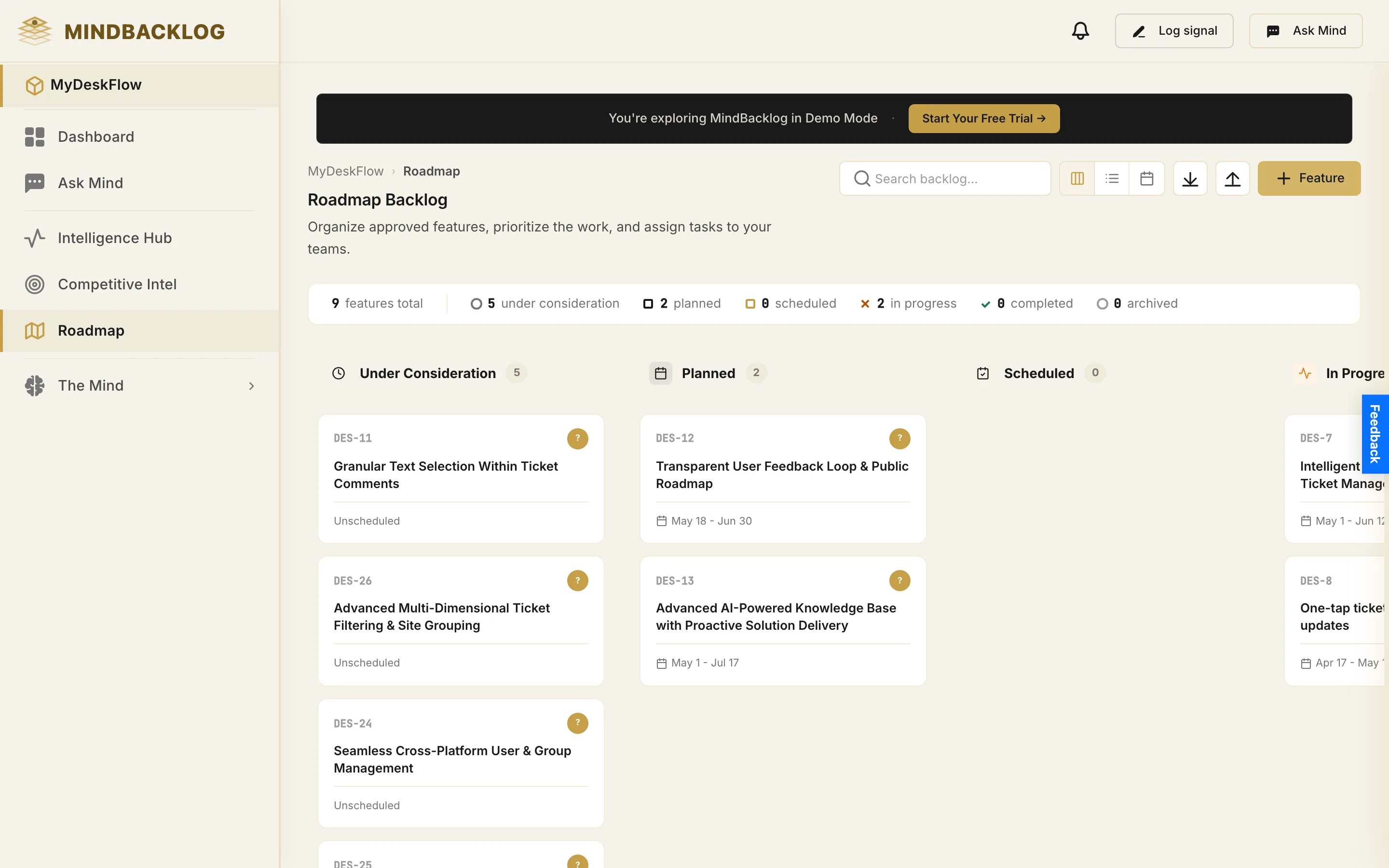
Each product gets its own Intelligence Hub and roadmap — Core, Mobile, Platform, Admin. Signals route automatically. Cross-product themes surface in a shared dashboard. A Core customer asking about Mobile no longer disappears into the wrong PM's Slack channel.
Shared RICE standard
RICE default with AI estimation — same scoring engine across every PM. Leadership compares the same currency across pods. No more reconciling 5 spreadsheets in the Monday review. No more apples-to-oranges QBR.
Living PRDs at consistent quality
The PRD quality lottery ends. Every PRD across every product cites signals, links to source channels, and includes competitive context. Engineering teams stop guessing which PRD is "the good one" — they all are. PRD quality becomes a system property, not a PM-by-PM craft level.
MCP for the whole org
Engineering queries from Cursor. Marketing from ChatGPT. Support from Claude. 20+ tools on the MCP server, one source of truth, every AI client pulling from the same intelligence layer. Cross-team launches stop going out misaligned.
A multi-product PM org's week, in sync.
Five moments where a shared evidence base and one scoring standard end the coordination tax.
Four capabilities a multi-product team uses differently.
The features that earn their keep at a 200+ person SaaS org — and how they get used differently from smaller teams.
One layer, every product surface.
Solo PMs run one workspace. Multi-product teams run 3-8 — Core, Mobile, Platform, Admin, Enterprise. Each workspace gets its own Intelligence Hub, roadmap, and PM owner. Cross-product themes surface in the shared dashboard so a Core signal mentioning Mobile no longer falls through the gap between pods. The cross-product churn that used to take 8 escalations to spot becomes visible a few dozen signals in.
Every team's AI client, one source of truth.
Founder-CTOs use MCP from Cursor. Multi-product teams plug 20+ tools into Claude, Cursor, AND ChatGPT — engineering, marketing, support, sales each query the same intelligence layer from whichever AI client they already use. Marketing launches stop going out misaligned with product reality. Support answers stop diverging from the roadmap.
Engineering stays in Jira. Product intelligence lives here.
Solo PMs sync one Jira project. Multi-product teams sync 4-8 — each pod's board mapped to its workspace. Features, user stories, bugs flow both directions in real time. Engineering never leaves Jira; product never leaves MindBacklog; the evidence trail is one click from any Jira ticket. The "where did this requirement come from" loop closes.
One scoring currency across pods.
Solo PMs score in isolation. Multi-product teams need every PM scoring the same way — otherwise leadership compares apples to oranges every QBR. RICE default with AI estimation backed by signal volume, sentiment, and channel diversity — same engine, every product. The Monday spreadsheet reconciliation disappears.
How multi-product teams fail with MindBacklog.
Honest patterns from 200+ person SaaS teams that almost got it right.
Letting each pod run its own workspace standards.
Multi-product teams that let each PM customize tagging, scoring, and channel routing rebuild the silo problem inside MindBacklog. Cross-product themes stop surfacing because each pod normalizes signals differently. Remedy: lock the shared taxonomy and scoring standard at workspace creation. Customization belongs at the roadmap layer, not the signal layer.
Treating MCP as an engineering-only tool.
PM teams that only enable MCP in Cursor for engineering miss the cross-team value. Marketing in ChatGPT, support in Claude, sales pulling cited customer quotes — that is where the alignment dividend lands. Remedy: roll MCP out to marketing, support, and sales alongside the PM seats, not after. The 20+ tools serve every team that ever needed product context.
Skipping the cross-product theme review.
The shared dashboard surfaces cross-product patterns — but only if someone reviews it weekly. Teams that delegate "cross-product themes" to no one let the dashboard grow stale. Remedy: assign cross-product theme review to the VP of Product or a senior PM, 30 minutes every Wednesday. The patterns that otherwise take 8 escalations to spot surface in the first review.
Questions multi-product SaaS teams ask.
Other use cases for similar teams.
Growth PM Leads
For the PM leads inside your org. Evidence-backed RICE, Competitive Intelligence dashboard, board-ready summaries — every priority defensible.
Read →Startup PMs
For PMs new to your team who came from solo-PM roles. Daily intelligence brief, Living PRDs in 30 seconds, Ask Mind on tap.
Read →Technical Founders
For acquired-team founders or platform partners. Concept Mode, REST API, MCP in Cursor — intelligence from day zero.
Read →