Every PM artifact, written from real evidence.
Six templated generators — PRDs, user stories, release notes, feature briefs, competitive analyses, feedback summaries — plus anything else you can ask Mind to produce. One signal layer underneath every artifact. Every claim cited.
Search filters · Living PRD
v3 · 2h agoProblem
Users cannot filter results. 47 signals · 4 channels
Evidence
Sentiment ↓18% this month. Globex Acme Beta Inc
Competitive
Competitor X shipped filters in May. +0.4★ reviews
Six artifacts. One evidence layer.
Living PRDs, user stories, release notes, feature briefs, competitive analyses, feedback analyses — all wired to the same signals.
All six generators read from the same signal layer.
PRD, stories, release notes, brief, competitive, feedback summary — every artifact for the same feature cites the same signals. No six-tools-six-contradictions to reconcile on Friday afternoon.
Citations are clickable. Engineers verify. Stakeholders cannot argue.
Every requirement, every story, every release note line anchors to a real signal with channel, customer, date, quote. "Did a customer ask for this?" becomes a click instead of a debate.
Artifacts refresh as new evidence arrives.
A PRD written in March from January data is stale by April. These artifacts re-cite, re-trend, re-contextualise as new signals land — so the document on engineering's screen matches the reality on the ground.
Any AI generates from a prompt. Only MindBacklog generates from your customers.
Six prompts in six tools produce six contradictory documents.
The PRD says enterprise admins need date filters. The user stories built off it (in a different tool) say "as a power user." The release notes (drafted in a third tool) talk about "improved CSV exports." The feature brief sent to leadership (a fourth tool) cites "customer feedback." The competitive analysis (a fifth) mentions a different competitor than the PRD. Four months later, nobody can reconcile what was actually shipped against what was actually asked for — because every artifact was generated from a different prompt with no shared evidence base.
Engineers do not trust the PRD because the user stories drift from it. Leadership does not trust the feature brief because the release notes disagree. The PM spends Friday afternoon reconciling six documents that should have been one trail of evidence. The artifacts each look reasonable in isolation and contradict each other in aggregate.
One signal layer. Six artifacts. Every citation matches.
Generate the PRD; the user stories and release notes inherit the same evidence trail. No reconciliation.
Shared signal layer across all six
Every generator reads from the same MIND engine — 9+ channels, classified in under a second, linked to features, sentiment-scored. A PRD on bulk export filters cites 47 signals; the user-story generator for the same feature cites the same 47 signals; the release notes draw from the same evidence; the feature brief summarizes the same trail.
Every claim carries a clickable citation
Citation chips on every paragraph in every artifact. Click one and the source Slack thread, App Store review, or widget submission opens. Engineers verify the customer quote themselves. Leadership audits the evidence trail. The artifact is not a wrapper around a model; it is a window onto the signal layer.
Artifacts refresh as evidence arrives
Generate a PRD on Monday with 47 cited signals. Twelve more land by Friday. The citation counts in the header are live; on next regeneration the document picks them up automatically, with your manual edits preserved. The artifact compounds in credibility every day it sits in the workspace.
Competitive context built in
Every artifact pulls competitive context automatically from public review mining via the Competitive Intelligence dashboard. The PRD references the competitor that shipped a similar feature in May. The feature brief notes the review delta. The competitive analysis generator goes deeper — full teardown anchored in the same evidence base.
Six templated generators. Plus anything else you ask for.
The named generators below are the most-used templates. Ask Mind handles everything outside that list — custom doc shapes, exec summaries, retro notes, board updates, sales battlecards — drawn from the same signal layer.
Living PRD Generator
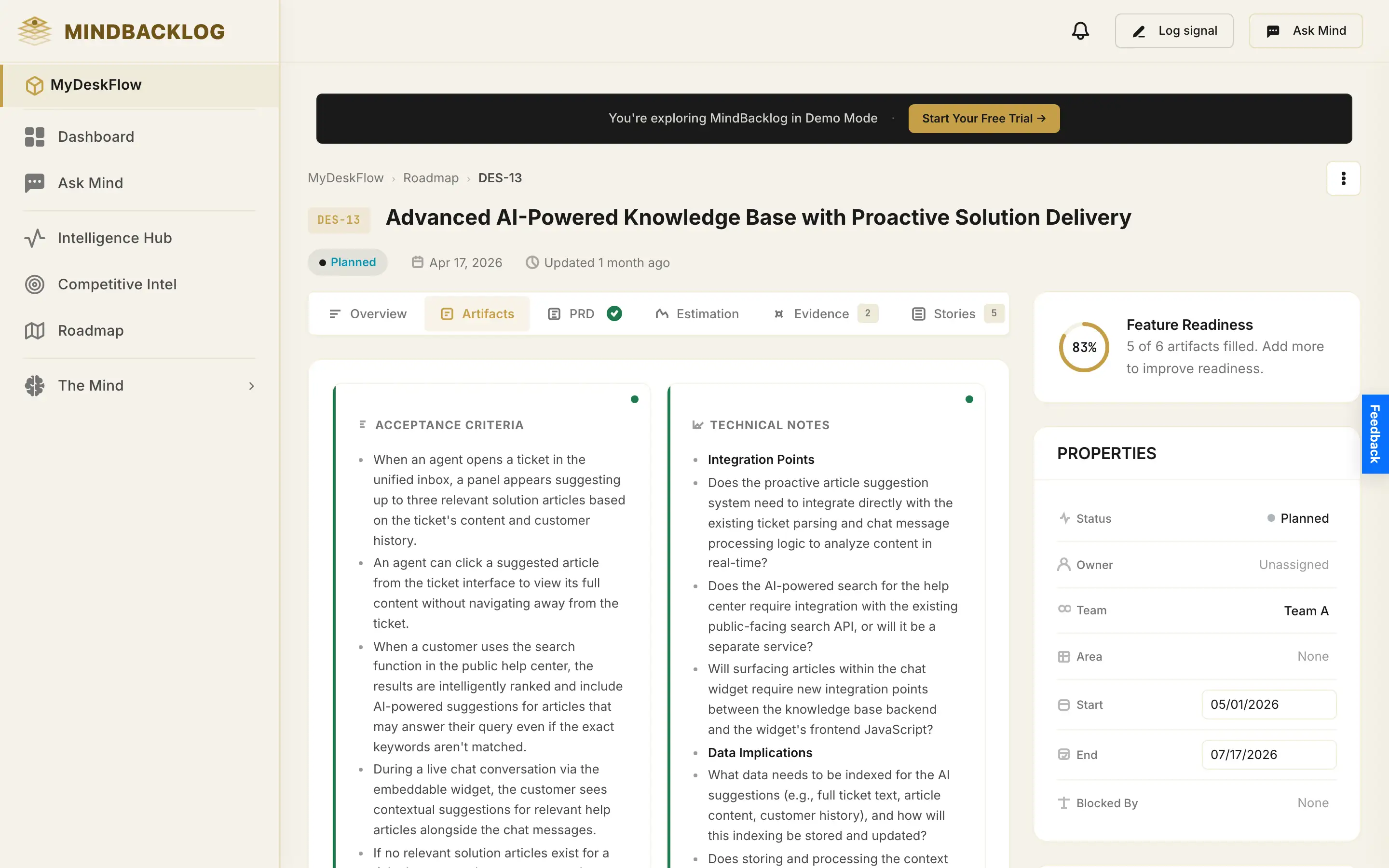
The flagship artifact. PRDs cited by every relevant signal, with competitive context inline and a RICE score at the bottom. Updates as new evidence arrives. Generates in under 30 seconds.
Open the generator →User Story Generator
INVEST-aligned user stories with acceptance criteria — tied to the same customer signals that back the parent PRD. Persona derived from the actual accounts cited, not invented.
Open →Release Notes Generator
Three voices — changelog, blog post, in-app banner — anchored in the signals that prompted each shipped change. The "what changed and why" you can send to customers without a copy-edit round.
Open →Feature Brief Generator
One-page decision document for leadership. Problem, evidence, options, recommendation — short form, same signal layer, faster decision loop. Built for the meeting, not the spec.
Open →Competitive Analysis
Full teardown of any competitor — pulled from public review mining, your own competitive intelligence dashboard, and the gap matrix. Sentiment shifts after ship, feature gaps, review deltas.
Open →Feedback Analysis
A trend report across your signal feed — themes getting louder, sentiment shifts, emerging patterns, channel-by-channel breakdown. The artifact you bring to quarterly review.
Open →Ask Mind for any artifact the six templates don't cover.
Exec summaries, board updates, retro notes, sales battlecards, support reply templates, custom decision docs — anything you can describe, drawn from the same signal layer with the same citation chips. The templates above are the most-used patterns; Ask Mind handles the long tail.
Artifacts are outputs. The intelligence layer is the input.
What flows in. What every artifact carries with it. Where it goes next.
Signal Pipeline & MIND Engine
9+ channels (plus REST API, Zapier, Make) classified in under a second, linked to features, sentiment-scored. Every artifact reads from this layer at generation time — no separate prompt, no model invention.
Citations, RICE, competitive context
Every artifact embeds clickable citation chips, the RICE score from AI Estimation (RICE is the default scoring framework), and competitive context drawn from the Competitive Intelligence dashboard. The evidence trail travels with the document.
Roadmap, Jira, Ask Mind
Living PRDs attach to roadmap items. Jira tickets sync the RICE score and link back to the PRD. Ask Mind references the artifacts in chat answers. The artifact is the proof; the workflow is everywhere.
Artifacts that read the same evidence never contradict each other.
The PRD, the stories, the brief, the release notes — every artifact reads the same MIND engine, so the citations match and the documents agree by construction. As signals accumulate, every artifact gets sharper.
Questions PMs ask about the artifact generators.
Where artifacts are generated. Where they live.
MIND Engine
The persistent intelligence layer that powers every generator. Compounds from day one and gets sharper with every signal.
Learn more →Intelligence Hub
Where signal clusters land. Accept a cluster and an artifact is one click away — PRD, brief, or analysis.
Learn more →RICE Prioritization
Every Living PRD carries the RICE score and the AI-derived estimate. The artifact and the score share one evidence trail.
Learn more →