AI User Story Generator
A blank prompt produces "as a user." This generator starts from your product's evidence — INVEST-aligned, sprint-ready stories with acceptance criteria drawn from the real signals behind each request. Engineers can audit the source.
Story · Bulk export filters
Ready for sprintAs a
Enterprise admin 12 signals
I want to
Filter exports by date range and status
So that
I can run weekly compliance reports without manual cleanup. Acme · Globex
Sprint-ready only if the "why" is real.
Three criteria that separate useful stories from templated text.
The "as a" is a real persona.
Not "as a user." The role comes from the actual signal sources — the enterprise admin on Acme's portal, the mobile-first SMB on the App Store, the support agent in the widget. Persona accuracy collapses when only one channel feeds the generator; native ingest across 9+ channels keeps the "as a" honest.
The "so that" carries the pain.
Acceptance criteria informed by real customer language — the exact phrases users typed, the edge cases they hit, the workarounds they invented. Engineers click any citation and read the Slack thread or App Store review that produced it. The "why" is on the ticket, not stuck in the PM's head.
INVEST-aligned, ready for refinement.
Independent, Negotiable, Valuable, Estimable, Small, Testable — the format is table stakes. The real lift is that refinement starts from a real "why" instead of a guessed one. Engineering stops asking "who actually wants this?" and starts asking the design questions that move the sprint forward.
Every story is a window onto the signal layer — not a static text block frozen the moment it was generated.
What separates a story engineers commit to from one they rewrite in refinement.
A user story is the smallest promise a team makes: who, what, and why, agreed before the sprint starts. The good ones pass INVEST, survive refinement intact, and ship without rewrite. Five rules get them there.
Follow INVEST.
Independent, Negotiable, Valuable, Estimable, Small, Testable. The classic checklist still works. A story that fails any of these is a story engineers will rewrite during refinement. Independent means it can ship without waiting on a sibling story. Negotiable means the build can shift without rewriting the intent. Valuable means a real user benefits when it ships. Estimable means engineering can size it without a discovery spike. Small means it fits one sprint. Testable means QA knows when it is done. Five rules, one acronym, decades of survival in real teams.
Anchor the "as a" in real signals.
The persona is not "as a user." It is the enterprise admin on Acme's portal, the mobile-first SMB on the App Store, the support agent in the widget. Generic personas produce generic stories — and generic stories generate refinement debates about who is actually being served. When the "as a" names a real role drawn from real signal sources, engineering and design walk into refinement with the same picture in their head. The downstream design tradeoffs become specific instead of philosophical.
Make the "so that" verifiable.
The benefit clause is the part teams cut first. It is also the part that matters most in retro — did we deliver what we said we would? "So that I save time" is unmeasurable; "so that I reduce CSV cleanup from 45 minutes to 5 minutes per week" is. A verifiable "so that" forces a measurable outcome into the story, which forces the team to define success before the build instead of after. When the retro comes, the verifiable benefit is the only thing that decides whether the story shipped its promise.
Write acceptance criteria QA can write a test from.
If QA reads the AC and can write a passing test, the AC is concrete. If they cannot, you are not done yet. Use the GIVEN / WHEN / THEN structure when it helps — GIVEN a starting state, WHEN the user does the action, THEN the system responds in a specific verifiable way. Vague AC like "works on mobile" leaves three roles interpreting it differently. Concrete AC like "GIVEN a viewport under 768px, WHEN the export modal opens, THEN the filter controls stack vertically and the submit button remains visible above the fold" is testable.
Trace every story back to a signal.
Stories without evidence are guesses. Stories with signal citations are commitments. Include the linked signals in the story — the engineer can click and verify the customer pain themselves. The citation is more than provenance; it is the answer to the question "why are we doing this?" that always comes up in refinement, in standups, in stakeholder reviews. A story with three named accounts and the channel they came from is a story the team will defend. A story with no evidence is a story the team will quietly deprioritize.
A story that does these five things does not get re-litigated in refinement.
Why most user stories burn a refinement cycle.
Stories fail in the same five ways on every backlog. Avoid them and the story goes from refinement to sprint untouched.
"As a user" with no role.
The most common failure. A generic persona produces a generic story. Engineering reads "as a user" and has no anchor for the design decisions — should this work on mobile? Does the persona use the keyboard? What workspace size do they operate in? Always name the role from the actual signal sources. An enterprise admin on a multi-product workspace and a solo founder on the free tier need different builds, even when the headline feature is identical.
Solution disguised as story.
"As a user I want a date filter dropdown" is a solution. "As an admin I cannot find recent exports, so I run reports manually each week" is a story. The first prescribes the build; the second protects the engineer's freedom to find the right build. When the story names the pain, the team can argue the implementation. When the story names the implementation, the team is locked into someone's first guess at the build — usually the PM's.
Missing or vague acceptance criteria.
A story without AC is an invitation to scope creep. A story with vague AC ("works on mobile") leaves QA, design, and engineering all interpreting it differently — and the bug filed on the released feature surfaces the disagreement after it is too late. Spell it out. Concrete AC is the smallest possible artifact that can fail or pass cleanly. If it cannot fail, it is not a criterion; it is a wish.
No estimate signal.
Stories without any sizing guidance — even rough ones — go into refinement cold and burn a sprint of debate before settling on a number. Include the historical effort comp ("similar to the export feature we shipped in March") so engineering has a starting point. The comp does not bind the team to a number; it gives them a benchmark to argue against. Cold estimation is the most expensive form of estimation a team can do.
Orphan stories with no parent feature.
A story floating without a parent feature, PRD, or theme is impossible to prioritize. Without a parent it cannot inherit a RICE score, it cannot be weighed against sibling work, and it cannot be traced to the customer evidence behind it. Always anchor the story to its feature and the feature to its evidence trail. Orphan stories quietly age in the backlog until someone deletes them, because nobody can defend why they exist.
Three sprint-ready stories from one feature.
Same feature ("bulk export filters"), three INVEST-split stories — each cited, each independently shippable.
Story 1 · Date range filter on bulk export
Ready for sprint · 3 ptsAs a
Enterprise admin on a multi-product workspace 12 signals Acme · Globex · Beta Inc
I want to
Filter the bulk export by a custom date range before downloading
So that
I can run weekly compliance reports without 45 minutes of CSV post-processing each Monday. Portal · Acme CFO
Acceptance criteria
AC1: Date range picker accepts start/end with relative shortcuts (last 7/30/90 days). AC2: The downloaded CSV holds only rows inside the selected range — nothing left to strip by hand. AC3: Empty range produces a clear empty-state, not a malformed CSV. Edge case · App Store review
Story 2 · Named views for recurring exports
Ready for sprint · 5 ptsAs a
Enterprise admin who runs the same export weekly 8 signals Slack · #customer-success
I want to
Save a filter combination (date range + owner + tag) as a named view
So that
I do not reconfigure the same filters every Monday and can share the view with my team. Widget · Globex Ops
Acceptance criteria
AC1: Views are workspace-scoped, named, and editable. AC2: Each named view has a URL teammates in the workspace can open. AC3: Default view falls back to last-used filters. UX edge · Portal
Story 3 · Scheduled export delivery to email
Ready for sprint · 5 ptsAs a
Finance lead who never logs into the product dashboard 6 signals Email · 3 enterprise accounts
I want to
Receive the saved-view export as a CSV attachment on a weekly schedule
So that
I get the compliance report in my inbox without depending on the admin to remember to run it. Acme CFO · 3 follow-ups
Acceptance criteria
AC1: Schedule frequency: weekly, biweekly, monthly. AC2: Recipient list is workspace-validated. AC3: Failed delivery surfaces in the workspace activity log. Compliance · Acme
Every citation chip opens the source signal in the live workspace. Engineers verify the "as a" and "so that" against real customer language before refinement.
The story has receipts.
General AI writes the format. The intelligence layer writes the content.
No persistent product memory
ChatGPT does not remember which personas use your product, which workflows they care about, or what edge cases the last sprint surfaced. The MIND engine holds every signal your channels have sent — each story inherits that context automatically.
No signal citations
A story without citations is a PM's opinion in story format. Every MindBacklog story carries citation chips — name, channel, date — that engineers and designers can click during refinement to read the original customer language.
No competitive context
Acceptance criteria often hinge on what users expect from comparable products. Competitive Intelligence mines public reviews continuously — so when a competitor shipped a similar feature with a known weakness, the AC includes a guardrail against that weakness automatically.
No multi-channel ingest
A story informed only by one channel misses the enterprise asks in Slack and the consumer frustration in App Store reviews. The signal pipeline ingests 9+ channels (plus REST API, Zapier, Make) so every persona and pain point is weighted against the full evidence base.
From raw signals to sprint-ready stories in 30 seconds.
Four steps. Capture and classification run on their own — you only step in to generate.
Connect your channels.
Slack, Email, App Store, Google Play, Public Portal, Feedback Widget, Web Scraper, Web Form, Reddit — plus REST API, Zapier, Make. Each channel connects in minutes. Each signal lands with channel and account attribution intact — the raw material for the "as a" and the citation chips on every story.
Every signal tagged with persona and pain.
The pipeline classifies signal type, links to the parent feature, identifies the persona (enterprise admin vs end user vs finance lead), and extracts the underlying customer pain. By the time you generate stories, the persona library is already built.
"Generate sprint-ready stories for [feature]."
Open Ask Mind from the side panel and ask for stories on the feature. The engine pulls every signal classified against it, splits the work along INVEST lines, and drafts acceptance criteria from the edge cases surfaced in real signals.
Stories delivered with citations attached.
3-7 independently shippable stories. Every story has a persona drawn from signals, a "so that" that reflects real customer language, and acceptance criteria informed by edge cases in the evidence. Push to Jira via the LIVE bidirectional sync.
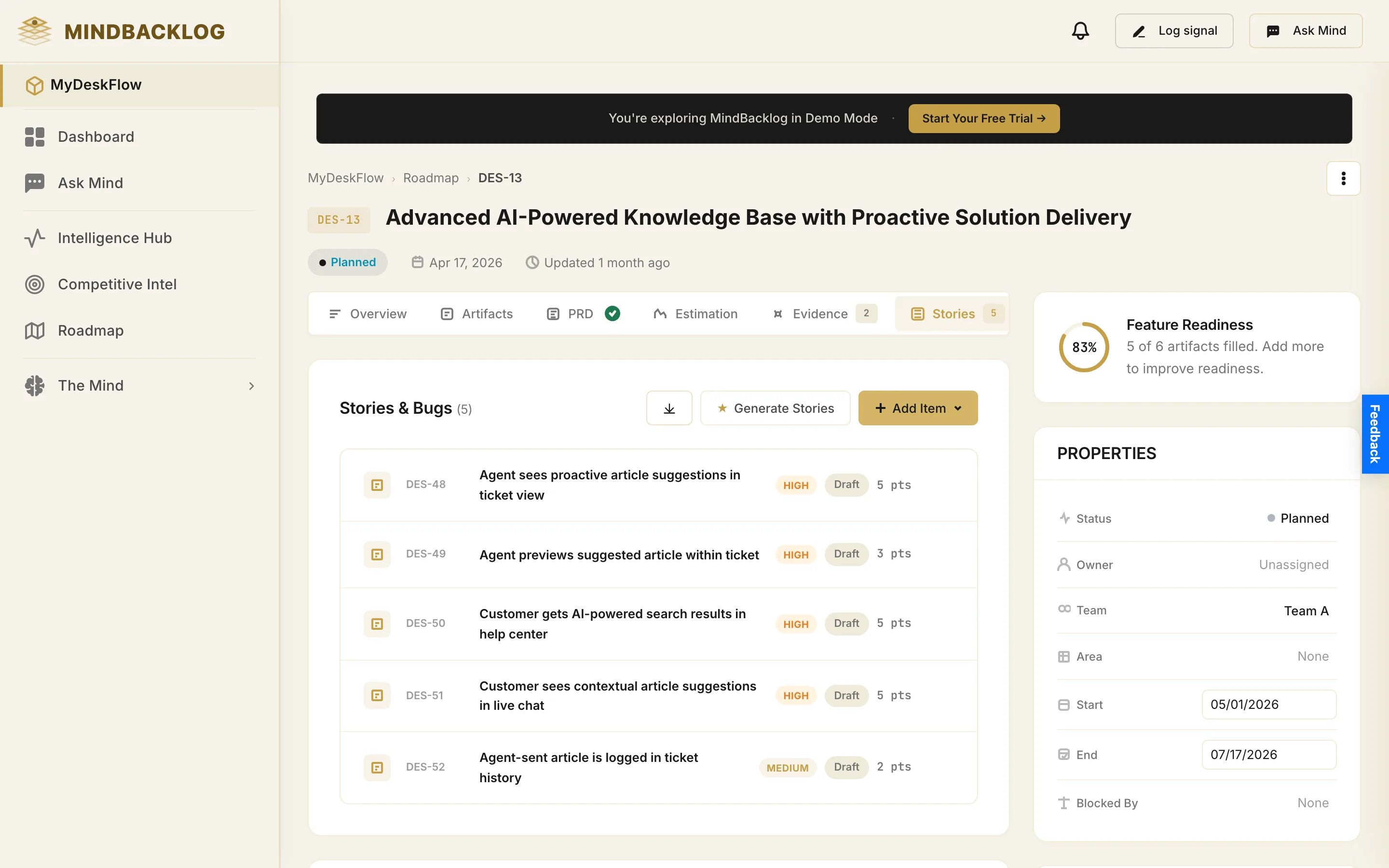
Where evidence-backed stories earn their sprint slot.
Six sprint workflows where the citation does the convincing.
Friday backlog refinement, no last-minute research.
Refinement turns into a story workshop, not a discovery session. Engineers read the citation chips before the meeting and arrive with technical questions instead of "why does the user want this?" Refinement runs short because discovery already happened.
Splitting a feature into shippable increments.
Ask Mind splits the feature along INVEST lines automatically. The first story usually ships standalone — the rest are sequenced by signal weight, so the version 1 release addresses the loudest customer pain, not whichever ticket happened to get picked first.
AC drawn from real edge cases.
Acceptance criteria written from imagined edge cases miss the ones customers actually hit. Pulling AC from the signal layer surfaces the empty-state bugs, the timezone issues, the locale problems — because customers have already mentioned them in the channels.
Customer-reported issues become stories with context.
When a bug signal hits 3+ accounts, the generator turns it into a fix story with the affected personas, the workflow context, and the AC for the fix — all pulled from the original conversations. The bug ticket arrives in the sprint with the customer impact attached.
Writing 30 stories in an afternoon.
A solo PM writing 30 stories from scratch is two days of prose. Drawn from the signal layer, the same 30 are an afternoon of edits — each arriving INVEST-split, persona-named, and cited. The synthesis happens once in the system, every story inherits the same evidence bar, and the backlog stays sprint-ready week to week.
Stories sync to Jira with citations preserved.
The bidirectional Jira sync (LIVE) pushes stories directly into the backlog with the citation chips intact. Engineers stay in Jira, but they can click any citation to jump back to the source signal in MindBacklog. Product intelligence lives in MindBacklog, execution stays in Jira.
Stories pull from the same signal layer as the parent Living PRD.
Stories share the persistent intelligence layer with the parent Living PRD, the RICE default score, Competitive Intelligence, and Ask Mind — signals across 9+ channels classified in under a second and threaded into the persona, the customer pain, and the edge-case AC. Every new signal sharpens the next regeneration. The story compounds from day one because the layer underneath does.
Questions PMs ask about the user story generator.
Other artifacts from the same signal layer.
Living PRD Generator
The parent document — cited by real signals, with competitive context and RICE score. Stories inherit its evidence layer.
Read →Release Notes Generator
Once the stories ship, generate changelog, blog, and in-app voices that cite back to the signals customers sent in.
Read →Feature Brief Generator
One-page briefs for leadership review — same evidence layer, shorter format, faster decision loop.
Read →Go deeper on the category behind the story.
What is product intelligence?
The category that powers Living user stories and PRDs.
Read pillar →Living PRD Generator
Stories live inside PRDs. The PRD generator is the parent artifact in the same evidence chain.
Read →Glossary
Definitions of Signal, MIND Engine, Living PRD, Evidence-Based Prioritization, and other category terms.
See glossary →Deeper reading on the craft.
Build what's right. Prove why.
Your first sprint-ready stories, from your URL.
Explore a sample workspace →