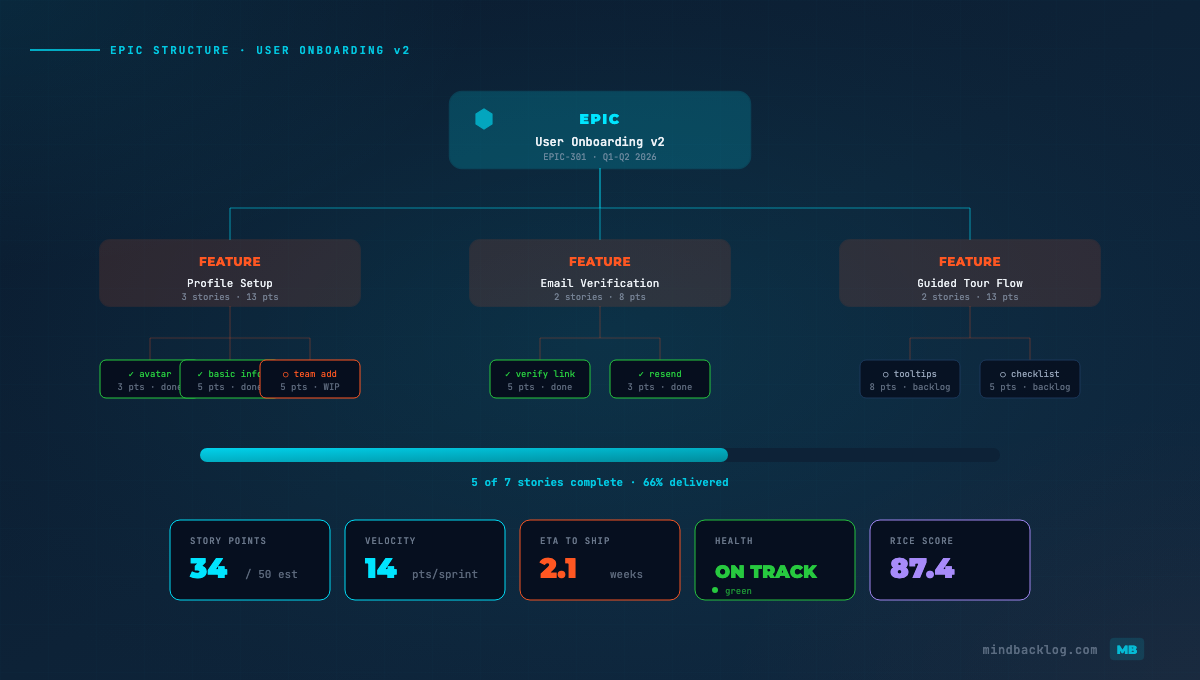
EPICs are one of the most misused concepts in product management. In theory, they serve a critical organizational function: grouping related features into a coherent strategic theme that can be planned, tracked, and communicated as a unit. In practice, most EPICs are either too broad (a catch-all bucket like ‘Platform Improvements’ containing thirty unrelated features) or too narrow (essentially duplicating the feature level with no added value). Both failures undermine the purpose EPICs are meant to serve.
The root cause is that EPICs are typically created reactively — someone needs a grouping for a roadmap presentation or a Jira hierarchy, so they slap a label on a collection of features and call it an EPIC. This approach produces EPICs that are organizational artifacts rather than strategic tools. A well-designed EPIC should answer a specific question: ‘What customer outcome or strategic goal does this collection of features collectively deliver?’ If the answer is vague or requires extensive explanation, the EPIC is poorly defined.
The Outcome-Based EPIC
The most effective EPIC design principle is to group features by shared outcome rather than by shared product area, technology, or theme. An outcome-based EPIC answers: ‘When all features in this EPIC are complete, what will be true for the customer or the business that is not true today?’
Consider the difference. A product-area EPIC like ‘Search Improvements’ might contain a performance optimization, a new filter type, a saved search capability, and a search analytics dashboard. These features share a product area but may serve different users, different workflows, and different strategic goals. An outcome-based EPIC like ‘Enable Customer Success Managers to Find At-Risk Accounts in Under 30 Seconds’ contains the same features but organized around a measurable outcome. The outcome orientation forces clarity about what success looks like and which features are actually necessary to achieve it.
Outcome-based EPICs also have a natural completion criterion. The EPIC is done when the outcome is achieved — not when an arbitrary set of features has been shipped. This prevents the common problem of EPICs that are never ‘complete’ because new features keep getting added without a clear endpoint.
The Right Granularity
An EPIC should contain three to seven features. Fewer than three, and the EPIC is probably just a feature in disguise. More than seven, and the EPIC is probably too broad and should be split into two or more focused EPICs.
Each feature within the EPIC should be independently deliverable — it should provide value on its own, even if the full EPIC outcome requires all features. This independence enables incremental delivery: the team can ship Feature A from the EPIC, deliver immediate customer value, and continue working on Features B and C. If the EPIC is designed such that no individual feature provides value until all features are complete, the EPIC is too tightly coupled and should be restructured.
The features within an EPIC should share a common user or user journey. If the EPIC contains features that serve entirely different user segments (one for admins, one for end users, one for API consumers), it is probably grouping by theme rather than by outcome. Split it into separate EPICs for each user segment.
Naming Conventions That Communicate
EPIC names should communicate the outcome, not the implementation. Names like ‘Search v2’ or ‘Q3 Backend Work’ tell stakeholders nothing about what will change for customers. Names like ‘Reduce Account Lookup Time for Large Teams’ or ‘Enable Self-Service Enterprise Onboarding’ communicate the customer impact immediately.
A useful template for EPIC names is the verb-outcome format: ‘Enable [user] to [outcome]’ or ‘Reduce [pain point] for [user segment].’ This format forces the creator to articulate who benefits and how, which often reveals whether the EPIC is coherently designed. If you cannot write the name in this format, the EPIC may need restructuring.
How AI Suggests EPIC Groupings
As the feature backlog grows, manually identifying the right EPIC groupings becomes increasingly difficult. AI can assist by analyzing the relationships between features — their shared customer signals, their overlapping product areas, their common user segments, and their collective contribution to strategic objectives.
When a PM creates a new feature, the system can suggest which existing EPIC it belongs to based on semantic similarity with the EPIC’s other features. If no existing EPIC is a good fit, the system can suggest creating a new EPIC and recommend other backlog features that should be included. This AI-assisted grouping ensures that EPICs remain coherent as the backlog evolves, rather than gradually becoming catch-all buckets as new features are added without careful evaluation.
The AI can also flag EPICs that have grown too large (more than seven features), too dispersed (features with low semantic similarity to each other), or too stale (EPICs where no features have been updated in months). These flags help the PM maintain EPIC hygiene over time.
EPIC-Level Data: Aggregation, Not Duplication
One of the most common EPIC management mistakes is manually maintaining data at the EPIC level that should be automatically derived from child features. EPIC completion percentage, total signal count, estimated effort, and status should all be calculated from the features within the EPIC — not manually entered and maintained separately.
When EPIC data is derived, it is always current and always consistent. When Feature C within the EPIC moves to ‘Shipped,’ the EPIC’s completion percentage updates automatically. When new signals are linked to Feature A, the EPIC’s total signal count increases. This automatic aggregation eliminates the maintenance burden that causes most EPICs to have outdated, unreliable metadata.
|
MindBacklog supports EPIC-level grouping with AI-suggested feature relationships, auto-aggregated data from child features, and dependency visualization on the Timeline view. Organize your features with purpose. Start at mindbacklog.com. |
Ready to put your product intelligence on autopilot? Start your 14-day free trial at MindBacklog.com — no credit card required.


