- Home
- Blog
- Customer Discovery
- Leading questions: examples that ruin a customer interview
Leading questions: examples that ruin a customer interview
A leading question hands people the answer you want. Six patterns that skew customer interviews, the quiet follow-ups, and how to rewrite each one.
On this page
A leading question carries the answer you hope for, so the person agrees with you instead of telling you what happened. In a customer interview, that turns their account into yours, and you leave with agreement you can’t build on. The examples below share one fix: ask about a specific past event in neutral words, then let them talk.
- A question leads when its wording, its premise or what you said just before it points to one answer.
- The common patterns do one of three things: suggest the answer, ask for a prediction or bundle two questions.
- The quiet ones are follow-ups: a summary with a spin, an assumed problem, a false choice, your own reaction.
- An answer you led counts as praise, however strong it sounds.
Why a leading question ruins the answer
Courtrooms have a rule for this. A lawyer questioning their own witness usually can’t lead, because the answer would really be the lawyer’s testimony. Customer interviews work the same way, except nobody objects.
So you have to catch it yourself. The cost is quiet. You finish ten calls with pages of agreement, and none of it tells you whether the problem costs enough to pay for a fix.
For example, a founder building a booking tool for yoga studios asks ten owners, “Are no-shows a big problem for you?” All ten say yes. Nobody was asked what they did about the last one, so the founder still can’t tell a small annoyance from a real cost.
Six leading question examples, grouped by what they do
The same six patterns turn up again and again in early interviews. The table uses the yoga studio example. The customer interview questions guide covers each rule in depth, with a 15-question script you can copy.
| Pattern | Leading | Neutral |
|---|---|---|
| Loaded word | “Isn’t it stressful when people don’t show up?” | “What happened the last time someone missed a class?” |
| Ending on “right?” | “You’d want automatic reminders, right?” | “How do clients find out when a class changes?” |
| What others think | “Most owners say no-shows are their worst problem. Same for you?” | “What’s the hardest part of running the schedule this month?” |
| Future hypothetical | “Would you charge a late-cancel fee if an app did it for you?” | “When did you last charge someone for cancelling late?” |
| Naming your product | “I’m building Stretchly, which fills waitlist spots. Would that help?” | “Walk me through what happens when a class fills up.” |
| Two in one | “How do you take bookings, and what would you change?” | “How do you take bookings?” Then, later: “Which step takes longest?” |
Questions that suggest the answer
Loaded words, a trailing “right?” and other people’s opinions all tell the person which answer is polite. Agreeing costs nothing. Disagreeing means correcting a stranger who’s clearly excited, and most people won’t.
Questions that ask for a prediction
Hypotheticals and pitches ask people to forecast their own behaviour. Forecasts are free and nobody checks them later, so they come out kind. Once your product has a name in the conversation, every answer bends toward it.
Questions that hide the real question
A two-part question lets the person answer the easier half. That’s usually the second half, which is often the speculative one. Ask the factual part, wait, and ask the next part only after they finish.
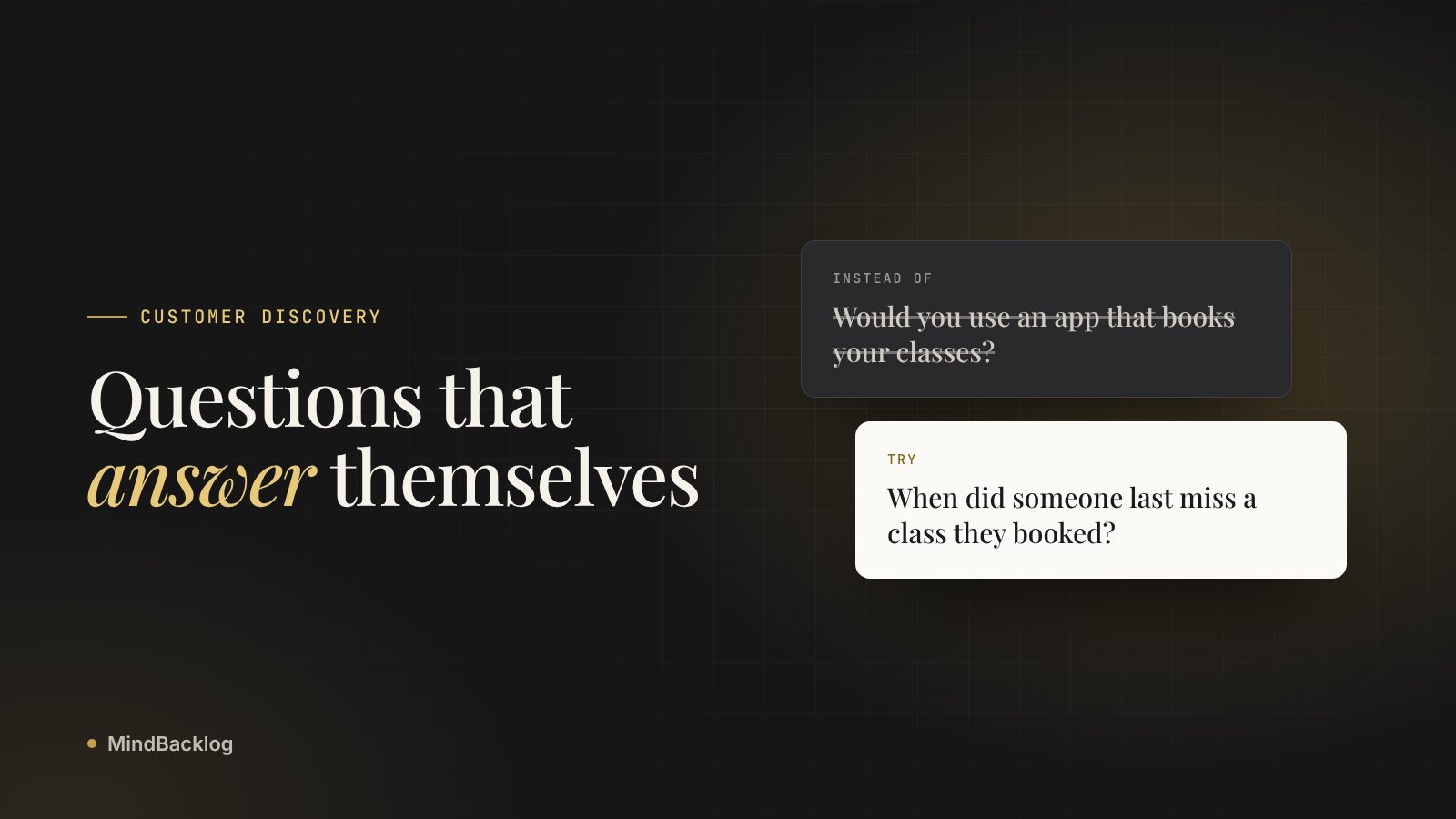
- Isn't it stressful when people no-show?
- You'd want reminders, right?
- Would you use a booking app?
- Most owners hate no-shows. You too?
- What happened at the last no-show?
- How do clients hear about changes?
- How do bookings come in today?
- What's hardest about the schedule?
The leading questions that don’t look like questions
Founders who’ve fixed the six patterns still lead, mostly in follow-ups. These feel like good listening, which is why they slip through.
- A summary with a spin. “So no-shows are killing your margins.” They agree to be polite, and you’ve written your own quote.
- An assumed problem. “How many hours a week do you lose to rebooking?” assumes they lose hours at all.
- A false choice. “Do clients book by text or through Instagram?” leaves out the paper sign-up sheet at the front desk.
- Your reaction. An excited “oh, nice” after the answer you wanted teaches them what to say next.
“So it sounds like no-shows are a nightmare for you.”
“You said ‘a few a week’. Tell me about last week’s.”
Repeat their exact words, then ask for the story behind them. For the other three, ask what happens next instead of how much it hurts, ask how bookings come in instead of offering options, and give every answer the same flat “got it”.
Find the leading questions in your own transcript
You won’t catch every one live, so catch them afterwards. Open the transcript, search your own lines for these, and mark the answer that came right after each hit.
- “Would” or “could”, which usually marks a hypothetical
- “Right?”, “isn’t it” or “don’t you think” at the end of a line
- Your product’s name, or a description of it, and when it first came up
- Feeling words: frustrating, painful, annoying, a nightmare
- “Most people” or “other owners”
- Two question marks in one turn
Rewrite each hit as a question about a specific past event, and use the rewrite on your next call. Each transcript then improves the next script.
Note. Not every closed question leads. “You said three people missed Tuesday’s class. Was that a normal week?” checks a fact they gave you. It only leads when the fact came from you.
Count every led answer as praise
An answer to a leading question tells you about the question. A strong “yes, it’s a nightmare” after “isn’t it a nightmare?” is your sentence in their voice.
The evidence ladder grades a belief by what people did, from praise up to paying. A led answer sits on the bottom rung with compliments, and praise never moves a belief. Only answers to neutral questions about things that happened can count as past pain.
Early in a call, the yoga founder asks, “Isn’t it annoying when people no-show?” The owner says, “So annoying. It happens constantly.” That quote is praise. Later the founder asks, “What happened with the last no-show?” The owner says, “Tuesday’s 6am class had three empty mats. I texted all three, nobody replied, and I stopped chasing.” That one is past pain: a real event, a workaround and a cost, given in answer to a neutral question.
Keep their words, not your summary. Drop a transcript and Mind keeps every piece in their words.
Start free trialDoing this in MindBacklog
Drop anything: a thread, a transcript, a CSV. Mind shows where it’ll go before filing it, and keeps every piece in their words. Track what you believe and how strong the evidence is: praise never counts as proof, and a test’s pass line is set first. How beliefs and evidence work.
Questions
What is an example of a leading question?
“Wouldn’t it be easier to book classes on your phone?” is a leading question. It names the answer it wants (easier, on the phone) and makes yes the polite reply. A neutral version asks what happened: “How did your last three clients book?”
Are leading questions ever OK in a customer interview?
Yes, in two places. You can confirm a fact the person already gave you, and you can ask directly for a commitment at the end. “Can I show you a draft next Thursday?” is direct on purpose, because a yes costs them time.
What’s the difference between a leading question and a closed question?
A closed question has a short answer, such as yes, no or a number. A leading question signals which answer you want. “How many classes did you run last week?” is closed but neutral, while “You ran a full schedule last week, right?” is closed and leading.