- Home
- Blog
- Customer Discovery
- Customer discovery for founders who can build in a weekend
Customer discovery for founders who can build in a weekend
When building takes a weekend, knowing what to build is the hard part. A one-week customer discovery loop for founders who build with Claude Code or Cursor.

On this page
- Why fast building makes discovery matter more
- A one-week customer discovery loop
- Find five people who have the problem this week
- Ask about last week, not about your app
- Keep every call, thread and CSV in one place
- Count people, not mentions
- Check before you open Claude Code
- Doing this in MindBacklog
- Questions
Customer discovery means finding out who has a problem, what they do about it today and whether it costs them enough to change, before you build the fix. When Claude Code or Cursor can turn an idea into an app over a weekend, discovery matters more, because building is no longer the slow part. A one-week loop of calls, saved quotes and one small ask tells you what’s worth the weekend.
- Cheap building moves the risk from “can I build it” to “should I”.
- Run discovery as a one-week loop: one problem, five calls, saved quotes, a count, one ask.
- Keep people’s exact words, and count people rather than mentions.
- Open your editor once someone has done more than say they like it.
Why fast building makes discovery matter more
A weekend build feels free, and the first version nearly is. The cost arrives later. Every feature you ship is code to maintain and one more thing an agent can break when it changes something nearby.
The second cost is attention. A founder with a working prototype starts defending it, and calls turn into demos. Demos produce compliments, and compliments feel like evidence.
The question changes from “can I build this” to “should I”. Your editor can’t answer that one. Only the people with the problem can.
A one-week customer discovery loop
This loop fits around building. It takes a few hours spread across the week, and it ends with a decision.
- Monday: write the problem and one belief. One sentence on who has the problem, and one thing that must be true for your idea to work.
- Monday: book five calls. Find people who have the problem now, where they already gather. Friends and other founders don’t count unless they have it.
- Tuesday to Thursday: hold the calls. Ask about the last time the problem happened. Keep your product out of it until the final minutes.
- Same day: save their exact words. Paste the transcript or notes with who said it and when. Mark any quote that came after you described your idea.
- Friday: count and rank. Group the quotes into problems and count how many different people raised each one.
- Friday: ask for something. Go back to the people with the top problem and ask for a second call, an intro or a spot on a waitlist.
Then run it again with a sharper belief. After a couple of loops, the problem either keeps coming up from people you didn’t know, or it fades.
For example, a founder building a stock-tracking app for small coffee roasters writes this belief: “Roasters with one or two staff run out of green beans because they track stock on paper.” On Monday she messages roasters from a trade group she belongs to. By Thursday she’s had five calls. Three describe a recent run-out without being asked. Two track stock fine in a spreadsheet and don’t want anything new.
Find five people who have the problem this week
Booking the calls is the step that’s easiest to put off. Look where the problem already gets discussed, and ask for a short call about their experience rather than a demo.
- People who already wrote to you, replied to a post or joined a waitlist
- Communities and trade groups where your users ask each other for help
- Your own network, filtered to people who have the problem now
- An intro at the end of every call: “Who else deals with this?”
Say who you are and that you’re building something, in one line. Then make the ask about them. “Can I ask how you track stock today? Twenty minutes, no pitch.” is an easier yes than a link to your landing page.
Ask about last week, not about your app
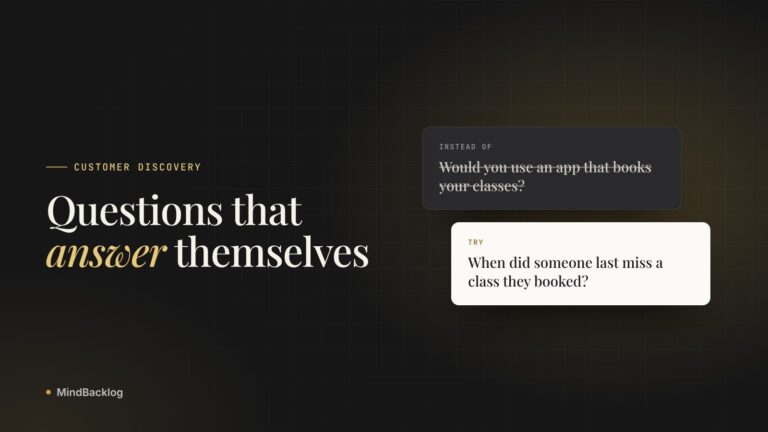
Builder founders are tempted to share the prototype in the first minute. Leave it closed. Ask about what happened, and save the demo for the end, when you can use it to ask for a next step.
“I built an app that tracks bean stock. Would you try it?”
“Tell me about the last time you ran low on green beans.”
Then follow the story: what they did next and what it cost them. The customer interview questions guide has the full set, with a script by stage and how to record consent.
Keep every call, thread and CSV in one place
Discovery input scatters fast. Call recordings sit in one app, DMs in another and a survey export in your downloads folder. Put each piece in one place the day it arrives, in the person’s words.
Your summary of a call is a guess about what they meant. The transcript is what they said. When you come back in a month to decide what to build, you’ll want the transcript.
Who:        roaster, 2 staff, sells to 6 cafés
When:       call, 12 Nov
Quote:      "Ran out of the Colombian on a Friday. Drove two hours to a supplier."
Prompted:   no
Workaround: paper stock sheet on the fridge
Problem:    running out of green beans
Count people, not mentions
One roaster who mentions run-outs six times is one person. Rank problems by how many different people have them, and keep a note of who they are.
| Source | What it shows | Watch for |
|---|---|---|
| Call transcript | The story behind a problem, in their words | Quotes that came after you pitched |
| Support thread or DM | A problem that hurt enough to write in about | One person writing many times |
| Survey CSV | How common an answer is | Answers to leading questions |
| Public post or review | What strangers say about the problem or a competitor | People who aren’t your users |
With five calls, every count is tiny, so read it as a lead to follow. A problem three of five people raised unprompted earns a second week. A problem one person raised earns a note.

Check before you open Claude Code
- Several people described the problem from their own recent past
- You can say what they do about it today and what that costs
- Their words are saved, with who said them and when
- At least one of them gave you time, an intro or a waitlist sign-up
- You can name the people you’d show the first version to
Then hand your agent the problem, the people and the quotes. The page for founders building with Claude Code or Cursor covers that step.
See what discovery hands your coding agent. A sample Build Pack where every section names its source.
See a sample Build PackDoing this in MindBacklog
Drop anything: a thread, a transcript, a CSV. Mind shows where it’ll go before filing it, and keeps every piece in their words. Every piece of feedback is sorted into problems ranked by who has them, with the quotes behind each, and public posts and competitor reviews are shown, never counted. Under 30 pieces of feedback, Mind says “Not ranked” instead of guessing. How feedback comes in.
Questions
What is customer discovery?
Customer discovery is the work of learning who has a problem, how they handle it now and what it costs them, before you build. It’s the first stage of Steve Blank’s customer development method. In practice it means conversations about people’s recent past, saved in their words.
How many customer discovery interviews do you need?
There’s no fixed number. Start with five people who have the problem now, then keep going until new calls stop changing what you believe. If every call surfaces a different problem, narrow who you’re talking to before adding more calls.
Should you do customer discovery after building a prototype?
Yes. Ask about their past first and keep the prototype out of the conversation until the end. Show it only to ask for a next step, such as a trial week or an intro. Shown early, it turns the call into a demo.