- Home
- Blog
- Customer Discovery
- How to test willingness to pay before you have a product
How to test willingness to pay before you have a product
Asking what people would pay gets you a guess. How to test willingness to pay with priced pages, deposits and pre-orders before the product exists.
On this page
To test willingness to pay before you have a product, ask people to do something that costs them, with a real price in front of them. Asking what they would pay gets you a guess. A priced page shows who stays interested after seeing the number, and a deposit or pre-order shows who will actually spend.
- “What would you pay?” gets a guess, and usually a polite one.
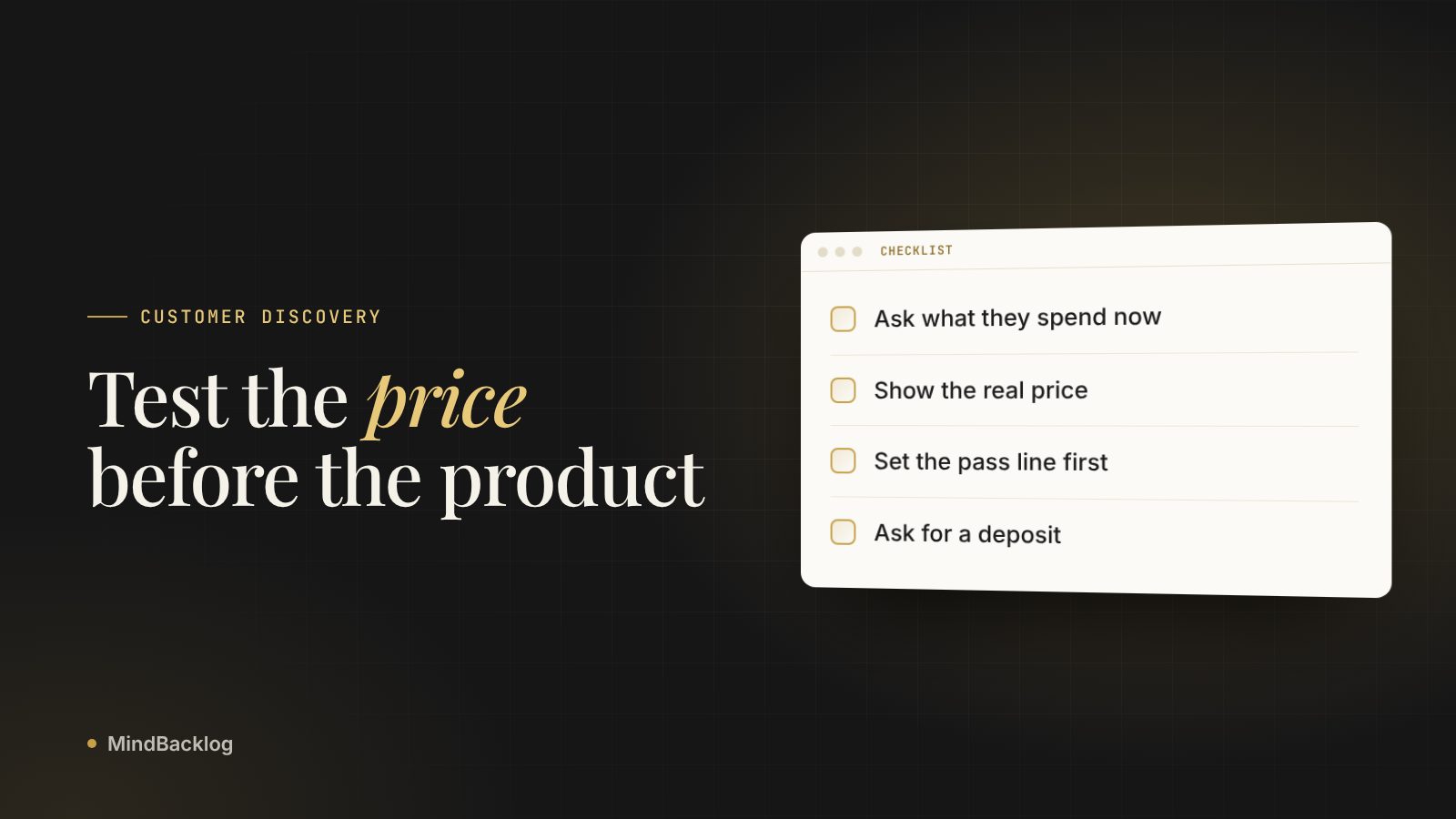
- Ask what they spend on the problem now. That’s a fact.
- A page with the real price filters out people who only liked the idea.
- A refundable deposit or a pre-order is the strongest test before launch, read against a pass line you set first.
Four ways to test willingness to pay, weakest first
Each method asks a little more of the buyer. The more it costs them, the more the result tells you.
| Method | What it costs them | What it shows |
|---|---|---|
| Asking about price | Nothing | What they’re willing to say |
| A page with the real price | A click, maybe an email | Whether the number puts them off |
| Refundable deposit | Money they can get back | Whether they’ll get a card out now |
| Pre-order | The real price, paid early | Whether they’ll pay full price for a date |
The examples below follow a founder building a scheduling tool for small physiotherapy clinics. The product doesn’t exist yet. She has talked to a dozen clinic owners about missed appointments.
- Price questionWords, costs nothing
- Priced pageA click after the number
- DepositMoney, refundable
- Pre-orderFull price, paid early
Ask what they spend now, not what they’d pay
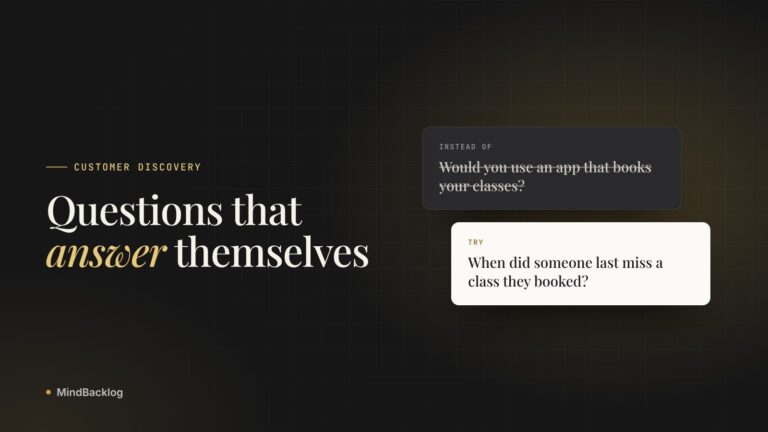
“How much would you pay for this?” asks for a prediction about a product they haven’t seen. Some people lowball to sound careful. Others name a friendly number to sound supportive. Neither tells you what happens at checkout.
“What would you pay for an app that fills cancelled appointments?”
“What did it cost you last month to fill cancelled slots?”
Current spend is a fact, and it shows the budget you’d compete for, such as a receptionist’s hours or a texting service. If a clinic spends nothing and shrugs at the gaps, your price has to beat doing nothing, which is the hardest sale there is.
If they name a number first, write it down. A number you suggested and they agreed with is your number.
Put the real price on a page
A landing page with the price on it filters for people who’ve seen the number. Write the price the way you’d charge it: per month, per clinician, billed monthly or yearly. Then count what happens after the price, not before it.
- The price and billing period sit above the button
- The page says what they get on day one, not the roadmap
- The button names the next step, like “Reserve a founding spot”
- A plain line after the click says it isn’t built yet
- One traffic source per test, so you know who you counted
A click is interest in a label. It costs nothing and usually has no name attached. An email left after you’ve said it isn’t ready is someone asking for access, a real step up but still short of money.
Ask for a refundable deposit
A refundable deposit is the cleanest willingness to pay test before launch. It asks for real money and gives the buyer an easy way out. That keeps the ask small enough to say yes to, and a card still had to come out.
For example, the physio founder offers clinic owners a founding spot at 60 dollars a month per clinician. They pay a 100 dollar deposit now, refundable until launch and taken off the first bill. She sends the offer only to owners who described losing money to no-shows.
Write down every reason for a no
The moment you ask for money, people tell you things they never said on the discovery call. Record each reason with the person and the date.
- “I’d need to check with my business partner.” Someone else decides. Find out who, and whether you can talk to them.
- “Not until it does online booking.” A must-have you didn’t know about. Count how many people name the same one.
- “That’s more than I pay for anything else.” They’re comparing you with their other tools instead of with the cost of the problem.
- “Maybe in the spring.” Timing. Ask what changes in the spring.
Refund requests work the same way. Each one comes with a reason, and the reason tells you what the page or the price got wrong.
Sell a pre-order with a date on it
A pre-order asks for the first month or year up front, for a product delivered on a date you name. It’s a stronger test than a deposit, because the amount is the real price. It’s also a promise. Offer one only when you’re confident you can ship by the date, and say what happens if you can’t.
For the physio tool, that might be the first year at the founding rate, paid now, with the product live by 1 April. If the date slips, tell buyers before it passes and offer the refund again.
Set the pass line before anyone sees the price
Decide what counts as a pass before the first offer goes out: how many payments, from whom, by when. Write down what you’ll do on a pass and on a miss. Without a line, any result can look like a signal, and three deposits feel promising when you’d hoped for eight.
Belief:     Clinic owners will pay 60 dollars a month per clinician.
Test:       refundable deposit of 100 dollars, taken off the first bill
Who:        the 12 owners who described losing money to no-shows
Pass line:  5 deposits by 15 January
On a pass:  build reminders and the waitlist first
On a miss:  call everyone who said no before changing the price
On the evidence ladder, money paid through a test whose line was set first reaches the top rung, Pays. Price answers in calls stay at praise, however keen they sound. A firm commitment short of money, like a booked onboarding call, moves a belief partway.
Note. Taking money for something that doesn’t exist yet comes with obligations. Say plainly that it isn’t built, say when it should be, and refund anyone who asks.
If you’re earlier than this and still looking for the problem, the page for founders with an idea and no users yet covers what to learn before you ask about price.
Write the pass line before the offer goes out. Track each belief and how strong the evidence behind it is.
See how it worksDoing this in MindBacklog
Track what you believe and how strong the evidence is. Praise never counts as proof, and a test’s pass line is set first. Who paid, who wrote in, who talked with you: every touch is dated and sourced, with whether you may contact them. How beliefs and tests work.
Questions
How do you measure willingness to pay?
Measure what people do with a real price in front of them. A deposit, a pre-order or a paid pilot counts. Answers to “what would you pay?” can help you pick a starting price, but they don’t show that anyone will pay it.
How big should a deposit be?
There’s no standard figure. Pick an amount that takes a card to pay and that you can refund without strain, and tie it to the real price so the result tells you about the price itself. Keep it refundable.
Does a waitlist sign-up show willingness to pay?
No. A sign-up shows someone wants access, and it says nothing about price. Follow up with a priced offer to the people on the list, and count only the ones who pay.