On this page
- Where affinity mapping comes from and when to use it
- Write one observation per note
- Pull notes from transcripts before you sort
- Group by the problem underneath
- Name each group as a problem a user could say
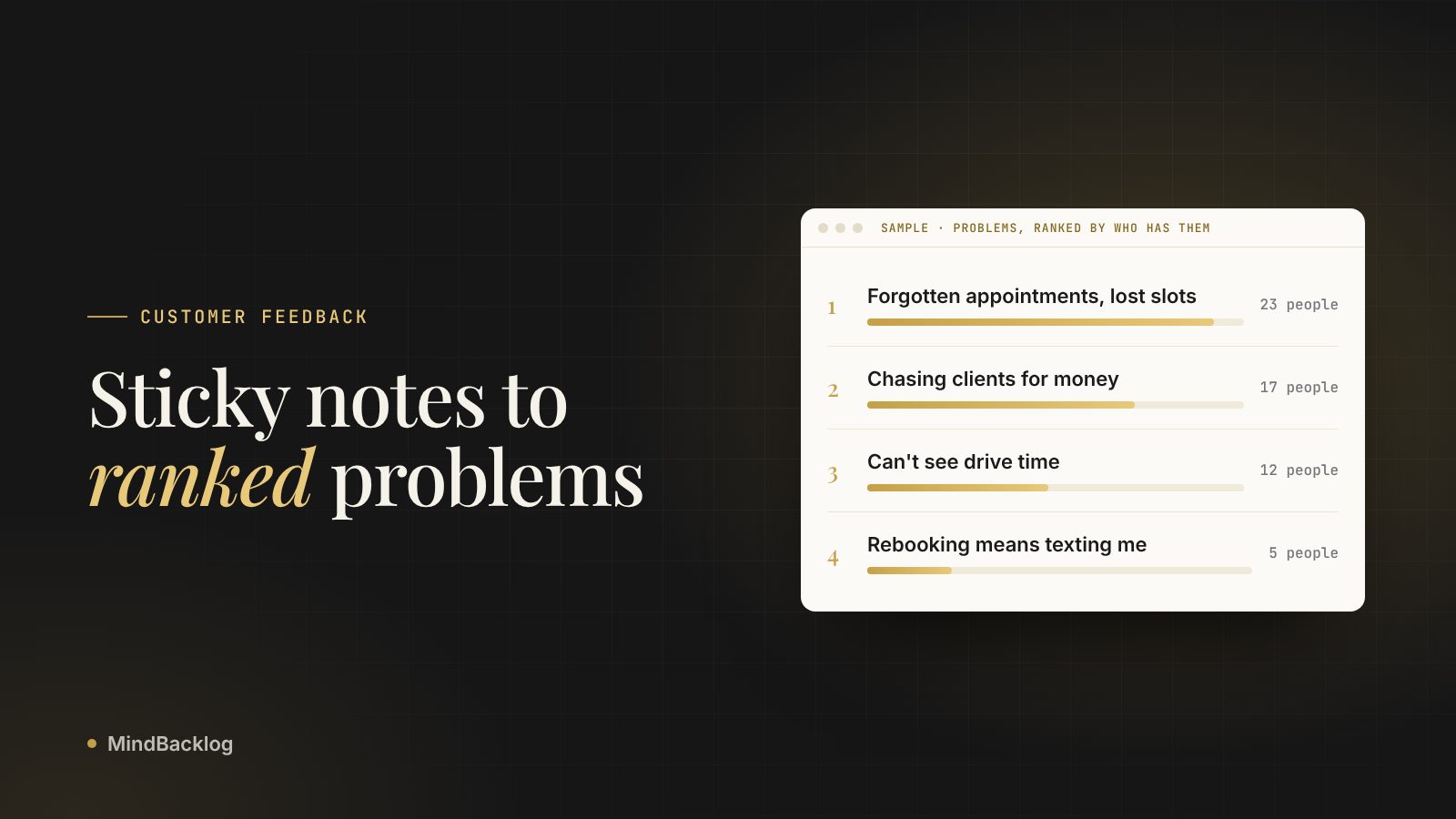
- Rank the groups by who has the problem
- Hand on the ranking with the quotes attached
- Doing this in MindBacklog
- Questions
Affinity mapping sorts research notes into groups by what they have in common, so patterns appear that no single interview shows. For interview notes, write one observation per note in the person’s words, group the notes by the problem underneath, and name each group as a problem. Then add a final step that turns the map into a decision: rank the groups by how many of the people you build for have each problem.
- One observation per note, in the person’s words, tagged with who said it.
- Group by the problem underneath, not by the feature someone asked for.
- Name each group as a sentence a user could have said.
- Rank groups by how many target users are in them, then by how strong their evidence is.
Where affinity mapping comes from and when to use it
The method is also called an affinity diagram or the KJ method, after the Japanese anthropologist Jiro Kawakita, who developed it to make sense of field notes. Product and design teams now use it on interviews, usability sessions and support conversations.
It fits best after a batch of interviews on one topic, while the conversations are fresh. A team of two to four can do it in an afternoon at a whiteboard or on a shared online canvas. One person can do it too, though a second person catches groupings you’d miss.
Write one observation per note
The notes decide the quality of everything after them. A paraphrased note loses the detail you need to group it well. A note that holds two ideas can’t sit in two groups.
For example, a small team building a booking app for mobile dog groomers runs eight interviews. Here’s the difference between a weak note and a useful one.
Wants better reminders and easier payments.
“I text every client the night before. It takes me 40 minutes.” (Dana, solo groomer, interview 3)
- One idea per note
- The person’s words in quotes where you have them
- A real event or behaviour, not a prediction
- Who said it and which segment they belong to
- Which interview it came from, so anyone can check
Pull notes from transcripts before you sort
Transcripts are too long to sort directly. Read each one and pull out the lines where the person describes a problem, a workaround or a cost. Ten to twenty notes per interview is a workable range.
An AI assistant such as ChatGPT or Claude can pull candidate quotes quickly. Check every one against the transcript before it becomes a note, because a summary can drift from what the person said. Keep the exact words, since they carry the detail that grouping depends on.
Group by the problem underneath
- Read everything first. Everyone reads all the notes before anyone moves one.
- Sort in silence. Move each note next to notes that feel like the same problem. Talk comes later, so the loudest person doesn’t set the groups.
- Split mixed groups. “Wants online payment” and “chases clients for money” feel close, but the first is a fix and the second is the problem.
- Park the leftovers. Notes that fit nowhere go in a parked pile. Forcing them into a group blurs it.
- Name each group last. Write the name once the notes in it clearly agree.
Name each group as a problem a user could say
Group names become the list you build from, so they need to say what hurts. A one-word topic hides the problem. A feature name hides it too, and it commits you to a fix too early.
| Weak label | Problem name |
|---|---|
| Reminders | Clients forget appointments and I lose the slot |
| Payments | I chase clients for money after the visit |
| Calendar | I can’t see drive time between bookings |
| Client app | Clients can’t rebook without texting me |
The last row started as a feature request. Asking what problem the app would solve turned it into something you can count and compare.
Rank the groups by who has the problem
A finished map shows groups. It doesn’t yet tell you which problem matters most. Ranking does that, in three passes.
- Count distinct people in each group, not notes. One talkative groomer with six notes counts once.
- Split those people by segment. Count the people you build for first, and list everyone else beside them.
- Mark the strongest evidence in each group. A described loss beats a complaint, and a request to try a fix beats both.
The groomer team’s ranked map from eight interviews: “Clients forget and I lose the slot” (6 of 8, all solo groomers, two lost a day’s income last month). “I chase clients for money” (4 of 8). “I can’t see drive time” (3 of 8). “Clients can’t rebook without texting me” (1 of 8, a salon with five staff, outside the target).
Note. Eight interviews give you a direction, not a measurement. Six of eight against four of eight is worth acting on. Four against three is a tie until the next round of interviews.
Hand on the ranking with the quotes attached
The ranked list is the output, and the quotes make it trustworthy. Keep each group’s notes with it when it goes into a spec or a planning session. Anyone who doubts the order can read what people said and judge for themselves.
Teams that repeat this every few weeks can find more on the page for small product teams.
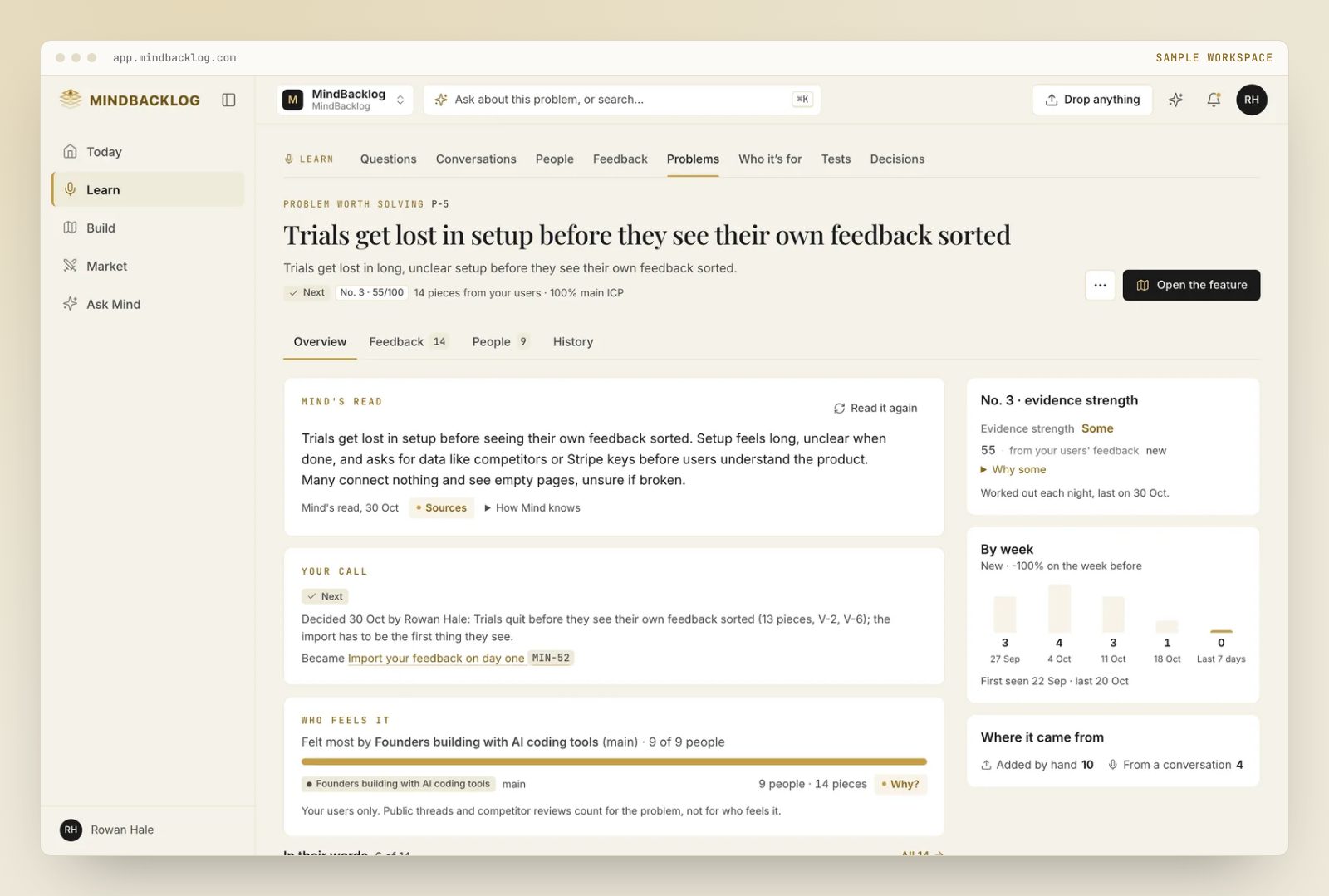
See problems ranked with the quotes kept. Every piece of feedback, sorted into problems ranked by who has them.
See how it worksDoing this in MindBacklog
Drop anything into MindBacklog: a thread, a transcript, a CSV. Mind shows where it’ll go before filing it, and keeps every piece in their words. Every piece of feedback is sorted into problems ranked by who has them, with the quotes behind each, and your users rank first. Under 30 pieces of feedback, Mind says “Not ranked” instead of guessing. How problems are ranked.
Questions
What is the difference between affinity mapping and thematic analysis?
Both group qualitative data into themes. Affinity mapping is a quick, visual exercise, often done as a group with sticky notes. Thematic analysis is a more formal coding process, usually done by a researcher with a written codebook. For a small team with one batch of interviews, affinity mapping is usually enough.
How many interviews do you need for affinity mapping?
There’s no minimum, and you can sort notes from three interviews. Patterns get more reliable as interviews add up. With a small batch, treat the ranking as a lead to check in your next conversations.
Can AI do affinity mapping for you?
AI can draft groups quickly, which helps on a first pass through long transcripts. Check two things yourself: that each note in a group says what the group name claims, and that the counts are of people rather than mentions. Keep the original quotes so anyone can check the grouping.