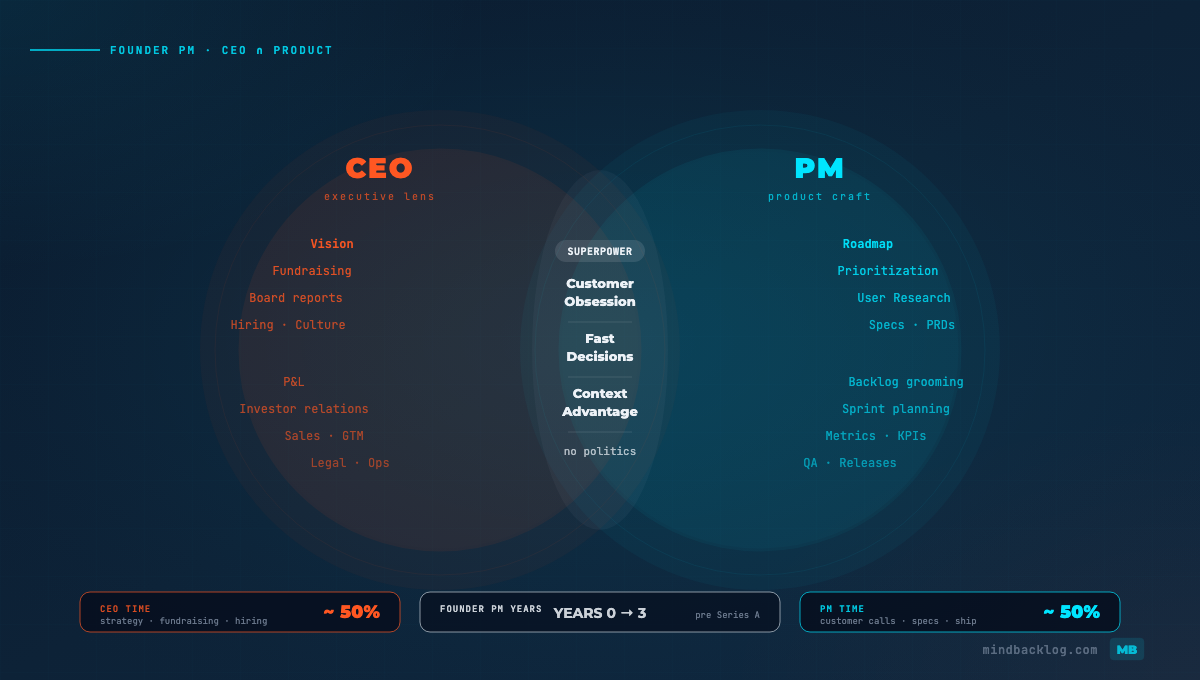
At most startups, the founder is the product manager. Not by title — the org chart might not even include a PM role — but by function. The founder decides what to build, talks to customers, writes specifications (or describes features to engineers over Slack), manages the roadmap (often in their head), and makes prioritization decisions based on a combination of vision, customer conversations, and gut instinct. This is not a failure of organizational design. It is the natural state of an early-stage company where the founder’s vision is the product strategy.
The challenge is that founder-led product management has unique failure modes that a professional PM is trained to avoid. The founder’s deep personal investment in the product creates biases that are invisible from the inside. Their proximity to customers creates a false sense of comprehensive understanding. And their role as CEO means product decisions compete with fundraising, hiring, sales, and a dozen other executive responsibilities for the same limited pool of attention.
The Founder PM’s Unique Advantages
Before discussing the pitfalls, it is worth acknowledging what founder-led product management does exceptionally well. The founder has unmatched context. They know why the product exists, what problem it was created to solve, and where it is ultimately heading. A hired PM must build this understanding over months. The founder has it from day one.
The founder has direct customer relationships. In the early stage, the founder is often the primary customer contact — they do the sales calls, the onboarding sessions, the support emails. This gives them a visceral understanding of customer needs that no amount of second-hand feedback can replicate.
The founder has decision authority. There is no organizational friction between identifying a need and acting on it. The founder can decide to pivot a feature, change a priority, or scrap a plan entirely — and it happens immediately. This speed of decision-making is a genuine competitive advantage in the early stage.
The Five Pitfalls of Founder-Led PM
Pitfall one: Vision Tunnel. The founder’s vision is the product’s greatest asset and its most dangerous liability. When the founder’s conviction about what the product should become overrides evidence about what customers actually need, the product drifts from market reality. The founder builds what they believe customers should want rather than what customers demonstrably do want. This is the fastest path to a technically impressive product that no one buys.
Pitfall two: Last Conversation Bias. The founder talks to a customer who passionately describes a need. The founder walks away convinced this is the most important thing to build. The next day, a different customer describes a different need with equal passion. The roadmap lurches from one direction to another, driven by whichever conversation happened most recently. Without a systematic way to aggregate and weight customer input, each individual conversation carries disproportionate influence.
Pitfall three: Feature Stuffing. The founder is the CEO, the salesperson, and the PM. When a prospect says ‘we would buy if you had Feature X,’ the founder-CEO hears revenue. The founder-PM adds Feature X to the roadmap. This happens repeatedly until the roadmap is a collection of one-off customer commitments rather than a coherent product strategy. The product becomes a custom solution for a handful of customers rather than a scalable product for a market.
Pitfall four: Delegation Failure. The founder can do everything — they have done it all since the beginning. So they continue doing it all, even as the team grows. They personally triage every piece of feedback, personally write every spec, personally approve every design. The team cannot move without founder input, creating a bottleneck that slows development and frustrates everyone.
Pitfall five: The Feedback Black Hole. The founder collects feedback from every customer conversation, every sales call, every support email — and stores it in their head, in scattered notes, or in an inbox they never revisit. The feedback exists but is never systematically processed, consolidated, or used to inform prioritization. Decisions are made from memory rather than from organized evidence.
How to Avoid the Pitfalls Without Hiring a PM
The most common advice for founder-PMs experiencing these pitfalls is ‘hire a PM.’ This is often premature. A PM hire before product-market fit can create friction rather than reducing it, because the PM’s process orientation may conflict with the speed and flexibility the startup needs. The alternative is to address the pitfalls through tooling and discipline rather than headcount.
For Vision Tunnel, the fix is systematic feedback collection that forces the founder to confront the full breadth of customer input, not just the signals that confirm their vision. When an AI system consolidates feedback from every channel and presents the unfiltered demand landscape, the founder can see where their vision aligns with customer needs and where it diverges. This data does not override vision — it informs it.
For Last Conversation Bias, the fix is evidence-based scoring that weights every customer signal equally rather than privileging the most recent one. When the founder can see that Feature A has forty-seven signals from twenty-three customers while Feature B (the one from yesterday’s call) has one signal from one customer, the recency bias loses its power.
For Feature Stuffing, the fix is a transparent prioritization framework that makes trade-offs visible. When adding a customer-specific feature means deprioritizing a feature with broader demand, the framework surfaces the trade-off explicitly. The founder can still choose to build the customer-specific feature — but they make the choice with full awareness of the opportunity cost.
For Delegation Failure, the fix is automation that removes the founder from operational tasks that do not require their judgment. When feedback triage, classification, and scoring are automated, the founder is no longer the bottleneck for these activities. They review outputs rather than performing the work, freeing time and attention for the decisions that genuinely require founder involvement.
For the Feedback Black Hole, the fix is a centralized feedback system that captures, processes, and organizes every piece of customer input without depending on the founder’s memory or organizational discipline. Every conversation, every email, every social mention flows into the same intelligence pipeline and is available for evidence-based decision-making.
When to Hire Your First PM
The right time to hire a dedicated PM is when the founder’s product responsibilities are consistently preventing them from fulfilling their CEO responsibilities — fundraising, hiring, strategy, partnerships — and when the product has achieved enough market validation that a PM can execute on a defined strategy rather than searching for product-market fit.
The transition from founder-led to PM-led product management is smoother when the systems are already in place. If the feedback pipeline, the prioritization framework, and the product context are already systematized (rather than living in the founder’s head), the new PM can onboard productively in weeks rather than months. The founder retains the role of product visionary — setting direction, making strategic bets, maintaining the long-term narrative — while the PM handles the operational execution that turns vision into shipped features.
|
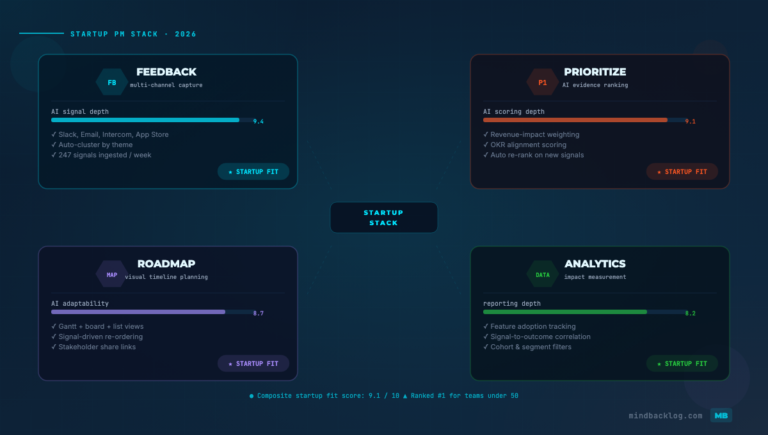
MindBacklog gives founder-PMs the infrastructure to manage product without the operational overhead — automated feedback pipeline, AI-powered scoring, and a MIND engine that captures your product knowledge so it’s never trapped in your head. Build with evidence and vision. Start at mindbacklog.com. |
Ready to put your product intelligence on autopilot? Start your 14-day free trial at MindBacklog.com — no credit card required.