The product roadmap is one of the most important and most misunderstood artifacts in product management. At its best, a roadmap aligns teams around shared priorities, communicates strategic intent to stakeholders, and provides a framework for making resource allocation decisions. At its worst, it becomes a false promise — a rigid feature timeline that creates unrealistic expectations and stifles the adaptability that product development demands.
The roadmapping discipline is undergoing a significant transformation in 2026, driven by two forces. First, the shift from feature-based to outcome-based thinking is changing what roadmaps communicate. Second, AI-powered tools are changing how roadmaps are maintained, making it practical to keep roadmaps dynamically updated rather than treating them as static documents that are revised quarterly.
The Case Against Feature Timelines
For years, the default roadmap format has been the feature timeline: a horizontal axis showing months or quarters, with specific features placed at specific dates. Feature X ships in March. Feature Y ships in June. Feature Z ships in Q4. This format is intuitive, specific, and almost always wrong.
The problem is that feature timelines conflate two different commitments: what we plan to build and when we plan to deliver it. The ‘what’ is a strategic decision that should be relatively stable. The ‘when’ is an operational outcome that depends on dozens of variables the PM cannot control — technical complexity that emerges during development, team capacity changes, shifting business priorities, and the inevitable scope evolution that accompanies any significant feature.
When you present a feature timeline to stakeholders, they hear dates as promises. When those dates inevitably slip, trust erodes — not because the PM made bad decisions, but because the roadmap format communicated a false level of certainty.
Outcome-Based Roadmapping
The alternative that has gained significant traction is outcome-based roadmapping. Instead of committing to specific features on specific dates, an outcome-based roadmap commits to business outcomes — ‘improve new user activation rate,’ ‘reduce churn in the enterprise segment,’ ‘enable self-service onboarding’ — and identifies the features or initiatives most likely to drive those outcomes.
This approach decouples strategic intent from implementation specifics. Stakeholders understand what the product team is trying to achieve and why, without getting anchored on specific features that may evolve or specific dates that may shift. It creates room for the product team to discover the best solution rather than committing to one prematurely.
The now-next-later format operationalizes outcome-based thinking. ‘Now’ contains the work actively in progress. ‘Next’ contains the work that has been validated and is being prepared for development. ‘Later’ contains the strategic themes and opportunities that are being explored but not yet committed. This format communicates priorities without communicating false precision about timing.
When Gantt Charts Still Matter
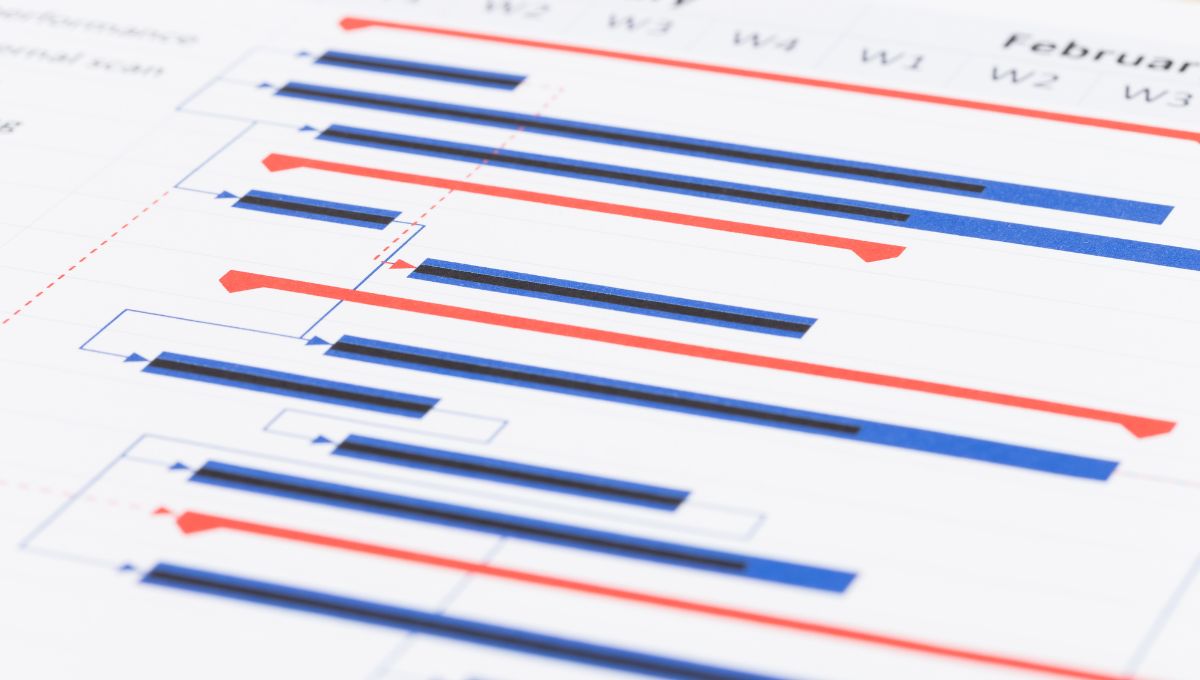
Despite the industry’s move toward flexible formats, Gantt charts retain genuine value in specific contexts. When features have hard external deadlines — regulatory compliance, contractual commitments, partner launches — the timeline dimension is not optional. When multiple teams are working on interdependent features, visualizing the dependency chain on a timeline is essential for coordination. When resource planning requires knowing which teams are committed to which work and when, the temporal view provides irreplaceable clarity.
The key is to use Gantt charts as an operational planning tool rather than a communication tool. The engineering team and the PM need the timeline view to coordinate execution. Executives and external stakeholders should see a higher-level outcome-based view that does not anchor on specific dates.
Modern Gantt chart implementations add intelligence to the traditional format. AI-predicted completion dates supplement initial estimates, showing where the team is trending ahead or behind plan. The solid-bar-plus-dotted-bar pattern provides a powerful visual for scope risk: the solid bar shows the originally planned timeline, while a dotted extension shows the AI-predicted actual delivery date based on current velocity and remaining scope. When the dotted bar extends significantly beyond the solid bar, it is an early warning of scope creep that the PM can address proactively.
Stakeholder-Specific Views
One of the most impactful roadmapping practices is maintaining multiple views of the same underlying plan, tailored to different audiences. Executives need a strategic view showing themes, outcomes, and major milestones without feature-level detail. Engineering needs a detailed view with technical dependencies, capacity allocation, and sprint-level planning. Sales needs a customer-facing view that highlights upcoming capabilities without revealing internal timelines. Customer success needs a view organized by customer segment showing features relevant to each segment’s needs.
Maintaining these multiple views has traditionally been a significant overhead, often requiring separate documents that quickly fall out of sync. AI-powered roadmap tools can automatically generate stakeholder-specific views from a single source of truth, keeping all views consistent while tailoring the level of detail and framing to each audience.
The Living Roadmap: AI-Powered Dynamic Updates
Perhaps the most significant shift in roadmapping is the move from periodic updates to continuous evolution. A traditional roadmap is reviewed and updated quarterly, sometimes monthly. Between updates, it is static — a snapshot that grows increasingly stale as new information arrives.
An AI-powered living roadmap updates continuously based on incoming signals. When new feedback shifts the priority of a feature, the roadmap reflects the change. When the development team’s velocity data suggests a feature will take longer than planned, the timeline adjusts automatically. When a competitor ships a feature that changes the strategic calculus, the roadmap flags the affected items for review.
This does not mean the roadmap changes chaotically. The AI suggests updates based on data; the PM approves or rejects them. But the gap between new information arriving and the roadmap reflecting that information shrinks from weeks or months to hours or days. The roadmap becomes a genuinely real-time reflection of the product strategy rather than a historical document.
EPICs: Grouping Features Meaningfully
As backlogs grow, individual features need to be grouped into larger strategic themes. EPICs serve this purpose, but they are often poorly defined — either too broad (an EPIC containing thirty unrelated features) or too narrow (essentially duplicating the feature level).
Well-designed EPICs group features that share a common outcome or customer journey. An EPIC like ‘Improve User Search Experience’ might contain three features: advanced filters, search performance optimization, and saved searches. Each feature stands on its own, but together they deliver a coherent improvement to a specific user workflow.
AI can assist with EPIC creation by analyzing the relationships between features — their shared customer segments, their overlapping technical components, and their collective impact on product objectives. When a PM adds a new feature to the backlog, the system can suggest which EPIC it belongs to or recommend creating a new EPIC if the feature represents a genuinely new strategic theme.
Connecting Roadmap to Execution
A roadmap is only as useful as its connection to the work actually being done. The gap between roadmap planning in a PM tool and sprint execution in Jira or Azure DevOps is where many product plans lose fidelity. Features that look clear on the roadmap become ambiguous when translated into user stories. Timelines that look reasonable at the roadmap level become unachievable when broken into engineering tasks.
Bidirectional sync between roadmap tools and development platforms closes this gap. When a feature on the roadmap is approved for development, the associated user stories and acceptance criteria flow into the development tool. As engineering completes work and updates statuses, those updates flow back to the roadmap. The PM always has an accurate picture of where each feature stands without manually checking two systems.
The most valuable data that flows back from development is velocity-based timeline prediction. When user stories for a feature have been estimated and the team’s sprint velocity is known, the system can calculate a predicted completion date and compare it against the roadmap’s planned date. Discrepancies surface automatically, giving the PM time to adjust scope, timeline, or resources before a missed deadline becomes a crisis.
| MindBacklog brings your roadmap to life with AI-powered dynamic updates, Gantt charts with predictive timeline visualization, and bidirectional sync with Jira and Azure DevOps. Build roadmaps that stay current and connected to execution. Join the founding member program. |