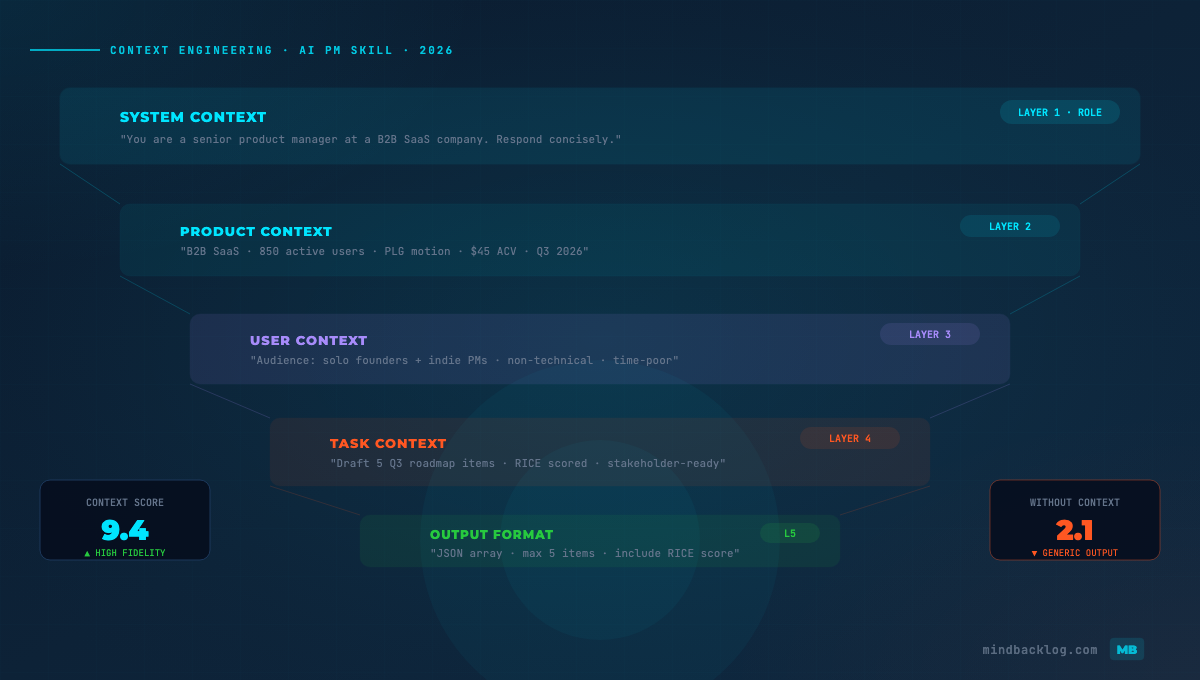
A new discipline is emerging in product management, and most PMs do not yet have a name for it. It is the practice of curating, structuring, and maintaining the information that AI systems use to make recommendations about your product. We call it context engineering, and it is rapidly becoming one of the most valuable skills a product manager can develop.
The concept is straightforward: an AI system is only as good as the context it operates with. Feed it nothing about your product, and it produces generic outputs indistinguishable from what any team at any company would receive. Feed it a rich, well-structured understanding of your product, your users, your competitive landscape, and your decision history, and it produces outputs that are specific, relevant, and immediately actionable. The quality gap between these two extremes is enormous, and context engineering is the skill that determines which end of the spectrum your AI operates at.
Why Context Is the Bottleneck, Not the AI
Most product teams that are disappointed with their AI tools are blaming the wrong component. The AI models available in 2026 — from Gemini to Claude to GPT — are extraordinarily capable. They can reason about complex product decisions, synthesize multi-source evidence, and generate high-quality specifications. The limiting factor is almost never the model’s capability. It is the context the model has to work with.
Consider an analogy. If you hire a brilliant product consultant but give them no information about your product, your customers, or your strategy, their recommendations will be generic. Not because they lack intelligence, but because they lack context. The same consultant, given a thorough briefing — product documentation, customer research, competitive analysis, decision history — would produce dramatically better recommendations. The intelligence was always there. The context was the bottleneck.
AI systems work the same way. The model is the consultant. The context is the briefing. Context engineering is the discipline of preparing that briefing — not as a one-time exercise, but as an ongoing practice that keeps the AI’s understanding current and comprehensive.
The Five Layers of Product Context
Effective product context is structured in five layers, each providing a different type of understanding that the AI needs to produce useful outputs.
The first layer is Product Identity — what your product does, who it serves, and what makes it different. This is the foundational context that informs every AI decision. It includes your product’s core value proposition, the primary user personas, the key workflows your product supports, and the product areas or modules that define your feature architecture. Without this layer, the AI cannot even classify feedback correctly, because it does not know what your product is.
The second layer is Customer Understanding — what your customers care about, what frustrates them, and what they are trying to accomplish. This layer is built automatically as feedback flows through the system, but it can be accelerated by providing user research reports, customer interview transcripts, NPS analysis, and churn analysis. The richer this layer, the more accurately the AI can assess feature impact and prioritize based on genuine customer needs.
The third layer is Competitive Landscape — who else serves your customers, what they do well, what they do poorly, and where they are heading. This context enables the AI to score competitive urgency accurately and to factor market dynamics into its recommendations. It includes competitor product descriptions, competitive feature comparisons, and competitive positioning documents.
The fourth layer is Decision History — what the team has built before, what worked, what did not, and why. This is perhaps the most underutilized context source. When the AI knows that a previous search improvement increased activation by 15 percent, it can calibrate its impact estimates for similar features. When it knows that a previous estimation for the billing module exceeded the actual timeline by 40 percent, it can adjust its effort estimates accordingly.
The fifth layer is Technical Architecture — how the product is built, what the major components are, and where the technical constraints lie. This context helps the AI produce more realistic effort estimates, identify potential technical risks, and generate specifications that reference the actual architecture rather than proposing implementations that are architecturally impractical.
Building Context: The PM’s New Investment
Context engineering requires a deliberate investment of PM time — not in operating the AI, but in feeding it the information it needs to operate well. This investment follows a front-loaded pattern: the initial setup requires the most effort, and ongoing maintenance is relatively lightweight.
Start with the first layer. Provide three to five high-quality sources about your product: the marketing website (which captures positioning and value proposition), the help documentation (which captures feature descriptions and workflows), and an internal product overview or vision document (which captures strategic direction). These sources give the AI enough foundational understanding to begin producing useful outputs.
Build the second layer passively by connecting feedback channels. Every customer signal that flows through the processing pipeline adds to the AI’s understanding of customer needs, pain points, and language. Over weeks, this layer becomes rich without requiring manual curation.
Add the third layer by uploading competitive analyses or connecting competitor monitoring channels. Even a simple document comparing your product to two or three main competitors provides enough context for the AI to factor competitive dynamics into its recommendations.
Build the fourth and fifth layers over time as they become available. Post-mortems, retrospectives, architecture documents, and past roadmap plans are all valuable context sources that deepen the AI’s understanding incrementally.
The Compounding Return on Context
Context investment has a compounding return profile. The first source you add produces a noticeable improvement in AI output quality. The tenth source produces a smaller marginal improvement. But the cumulative effect — the difference between an AI with one source and an AI with thirty sources — is transformative. The AI moves from producing generic outputs to producing outputs that feel like they were written by someone who has worked on your product for years.
This compounding effect creates a powerful retention dynamic. A team that has invested in building rich product context over six months has an AI system that is dramatically more valuable than a freshly configured one. The context cannot be easily transferred to a competing tool, because it is not just data — it is a synthesized, structured understanding that was built through months of signal processing, source merging, and PM refinement.
This is why context engineering is not just a productivity skill — it is a strategic investment. The context you build today makes every future AI interaction more valuable. The PM who invests in context engineering in Q1 reaps compounding benefits through Q2, Q3, and beyond.
Context Engineering vs. Prompt Engineering
Context engineering is often confused with prompt engineering, but they are fundamentally different disciplines. Prompt engineering is the skill of crafting effective queries — asking the right question in the right way to get a useful response from an AI. It is a valuable skill, but it operates at the interaction level: each query is crafted individually, and the quality depends on the prompt’s clarity.
Context engineering operates at the system level. It is about building the persistent knowledge base that informs every AI interaction across the entire platform — not just one query, but thousands. A well-engineered context means that even a simple, unoptimized query produces high-quality results, because the AI already has the understanding it needs. Context engineering reduces the need for prompt engineering by ensuring the AI is always operating with comprehensive product knowledge.
In practical terms: the PM who invests in context engineering writes a feature title, clicks ‘generate PRD,’ and gets a useful first draft. The PM who relies on prompt engineering writes a three-paragraph prompt explaining the product, the users, the competitive landscape, and the strategic priority — and gets a similar result, but only for that one interaction. One approach scales. The other does not.
|
MindBacklog’s MIND engine is built for context engineering. Feed it your product docs, competitive data, and strategic objectives — then watch every AI interaction across the platform get sharper. The context compounds. The investment pays dividends forever. Start at mindbacklog.com. |
Ready to put your product intelligence on autopilot? Start your 14-day free trial at MindBacklog.com — no credit card required.


