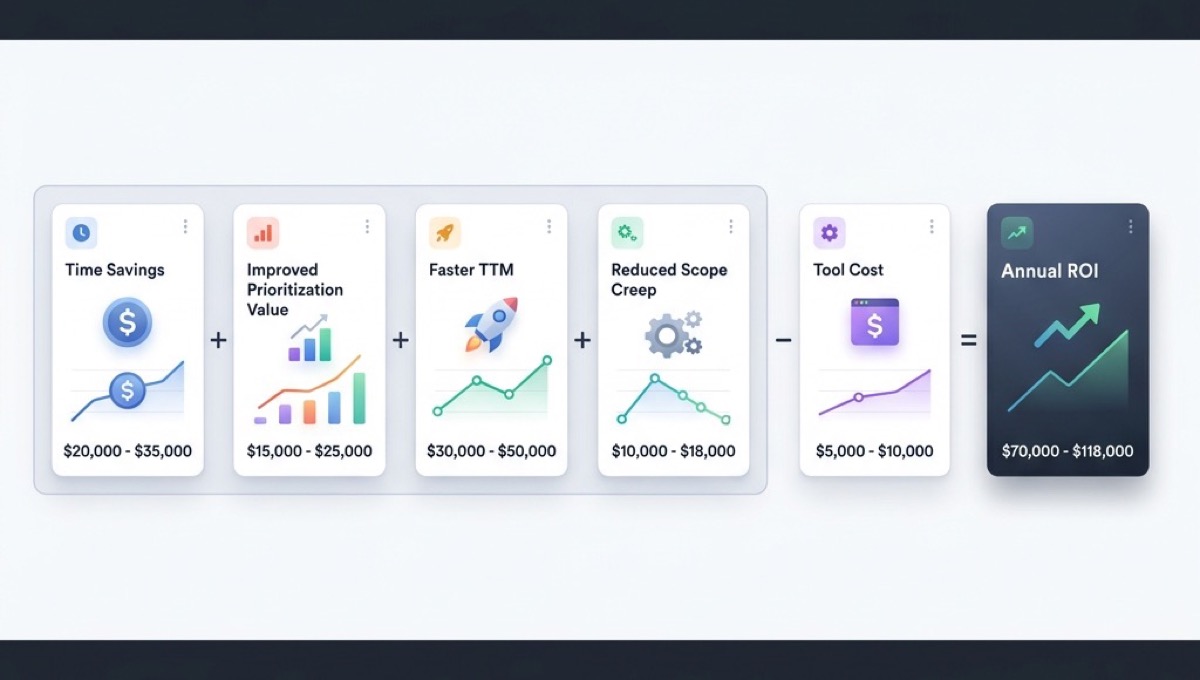
Convincing a CFO to invest in a new product management tool requires a different language than convincing a PM. PMs think in terms of better prioritization, faster feedback loops, and improved customer understanding. CFOs think in terms of dollars saved, revenue generated, and payback periods. This guide translates the benefits of AI-powered product management into the financial framework that drives procurement decisions.
The business case for AI PM tools rests on four pillars: time savings from automated operational tasks, revenue impact from improved prioritization accuracy, faster time-to-market from streamlined workflows, and reduced waste from fewer misallocated development sprints. Each pillar is quantifiable, and together they produce an ROI that makes the tool investment look like one of the easiest budget decisions on the table.
Pillar 1: Time Savings — The Immediately Measurable Win
Time savings is the most straightforward component of the ROI calculation because it can be measured directly from pre- and post-adoption workflow analysis.
Feedback triage and categorization consumes two to three hours per day for a PM handling moderate feedback volume. AI reduces this to fifteen to twenty minutes of review. Weekly savings: eight to twelve hours. At a fully loaded PM cost of $80 to $120 per hour, this single task saves $33,000 to $75,000 per PM per year.
Duplicate detection and cross-referencing consumes four to five hours per week. AI semantic matching eliminates this almost entirely. Annual savings: $16,000 to $30,000 per PM.
Specification writing — PRDs, user stories, and acceptance criteria — consumes eight to twelve hours per sprint. AI-assisted drafting cuts this to three to four hours. Over 26 sprints per year, savings are five to eight hours per sprint, or $10,000 to $25,000 annually per PM.
Stakeholder updates, competitive monitoring, and scoring exercises together consume four to six hours per week. AI automation reduces this to one to two hours. Annual savings: $8,000 to $20,000 per PM.
Total time savings per PM: fifteen to twenty-five hours per week, translating to $67,000 to $150,000 in recovered productivity annually. For a three-person PM team, the range is $200,000 to $450,000. This alone typically produces a 5x to 15x return on the cost of the AI tool.
Pillar 2: Improved Prioritization Accuracy — The Revenue Multiplier
The revenue impact of better prioritization is larger than the time savings but harder to measure precisely. The logic is straightforward: when the product team builds the right features, those features drive more revenue (through conversion, retention, or expansion) than the wrong features would have.
Estimate this impact conservatively. If improved prioritization converts just two sprints per year from misallocated work (features with low adoption) to high-impact features (features that drive measurable business outcomes), the value equals the revenue differential between those outcomes.
For a typical B2B SaaS company, a high-impact feature might reduce churn by one to two percentage points or increase conversion by half a percentage point. On a $5M ARR base, a one-point churn reduction saves $50,000 per year in recurring revenue. On a pipeline generating 100 trials per month, a half-point conversion improvement at $5,000 average contract value generates $30,000 per year in new revenue.
These numbers are conservative. The actual impact of prioritization improvement is typically much larger because the compounding effect of better features extends beyond the immediate quarter — better features improve retention, which improves lifetime value, which compounds over the customer’s entire relationship with your product.
Pillar 3: Faster Time-to-Market
AI-powered workflows accelerate time-to-market in two ways. First, the specification phase is compressed — features move from idea to actionable specification faster when AI generates first-draft PRDs and user stories. Second, the feedback loop is tighter — customer signals are processed and available for decision-making in hours rather than weeks, reducing the lag between customer need identification and development start.
Quantifying the value of speed depends on your market dynamics. In highly competitive markets, shipping a feature one month earlier can mean capturing market share before a competitor. In retention-critical contexts, addressing a churn-causing pain point one sprint earlier prevents the revenue loss that would have occurred during the delay.
A conservative estimate: if faster time-to-market prevents the loss of even two mid-market customers per year who would have churned while waiting for a critical feature, and each customer represents $20,000 to $50,000 in annual revenue, the saved revenue is $40,000 to $100,000.
Pillar 4: Reduced Waste from Scope Creep and Misalignment
Scope creep is the silent budget killer in product development. Features that were estimated at four weeks take eight. Sprints that were planned at 30 story points deliver 22. The cumulative effect is that 20 to 30 percent of development capacity is consumed by unplanned work that should have been caught earlier.
AI-powered tools reduce scope creep through better estimation (calibrated by historical velocity data), earlier detection (predictive alerts when a feature is trending behind plan), and more rigorous specification (AI-generated stories with comprehensive acceptance criteria reduce ambiguity that causes scope expansion during development).
If AI reduces scope creep by even 10 percent of its current level — recovering one to two sprints per year of otherwise wasted capacity — the value at a $100,000 per-sprint engineering cost is $100,000 to $200,000 annually.
Putting It Together: The Total ROI
For a three-person PM team at a growth-stage SaaS company, the conservative annual ROI calculation looks like this: time savings of $200,000 to $450,000, prioritization improvement of $80,000 to $150,000, faster time-to-market value of $40,000 to $100,000, and reduced waste of $100,000 to $200,000. Total annual value: $420,000 to $900,000.
Against an AI PM tool cost of $17.99 to $47.99 per seat per month — roughly $650 to $1,730 per seat per year, or $1,950 to $5,200 for a three-person team — the ROI ranges from 80x to 460x. Even at the most conservative estimates and the highest tool cost, the payback period is measured in weeks, not months.
These numbers are deliberately conservative. They do not include the strategic value of competitive intelligence, the cultural benefit of evidence-based decision-making, or the compounding effect of an AI system that gets more accurate over time. The actual ROI for most teams will exceed these estimates.
Making the Case to Your CFO
When presenting this business case, lead with the time savings — they are the most immediately measurable and the hardest to dispute. Follow with the prioritization accuracy argument, framed as the cost of building the wrong things. Close with the total ROI calculation, emphasizing that the tool cost is a rounding error relative to the value generated.
The strongest formulation: ‘This tool costs $5,200 per year for our team. It saves at least $200,000 in PM productivity alone, before accounting for better product outcomes. The question is not whether we can afford this tool. The question is whether we can afford not to use it.’
|
MindBacklog starts at $17.99/seat/month — a fraction of the value it creates. Time savings, better prioritization, faster time-to-market, and reduced waste. The ROI is measured in weeks, not years. Build your business case with a free 14-day trial at mindbacklog.com. |
Ready to put your product intelligence on autopilot? Start your 14-day free trial at MindBacklog.com — no credit card required.


