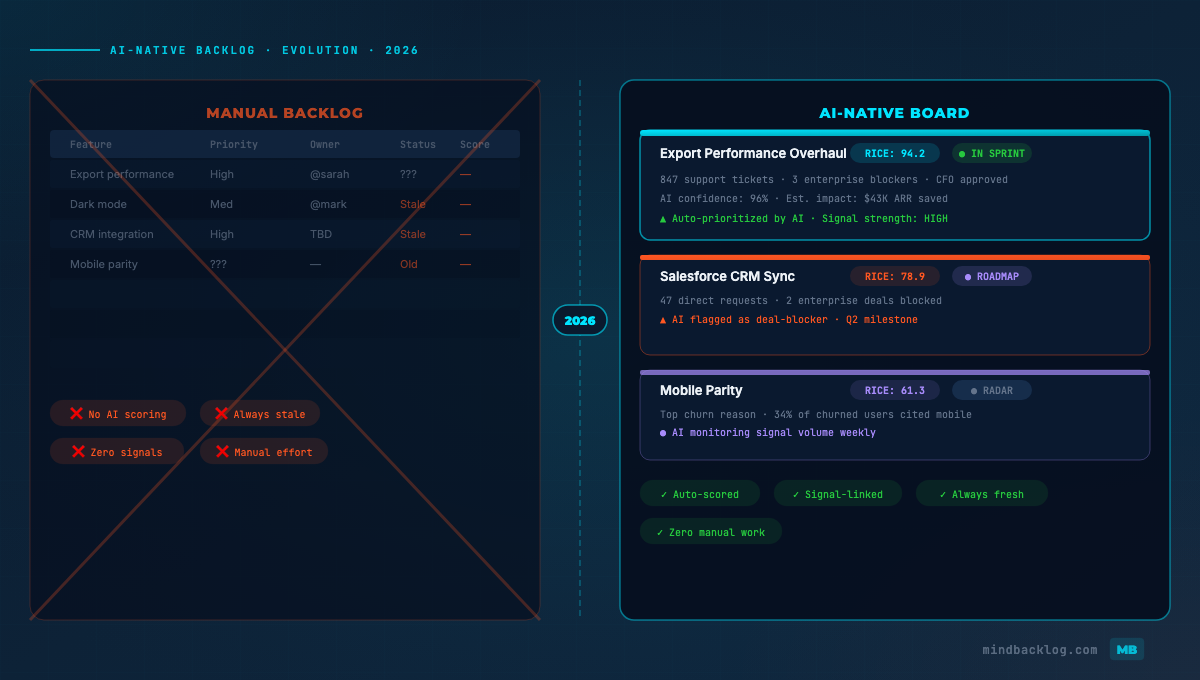
Let us be direct: if you are managing your product backlog in a spreadsheet in 2026, you are operating with a competitive disadvantage that grows wider every month. Spreadsheets were the default backlog management tool for product teams for years — not because they were good at the job, but because nothing better existed that justified the switching cost. That calculus has changed. AI-native product management tools now provide capabilities that spreadsheets cannot replicate at any investment of time or effort, and the cost of these tools is a fraction of the productivity they unlock.
What Spreadsheets Cannot Do
The limitations of spreadsheets for backlog management are not about formatting or convenience. They are fundamental capability gaps that no amount of clever formulas, macros, or conditional formatting can address.
Spreadsheets have no intelligence. They store what you type but cannot analyze, classify, or score it. They cannot read a piece of customer feedback and determine whether it is a feature request, a bug report, or a complaint. They cannot detect that two entries describe the same need using different language. They cannot assess how a feature aligns with your strategic objectives. Every analytical operation must be performed by the PM and manually encoded into the spreadsheet.
Spreadsheets have no automation. Every new piece of feedback must be manually entered. Every score must be manually calculated. Every status must be manually updated. Every stakeholder update must be manually assembled from the spreadsheet data. The PM is the execution engine, and the spreadsheet is just the storage medium.
Spreadsheets have no cross-referencing. When a customer emails a feature request, there is no automatic connection between that email and the relevant row in the backlog spreadsheet. When the same feature is discussed on Reddit, in a support ticket, and in a stakeholder meeting, each mention exists in isolation unless the PM manually connects them. The evidence for each feature is fragmented rather than consolidated.
Spreadsheets have no memory. They do not learn from your product’s history. They cannot calibrate estimates based on past performance. They cannot improve their recommendations over time. A spreadsheet on day three hundred is exactly as capable as a spreadsheet on day one — the only thing that has grown is the number of rows.
The Hidden Cost of Spreadsheet Management
The true cost of spreadsheet backlog management is not the cost of the spreadsheet itself (which is free or nearly free) but the PM time consumed by the manual operations the spreadsheet requires. Data entry, cross-referencing, formula maintenance, version management, status updates, report generation — these tasks consume ten to fifteen hours per week for a PM managing a moderately sized backlog. That is over five hundred hours per year of PM time spent on data management rather than product management.
There is also a quality cost. Manual processes introduce errors — misclassified items, duplicate entries, inconsistent scoring, outdated statuses. These errors compound: a misclassified feature request might never be linked to the growing body of evidence supporting it, causing the PM to underestimate demand. A duplicate entry might inflate the apparent priority of a different feature. Over time, the spreadsheet becomes an unreliable representation of reality, and the PM loses confidence in the data.
And there is an opportunity cost. The fifteen hours per week spent maintaining the spreadsheet are fifteen hours not spent on customer discovery, strategic analysis, stakeholder alignment, or the creative synthesis that produces breakthrough product insights.
The AI-Native Alternative
AI-native product management platforms replace every manual spreadsheet operation with an automated, intelligent equivalent. Feedback ingestion is automatic — signals from email, support tickets, web forms, and other channels flow into the system without manual data entry. Classification is automatic — each signal is analyzed and categorized by AI. Deduplication is automatic — semantic matching identifies when different language describes the same need. Scoring is automatic — features are evaluated against consistent criteria using evidence from linked signals. Status tracking is automatic — the system maintains current state without manual updates.
But the advantage is not just automation. It is intelligence. The AI system learns your product over time. It understands your product areas, your user segments, your competitive landscape, and your strategic priorities. It uses this understanding to classify signals more accurately, score features more relevantly, and generate specifications more specifically. The spreadsheet is a static container. The AI-native platform is a dynamic intelligence engine that gets better with use.
Making the Migration
Migrating from a spreadsheet to an AI-native platform does not require a disruptive big-bang transition. Start by setting up the new platform and feeding it your product context — documentation, competitive analysis, strategic objectives. Then connect your feedback channels so new signals start flowing through the AI pipeline. Import your existing backlog items from the spreadsheet as initial features. Within two to three weeks, the new platform is operational and the spreadsheet can be retired.
The critical step is committing to the new system as the single source of truth. If the PM continues to maintain the spreadsheet alongside the new platform, the migration fails — you have doubled the maintenance burden instead of eliminating it. Set a clear cutover date and enforce it.
|
MindBacklog replaces your spreadsheet backlog with an AI-native intelligence engine that automates triage, deduplication, scoring, and spec generation. Keep the simplicity. Add the intelligence. Start your free trial at mindbacklog.com. |
Ready to put your product intelligence on autopilot? Start your 14-day free trial at MindBacklog.com — no credit card required.


