The customer feedback management market is undergoing its most significant transformation since the category was created. For the past decade, the market was defined by a stable set of players offering variations on the same theme: collect feedback through a portal or widget, let customers vote, and present the results in a dashboard. The tools differed in polish and pricing but not in fundamental capability. A PM using Canny in 2019 had roughly the same workflow as a PM using UserVoice — manual triage, manual tagging, manual prioritization.
That stability is ending. The convergence of large language models, vector embeddings, and agentic AI architectures has created a new category of feedback tools that operate at a fundamentally different level. These AI-native platforms do not just collect and display feedback — they ingest it from multiple sources automatically, classify it through multi-phase AI pipelines, consolidate duplicate signals using semantic understanding, and score features based on evidence rather than vote counts. The gap between the old generation and the new is not incremental. It is structural.
The Market as It Stands
The 2026 feedback tool landscape can be divided into four categories, each serving a different need and each facing different competitive pressures.
Traditional survey and NPS tools — platforms like SurveyMonkey, Qualtrics, and Delighted — focus on structured feedback collection through surveys. They excel at measuring satisfaction at defined touchpoints but do not capture the unstructured, spontaneous feedback that contains the richest product insights. Their limitation is structural: they only hear from customers when they ask, and they only capture what the survey questions allow.
Feedback-only platforms — Canny, UserVoice, Nolt, and Frill — focus on feature request collection and voting. They provide a clean customer-facing portal and basic prioritization tools. Their strength is simplicity and focus. Their limitation is that they operate as standalone data silos — feedback collected through the portal is not consolidated with feedback from email, support tickets, social media, or app reviews. The PM still has to manually cross-reference multiple sources.
Full-stack PM platforms — Productboard, Aha!, and airfocus — combine feedback collection with roadmapping and prioritization in a single tool. They offer broader workflow coverage than feedback-only tools, but their AI capabilities are typically bolted on rather than architecturally native. Feedback classification, scoring, and consolidation still require significant manual effort. Their pricing also reflects their enterprise heritage — $59 to $80 per seat per month puts them out of reach for many startups and small teams.
AI-native PM platforms represent the emerging fourth category — tools built from the ground up around AI intelligence engines. These platforms assume multi-source ingestion as the default, automate classification and consolidation through AI pipelines, maintain persistent product context that improves over time, and provide evidence-based scoring that does not depend on manual input. This category is new, the players are fewer, and the capabilities are differentiated in ways that the other categories cannot easily replicate.
Five Trends Shaping the Next Three Years
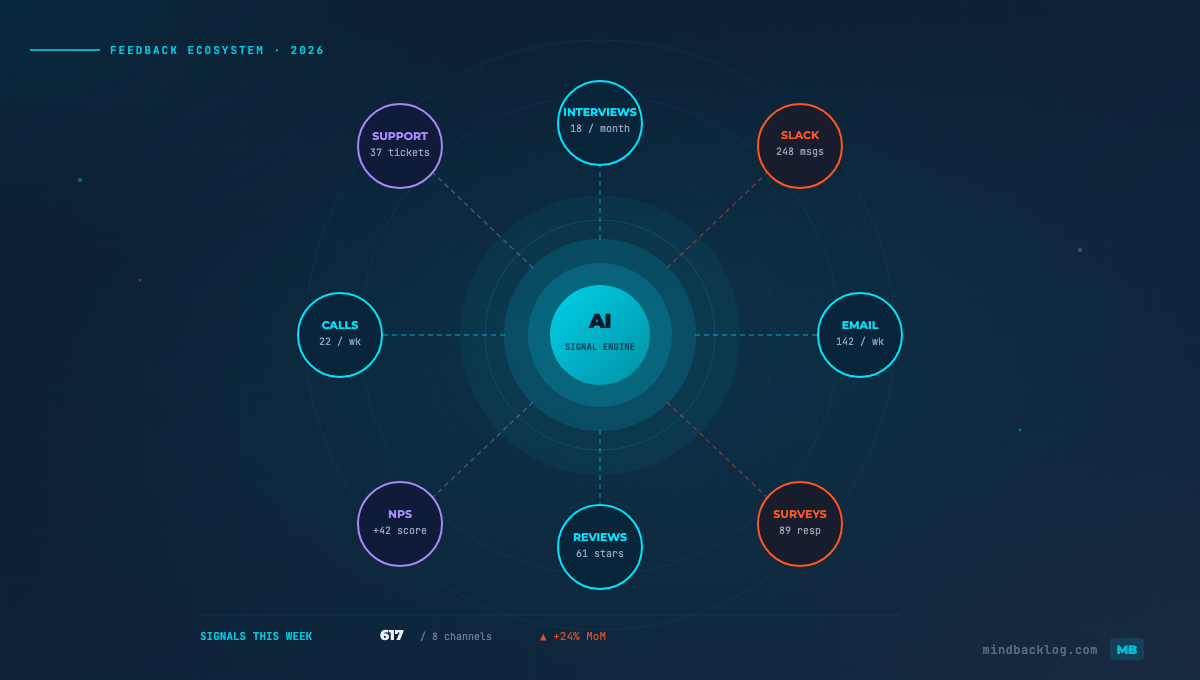
Trend one: multi-source consolidation as table stakes. The idea that a feedback tool should only capture feedback through its own portal is becoming obsolete. PMs expect their tools to ingest from email, support tickets, app store reviews, social media, and web scrapers — and to process all of these sources through a unified pipeline. Tools that cannot offer multi-source ingestion will be relegated to a secondary role as one input among many, rather than the central intelligence hub.
Trend two: AI classification replacing manual tagging. The manual tag-and-categorize workflow that has defined feedback management for a decade is being replaced by AI that classifies feedback automatically based on product context. This shift is not optional — it is demanded by the volume of feedback that modern products generate. A team receiving fifty signals per day cannot manually classify each one. A team receiving five hundred signals per day does not even attempt it.
Trend three: semantic deduplication replacing keyword matching. The recognition that customers describe the same need in wildly different language has made keyword-based deduplication visibly inadequate. Vector embeddings and semantic matching — technologies that were academic curiosities five years ago — are now practical, affordable, and dramatically more accurate than string matching. Any tool that still relies on keyword-based deduplication is delivering an incomplete and distorted view of customer demand.
Trend four: evidence-based scoring replacing vote counts. The limitations of feature voting as a prioritization mechanism — vocal minority bias, gaming vulnerability, lack of strategic alignment — are increasingly understood by the PM community. The alternative is scoring that combines multiple dimensions: signal volume and diversity, customer value weighting, strategic alignment, competitive urgency, and sentiment intensity. AI-driven scoring provides this multi-dimensional view without requiring the PM to manually assess each dimension.
Trend five: persistent product context as the differentiator. The most consequential trend is the emergence of AI systems that maintain persistent understanding of your specific product. Generic AI tools produce generic outputs. Context-aware AI tools produce outputs that are specific to your product, your customers, and your competitive landscape — and they improve over time as the context deepens. This compounding effect creates switching costs that benefit the platforms that invest in persistent intelligence and penalize those that treat each AI interaction as a one-shot prompt.
The Consolidation That Is Coming
The market is heading toward consolidation along two axes. First, the distinction between feedback tools and PM tools is dissolving. PMs do not want a separate tool for feedback collection and a separate tool for prioritization and roadmapping. They want a unified workflow where feedback flows directly into the pipeline that scores, prioritizes, and plans features. Tools that span this workflow will absorb market share from tools that cover only one stage.
Second, the distinction between AI-assisted and AI-native tools will widen into an unbridgeable capability gap. Tools that bolt AI features onto an existing architecture — adding a ‘summarize’ button here, a ‘generate PRD’ button there — will hit a ceiling because the underlying data model was not designed for AI-driven workflows. AI-native tools that were architected around intelligence from the foundation — with persistent context, multi-source pipelines, and compounding learning — will deliver capabilities that bolt-on approaches cannot match regardless of how much AI they add.
For PMs evaluating tools in 2026, the critical question is not ‘does this tool have AI?’ — almost all of them do. The question is ‘was this tool built around AI, or was AI added after the fact?’ The answer determines whether the tool will become more valuable over time or simply offer a slightly faster version of the same manual workflow.
What to Look for When Evaluating Feedback Tools
Based on the trends above, seven capabilities separate the next generation of feedback tools from the current generation. Multi-source ingestion that natively connects to the channels where your feedback already lives. Automatic AI classification that does not require manual tagging. Semantic deduplication that catches meaning-level duplicates, not just keyword matches. Persistent product context that improves AI accuracy over time. Evidence-based scoring that synthesizes multiple dimensions into defensible priority rankings. Workflow integration that spans from signal to roadmap without tool-switching. And competitive intelligence that monitors competitor feedback alongside your own.
No tool does all of these perfectly today. But the tools that are architecturally positioned to deliver all of them — the AI-native platforms built from the foundation with these capabilities in mind — are the ones that will define the category for the next decade.
|
MindBacklog is AI-native from the foundation — multi-source ingestion, 4-phase AI pipeline, persistent MIND engine, evidence-based scoring, and competitive intelligence in one platform. See how the next generation of feedback management works. Start at mindbacklog.com. |
Ready to put your product intelligence on autopilot? Start your 14-day free trial at MindBacklog.com — no credit card required.


