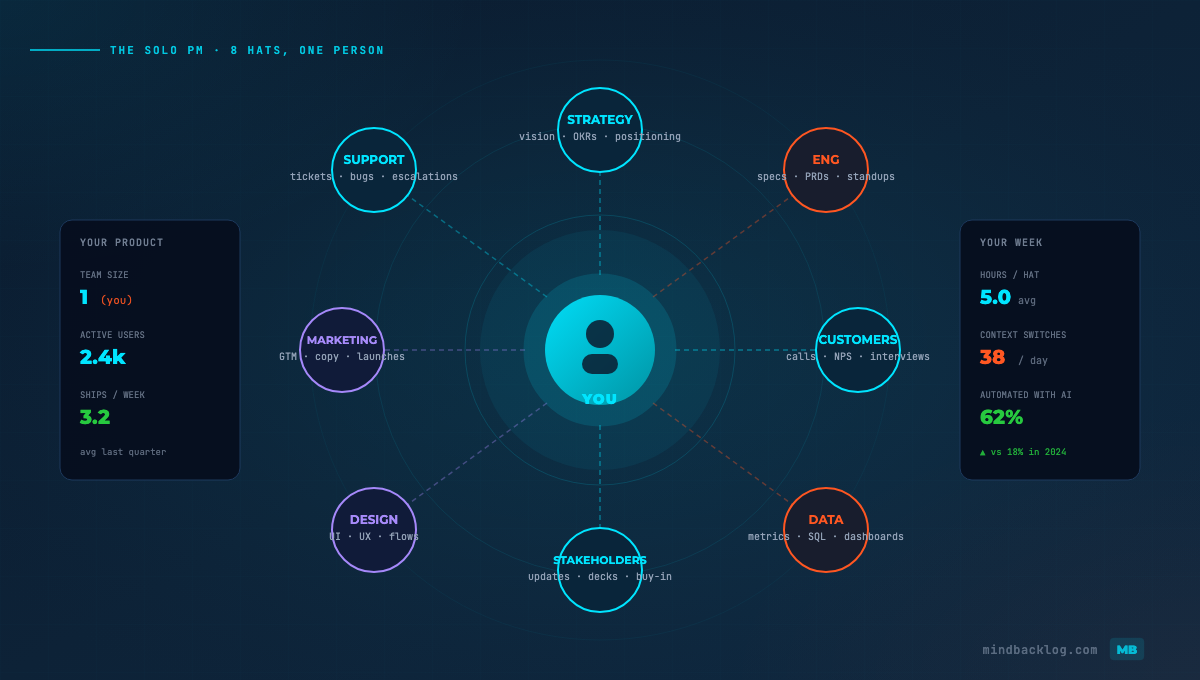
Being a solo product manager is one of the most demanding roles in technology. You own every aspect of the product discipline — customer research, feedback management, competitive analysis, feature prioritization, specification writing, roadmap planning, stakeholder communication, sprint support, and launch coordination — with zero colleagues to share the load. There is no product operations person to manage the backlog. No user researcher to run customer interviews. No technical PM to handle the engineering interface. It is all you.
The conventional advice for solo PMs is some variation of ‘prioritize ruthlessly’ and ‘learn to say no.’ This advice is correct but insufficient. The real challenge is not knowing what to prioritize — it is having the operational capacity to execute on your priorities after the operational overhead of running the product has consumed most of your working hours. The solo PM’s crisis is not strategic confusion. It is time bankruptcy.
The Time Bankruptcy Problem
A solo PM at a typical startup faces a daily workload that would reasonably occupy two to three people. Morning starts with email and Slack triage — scanning for customer feedback, stakeholder requests, and engineering questions. Then feedback processing — reading, categorizing, and cross-referencing new inputs against the existing backlog. Then meetings — standups, stakeholder check-ins, customer calls. Then the actual product work — writing specs, reviewing designs, analyzing data, and making prioritization decisions. Then the communication work — status updates, roadmap presentations, and documentation.
Something always gets dropped. Usually it is the strategic work — customer discovery, competitive analysis, and long-term planning — because the operational work has immediate deadlines and visible consequences if neglected. The stakeholder update is due today. The sprint needs a story refined by tomorrow. The customer email needs a response. Strategic work, by contrast, has no deadline and no one asking for it. So it gets pushed to ‘next week,’ which becomes ‘next month,’ which becomes ‘never.’
This pattern is unsustainable and creates a negative spiral. Without strategic work, the PM’s decisions become increasingly reactive. Without competitive analysis, the product drifts from market reality. Without customer discovery, the backlog reflects past conversations rather than current needs. The product stalls, and the PM works harder but accomplishes less.
Survival Strategy 1: Automate the Operational Baseline
The single highest-leverage investment a solo PM can make is automating the operational tasks that consume the bulk of their time. Feedback triage, classification, deduplication, and scoring should all be handled by AI, not by the PM. The PM should be reviewing AI outputs, not performing the analysis from scratch.
Set up an AI-powered feedback pipeline that ingests from every channel where customers communicate — email, web forms, app reviews, support tickets. Connect these channels once and let the system process incoming signals continuously. Your morning review becomes fifteen minutes of checking the AI’s work, not two hours of manual triage.
Automate stakeholder updates by using AI to draft weekly summaries from roadmap progress and pipeline activity. Automate scoring by using AI-driven priority calculations that update as new evidence arrives. Automate first-draft specifications by using AI to generate PRDs and user stories from feature context. Each automation reclaims hours per week that you can redirect to strategic work.
Survival Strategy 2: Establish a Ruthless Cadence
Without a team to distribute work across, the solo PM needs a rigid weekly cadence that ensures every critical activity receives regular attention. Ad-hoc scheduling leads to the strategic work being perpetually deferred.
A sustainable weekly cadence might look like this: Monday morning — review the AI Daily Brief, triage any urgent items, plan the week’s priorities. Tuesday — customer conversations (discovery calls, feedback follow-ups). Wednesday — specification work (refining features, reviewing AI-generated PRDs, preparing stories for the sprint). Thursday — stakeholder communication (roadmap updates, priority discussions, team alignment). Friday — strategic work (competitive analysis, long-term planning, retrospection on the week).
The key discipline is protecting the strategic time slots. Thursday’s stakeholder communication and Friday’s strategic work are the first things to get displaced when operational fires arise. Block these times on your calendar and treat them as non-negotiable. If operational fires genuinely require attention, handle them — but recognize that consistently losing strategic time is a signal that your operational automation is insufficient, not that strategic work is a luxury.
Survival Strategy 3: Lower Your Documentation Standards (Strategically)
Enterprise-grade PRDs with ten sections and thirty requirements are a luxury that solo PMs cannot afford. The goal is not comprehensive documentation — it is sufficient documentation. Every feature needs enough specification for engineering to build it correctly. It does not need a twenty-page document that took a week to write.
AI-generated specifications are the solo PM’s best friend here. A context-aware AI can produce a solid first-draft PRD in minutes that covers the essential sections: problem statement, target users, core requirements, success metrics, and open questions. The solo PM spends twenty minutes refining this draft rather than four hours creating it from scratch. The result is good-enough documentation produced in a fraction of the time.
Adjust your documentation depth based on feature complexity and risk. High-complexity features that touch critical systems deserve thorough specifications. Low-complexity features that are well-understood by the engineering team can be specified with a lean one-page format or even a well-structured user story with acceptance criteria. Save your documentation energy for where it reduces risk.
Survival Strategy 4: Make Every Customer Conversation Count
A solo PM cannot conduct as many customer interviews as a team with a dedicated researcher. Each conversation must therefore be maximized for insight. Prepare targeted questions based on the specific feedback themes you are investigating. Record conversations (with permission) and use AI to transcribe and extract key insights. Feed those insights directly into your product context system so they inform future AI recommendations.
Prioritize conversations with the customers whose feedback has the most strategic value — enterprise accounts considering expansion, churned customers willing to share why they left, and power users who push the product’s boundaries. One conversation with a churned customer often yields more actionable insight than five conversations with satisfied users.
Survival Strategy 5: Build in Public
Solo PMs at startups have an asset that PMs at large companies do not: proximity to the market and the freedom to be transparent. Building in public — sharing your roadmap direction, your decision rationale, and your product learnings openly — creates a virtuous cycle. Customers who see transparency become more engaged. Engaged customers provide better feedback. Better feedback leads to better product decisions. And the content you produce for building in public doubles as marketing.
Use your public feature voting portal to let customers see what you are working on and influence priorities through votes and submissions. Publish periodic updates about what you shipped and why. Share the data behind your decisions — ‘we prioritized this feature because 47 customers across 3 channels requested it’ — to build trust in your process. The transparency costs you almost nothing in time (especially with AI-assisted update drafting) and returns outsized value in customer engagement and trust.
|
MindBacklog is built for solo PMs who need to do more with less. AI automates feedback triage, scoring, and spec writing. The three-bucket workflow keeps you focused. The MIND engine gets smarter as you use it. Survive and thrive as a team of one. Start at mindbacklog.com. |
Ready to put your product intelligence on autopilot? Start your 14-day free trial at MindBacklog.com — no credit card required.