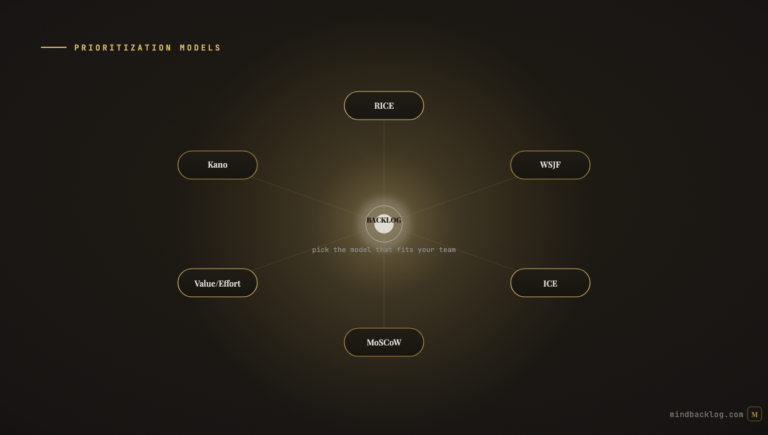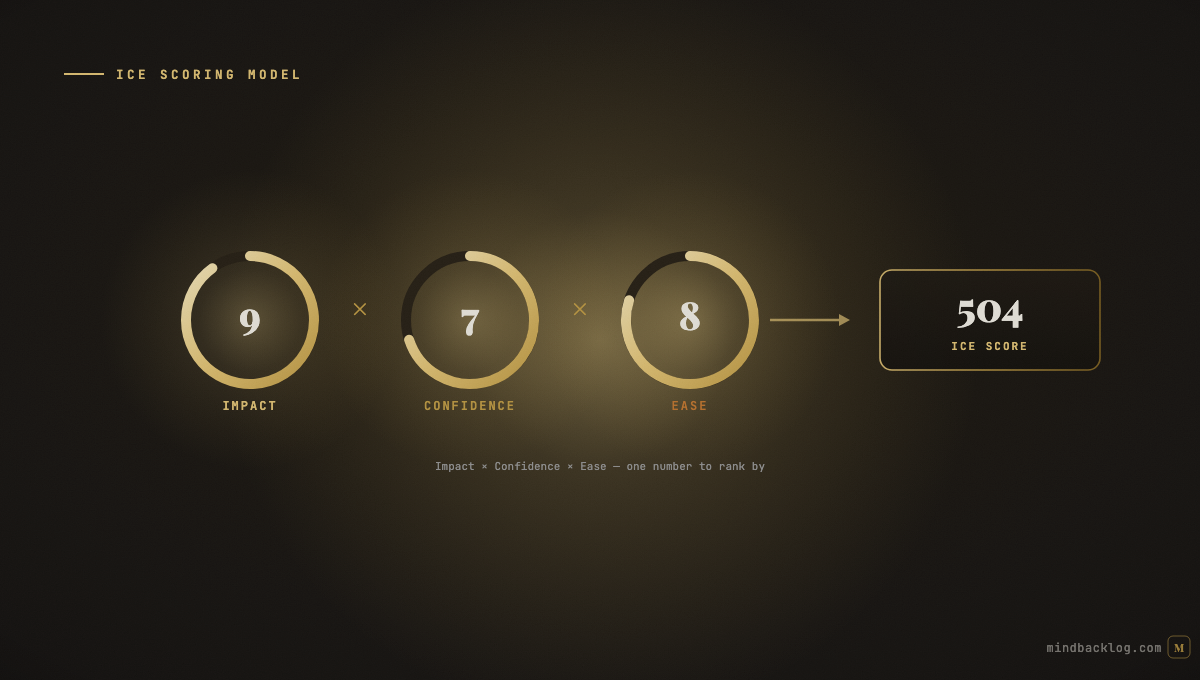
ICE scoring — Impact, Confidence, Ease — is the lightweight prioritization framework that growth teams and startups reach for when they need speed over sophistication. Each feature is scored on three dimensions using a simple 1-to-10 scale, the scores are multiplied together, and features are ranked by the resulting ICE score. The entire exercise takes minutes, which is why it remains popular despite the existence of more rigorous alternatives like RICE and WSJF.
ICE’s simplicity is both its strength and its limitation. It is fast enough to score fifty features in a single session. But it lacks a Reach component (which means it cannot differentiate between features that impact ten users versus ten thousand), and the 1-to-10 scale is difficult to calibrate consistently across team members. Understanding when ICE is the right tool and how to use it effectively prevents the common failure mode where ICE produces rankings that feel arbitrary.
The Three Components
Impact measures the expected effect of the feature on a key metric — conversion, retention, engagement, revenue, or satisfaction. Score from 1 (minimal impact on any metric) to 10 (transformative impact on a core metric). The key discipline is defining which metric you are scoring against before you start. Scoring ‘impact’ in the abstract invites inconsistency.
Confidence measures how certain you are about your impact and ease estimates. Score from 1 (pure speculation, no data) to 10 (validated by data, A/B test results, or historical precedent). Confidence serves as a hedge against optimistic impact scores. A feature with Impact 9 but Confidence 2 scores the same as a feature with Impact 6 and Confidence 3 — appropriately, because the uncertain high-impact feature is no more reliable than the moderately certain medium-impact feature.
Ease measures how simple the feature is to implement — the inverse of effort. Score from 1 (extremely complex, multi-sprint effort) to 10 (trivial, can be shipped in a day). Note that ICE uses Ease rather than Effort, which inverts the scale compared to RICE. This is a common source of confusion when teams switch between frameworks.
When ICE Is the Right Choice
ICE works best in three contexts. First, early-stage products with small, relatively homogeneous user bases, where the lack of a Reach component is not a significant limitation because all users are similar. Second, growth experiments where the team is testing many small hypotheses rapidly and needs a quick scoring mechanism that does not slow down the experimentation cycle. Third, initial backlog triage where the goal is to separate obviously high-priority features from obviously low-priority ones, with the intent to apply a more rigorous framework to the middle tier.
ICE is not the right choice when the user base is large and segmented (because reach differentiation matters), when the features being compared span a wide range of effort (because the 1-10 scale compresses too much at the high end), or when stakeholders require defensible, evidence-based scoring (because ICE’s subjectivity is difficult to justify in formal reviews).
Common ICE Mistakes
The most common mistake is inconsistent calibration. One team member’s 7 on impact is another’s 5. The fix is to anchor the scale before scoring: agree on a reference feature for each score level. ‘A 5 on impact is a feature like the search improvement we shipped last quarter.’ ‘A 3 on ease is a feature that touches the database schema.’ These anchors keep scores comparable across scorers.
The second mistake is treating ICE as a final decision rather than a conversation starter. ICE scores should identify which features warrant deeper analysis, not which features to build. The top-scoring features should be validated with more rigorous methods (customer research, technical spike, RICE scoring) before committing development resources.
AI-Enhanced ICE Scoring
AI improves ICE scoring by pre-populating component estimates from evidence. Impact is estimated from signal volume and sentiment intensity. Confidence is derived from the diversity and volume of supporting evidence. Ease is estimated from historical delivery data for similar features. The PM reviews and adjusts, but the starting point is data-grounded rather than subjective, which improves both accuracy and consistency.
| MindBacklog supports ICE alongside RICE, WSJF, and AI-powered scoring — all in one platform. Start with the framework that fits your team and evolve as your data grows. Start at mindbacklog.com. |
Ready to put your product intelligence on autopilot? Start your 14-day free trial at MindBacklog.com — no credit card required.