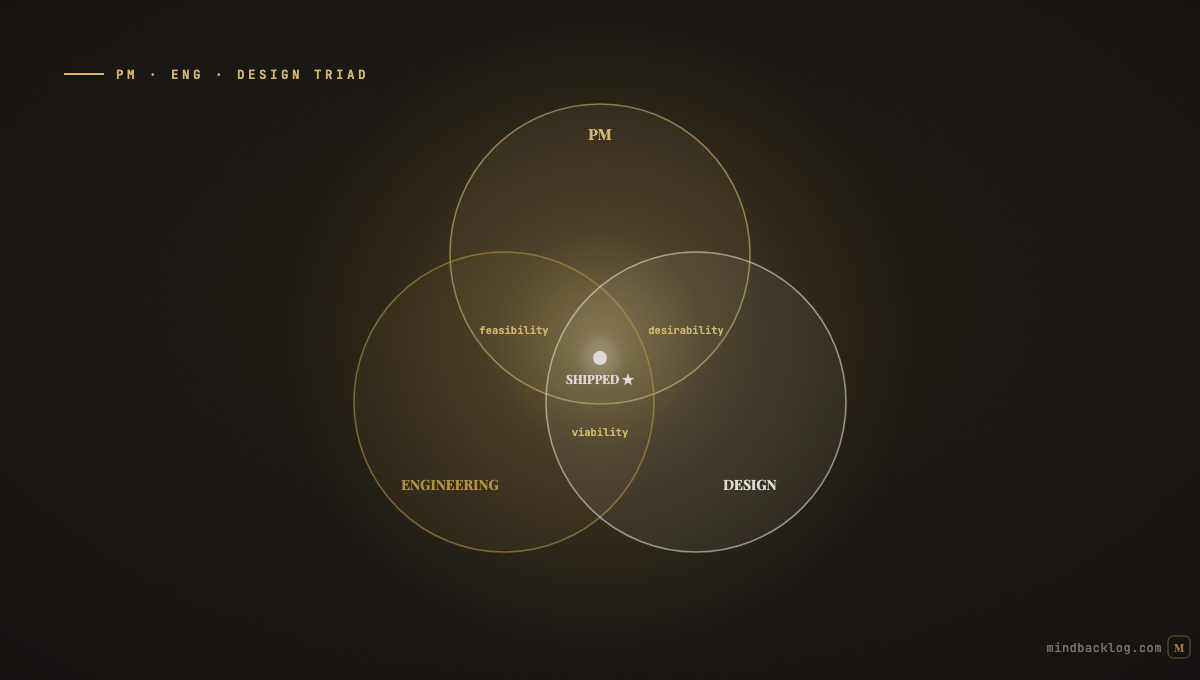
The quality of a product is determined not by the individual brilliance of its PM, engineers, or designers, but by how effectively these three functions collaborate. A brilliant PM with a mediocre engineering relationship produces specifications that are technically impractical. A brilliant engineer with no design collaboration produces features that work perfectly but are unusable. A brilliant designer with no PM alignment produces elegant solutions to the wrong problems.
The PM-engineering-design triad is the foundational unit of product development. When the triad collaborates effectively — sharing context, challenging assumptions, and building on each other’s expertise — the resulting product decisions are better than any single function could produce alone. When the triad operates through handoffs instead of collaboration, each function works with an incomplete picture and the product suffers.
The Handoff Anti-Pattern
The most common collaboration failure is the sequential handoff model. The PM researches the problem, writes a specification, and hands it to design. Design creates mockups based on the spec and hands them to engineering. Engineering builds what the mockups describe and hands it to QA. Each handoff is a lossy transfer — context is lost, assumptions are not surfaced, and feedback arrives too late to be incorporated without rework.
The handoff model persists because it is organizationally comfortable. Each function has a clear deliverable (the PM delivers specs, design delivers mockups, engineering delivers code) and clear boundaries (I did my part, now it is your turn). But the comfort is illusory — the rework, misalignment, and customer impact that the handoff model produces cost far more than the collaboration time it saves.
The Triad Model
Effective collaboration starts with shared problem definition. Before any specification is written or any design is explored, the PM, engineering lead, and design lead should align on the problem: What customer need are we addressing? What evidence supports it? What constraints exist? What does success look like? This shared understanding ensures that all three functions are solving the same problem — which sounds obvious but is violated surprisingly often in handoff-based workflows.
From shared problem definition, the triad explores solutions collaboratively. Design proposes experience approaches while engineering evaluates feasibility. The PM validates that proposed solutions address the customer need within the strategic constraints. This parallel exploration produces solutions that are desirable (design-validated), viable (PM-validated), and feasible (engineering-validated) — the classic product development trifecta.
Specifications emerge from this collaboration as shared artifacts that all three functions own. The PM does not write a spec and throw it over the wall. The spec captures the triad’s shared understanding and is reviewed and refined together. This shared ownership means there are no surprises during development — the engineering team already contributed to the specification and understands the reasoning behind every requirement.
Communication Rituals That Work
Three communication rituals sustain effective triad collaboration. A weekly triad sync (thirty minutes) keeps the three leads aligned on current priorities, upcoming work, and any emerging concerns. This is not a status meeting — it is a strategic alignment check where each function shares what they are learning that affects the others.
A problem definition kickoff (sixty to ninety minutes per major feature) brings the triad together at the start of each significant feature to align on the problem, explore initial solution directions, and identify the key unknowns to investigate. This replaces the PM working in isolation for a week and then presenting a finished spec.
A design review (thirty to sixty minutes per feature) brings the triad together to evaluate design proposals against technical feasibility, customer evidence, and strategic alignment. Engineering raises feasibility concerns early. The PM validates that the design addresses the core customer need. Design iterates based on both inputs.
Shared Context: The Collaboration Enabler
The single biggest enabler of triad collaboration is shared context. When all three functions have access to the same customer evidence, the same competitive intelligence, and the same strategic objectives, their contributions are grounded in shared reality rather than individual perspectives.
AI-powered product intelligence platforms serve this function by making customer evidence, priority scores, and product context visible to everyone — not just the PM. When the designer can see the customer signals linked to a feature and the engineer can see the business value score, each function brings more informed contributions to the collaboration. The context is shared. The expertise is complementary. The product benefits.
| MindBacklog makes product intelligence accessible to your entire triad — customer evidence, priority scores, and product context visible to PM, engineering, and design. Shared context for shared decisions. Start at mindbacklog.com. |
Ready to put your product intelligence on autopilot? Start your 14-day free trial at MindBacklog.com — no credit card required.