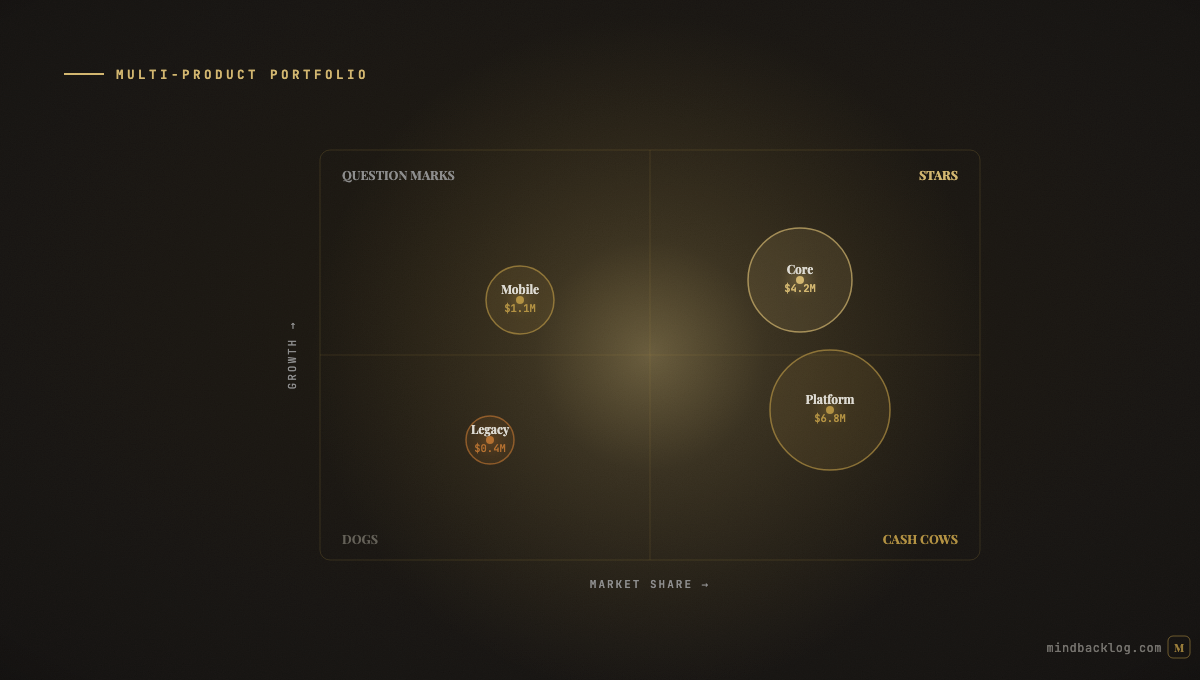
Managing a single product is demanding. Managing two or three products simultaneously — which is common at startups, agencies, and growing SaaS companies — is a fundamentally different challenge. The problem is not that each product is individually complex. It is that the PM’s attention becomes the shared bottleneck across all products, and the cognitive cost of context-switching between products consumes more time than the actual work within each product.
Without a systematic approach, multi-product management devolves into reactive firefighting. The PM spends their time on whichever product has the most urgent issue today, while the other products coast on autopilot — accumulating unprocessed feedback, stale priorities, and stakeholder frustration. The solution is not working harder. It is building an operational infrastructure where each product maintains its own intelligence baseline without requiring constant PM attention.
The Attention Allocation Problem
A PM managing three products has roughly thirteen to fifteen productive hours per week per product (assuming a fifty-hour week with five hours of overhead). That is enough time for either strategic work (customer discovery, competitive analysis, vision refinement) or operational work (feedback triage, scoring, spec writing, stakeholder updates) — but not both. Without AI, operational work wins every time because it has deadlines and visible consequences. Strategic work gets perpetually deferred.
The multi-product PM’s first priority must be automating the operational baseline for every product. When feedback triage, classification, deduplication, and scoring run automatically for all three products, the PM’s per-product time is freed for strategic work. They check the AI Daily Brief for each product each morning — fifteen minutes total — and allocate their strategic hours to whichever product most needs their attention that day.
Isolated Intelligence Per Product
Each product in a multi-product portfolio needs its own isolated intelligence system. The MIND engine, the feedback channels, the feature backlog, the roadmap, and the objectives should all be product-specific. An enterprise billing platform and a consumer mobile app have different users, different competitive landscapes, and different strategic priorities. Mixing their intelligence into a shared system produces noisy, inaccurate AI outputs.
The isolation means that AI classification for Product A is grounded in Product A’s context, and classification for Product B is grounded in Product B’s context. The same piece of feedback about ‘search performance’ means something different in each product’s context, and the AI needs separate product understanding to classify and score it correctly.
Isolation also means that each product can be at a different maturity level. Product A might have rich context from twelve months of feedback, producing highly accurate AI outputs. Product B might be newly launched with minimal context, producing less specific outputs that improve over time. Each product’s intelligence compounds independently.
Cross-Product Pattern Detection
While product intelligence should be isolated, cross-product analysis can reveal valuable patterns. If customers of Product A and customers of Product B are both requesting similar capabilities — better reporting, improved integrations, mobile access — the overlap suggests a market-wide need that may warrant platform-level investment rather than product-specific features.
Cross-product pattern detection also surfaces risk. If feedback sentiment is declining across multiple products simultaneously, the cause may be systemic — an infrastructure issue, a pricing change, or a competitive shift — rather than product-specific. Detecting this pattern across products enables a response that addresses the root cause rather than treating symptoms individually.
The Weekly Portfolio Review
A multi-product PM needs a weekly ritual that ensures no product is neglected for too long. A thirty-minute weekly portfolio review covers each product briefly: What changed this week? (AI Daily Brief summary.) What needs attention? (Flagged items from the ‘Needs Your Attention’ dashboard.) What is the top priority for next week? (One strategic focus per product.)
This review prevents the common failure mode where one product monopolizes the PM’s attention for weeks while others drift. By forcing a touchpoint with every product weekly, the PM catches emerging issues before they become crises and maintains enough context to make good decisions when each product needs strategic attention.
Stakeholder Communication Across Products
Multi-product PMs face a communication multiplier — each product has its own stakeholders who expect updates, roadmap visibility, and priority transparency. Without automation, communication overhead scales linearly with the number of products and quickly becomes unmanageable.
AI-generated stakeholder updates for each product — drafted from roadmap progress, recent feedback trends, and flagged risks — reduce this overhead from hours to minutes. The PM reviews and personalizes each update but does not draft from scratch. The communication cadence remains consistent even when the PM’s attention is concentrated on a different product that week.
|
MindBacklog supports multi-product portfolios with isolated MIND engines per product, independent feedback pipelines, and product-specific AI intelligence. Manage three products without dropping any. Start at mindbacklog.com. |
Ready to put your product intelligence on autopilot? Start your 14-day free trial at MindBacklog.com — no credit card required.


