One of the most common and most costly mistakes in product development is building features that do not connect to business outcomes. The feature works as specified. The engineering team delivered it on time. The customer who requested it is happy. But six months later, no one can demonstrate that the feature moved any metric that the business cares about. It exists on the feature list but contributes nothing measurable to the product’s success.
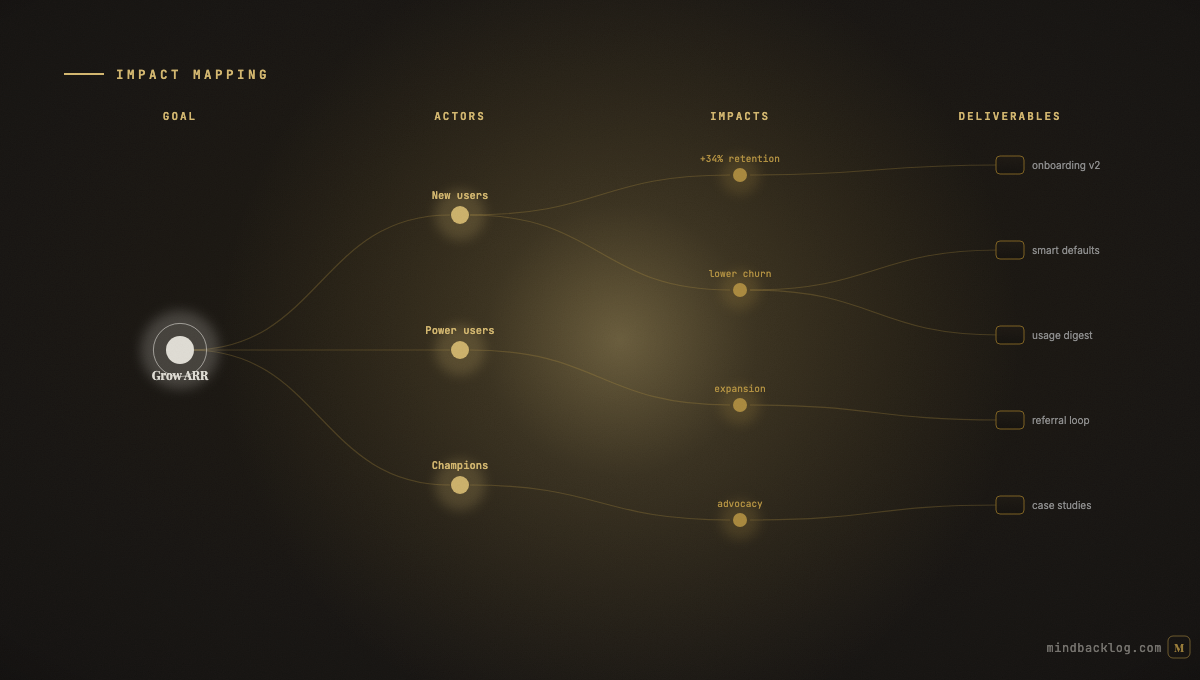
Impact mapping is a strategic planning technique designed to prevent this disconnect. Developed by Gojko Adzic, it creates a visual model that explicitly connects every feature (deliverable) to a behavioral change (impact) in a specific user group (actor) that drives a measurable business outcome (goal). If the connection cannot be drawn, the feature should not be built — or at minimum, should not be prioritized over features with clear outcome connections.
The Four Levels of an Impact Map
An impact map is read from left to right across four levels. The Goal is the measurable business outcome you are trying to achieve. It should be specific, quantified, and time-bound: ‘Reduce enterprise churn from 8% to 5% by Q4’ or ‘Increase new user activation rate from 35% to 55% by June.’ Vague goals like ‘improve the product’ produce vague impact maps.
Actors are the people or systems whose behavior must change to achieve the goal. For a retention goal, actors might include enterprise CSMs (who need to identify at-risk accounts faster), power users (who need more efficient workflows to maintain engagement), and new users (who need smoother onboarding to reach value quickly). Each actor group represents a different pathway to the same goal.
Impacts are the specific behavioral changes you need from each actor. For enterprise CSMs, the impact might be ‘identify at-risk accounts in under 30 seconds instead of 10 minutes.’ For power users, it might be ‘complete their primary daily workflow with 40% fewer clicks.’ Each impact is a measurable change in how the actor works — not a feature description, but a behavior description.
Deliverables are the features, improvements, or capabilities that enable each impact. For the CSM impact of faster account identification, the deliverable might be ‘advanced search filtering by account tier and risk score.’ For the power user impact of fewer clicks, the deliverable might be ‘keyboard shortcuts for the ten most common actions.’ Each deliverable is a concrete, buildable work item.
Why Impact Maps Prevent Wasted Features
The power of impact mapping is the traceability it enforces. Every feature on the map traces through a specific impact, to a specific actor, to a measurable goal. If a proposed feature cannot be placed on the map — if it does not enable a behavior change for a specific actor that drives a measurable outcome — it is disconnected from the business strategy and should be deprioritized.
This traceability also enables better post-launch evaluation. When a feature ships, you can measure whether the intended impact materialized. Did CSMs actually identify at-risk accounts faster? Did power users actually complete their workflow with fewer clicks? If the impact did not materialize despite the feature working as designed, the problem is not execution — it is the assumption about what would change behavior. This learning informs future impact maps and reduces the likelihood of repeating the same type of mistake.
Building an Impact Map: A Step-by-Step Workshop
Impact mapping works best as a collaborative exercise involving the PM, engineering leads, design, and key stakeholders. The workshop follows the four levels in sequence.
Start by defining the goal. This should be pre-selected by the PM based on strategic priorities. Present the goal, the current baseline metric, and the target. Ensure the group agrees on the goal’s importance and the measurement approach.
Next, brainstorm actors. Ask the group: ‘Whose behavior needs to change to achieve this goal?’ Cast a wide net initially — include customer segments, internal teams, and even external systems. Then narrow to the three to five actors with the most leverage on the goal.
For each actor, brainstorm impacts. Ask: ‘What behavior change would this actor need to exhibit?’ Focus on observable, measurable changes — not feelings or attitudes, but actions. ‘Logs in more frequently’ is measurable. ‘Feels more confident’ is not.
Finally, for each impact, brainstorm deliverables. Ask: ‘What could we build that would enable this behavior change?’ This is where traditional feature brainstorming occurs, but constrained by the requirement that each feature must connect to a specific impact. This constraint prevents the workshop from devolving into an unconstrained wish list.
Impact Mapping Meets Evidence-Based Prioritization
Impact mapping provides the strategic framework — which features connect to which outcomes. Evidence-based prioritization provides the tactical ranking — which connected features should be built first. The two techniques are complementary.
Once the impact map is complete, each deliverable can be scored using your prioritization framework (RICE, WSJF, or AI-driven scoring). The difference from scoring without an impact map is that every feature being scored has a clear outcome connection. There are no ‘orphan’ features that scored well on customer demand but have no traceable connection to a business goal.
AI-powered scoring is particularly powerful in combination with impact mapping, because the AI can evaluate each feature’s alignment with the goal — not just its customer demand or effort, but its strategic relevance to the specific outcome the team is pursuing.
|
MindBacklog connects features to strategic objectives through OKR-powered scoring. Every feature’s AI Priority Score reflects its alignment with your stated goals — the digital equivalent of an always-current impact map. Start at mindbacklog.com. |
Ready to put your product intelligence on autopilot? Start your 14-day free trial at MindBacklog.com — no credit card required.