- Home
- Blog
- Customer Discovery
- The Mom Test questions to ask before you open Cursor
The Mom Test questions to ask before you open Cursor
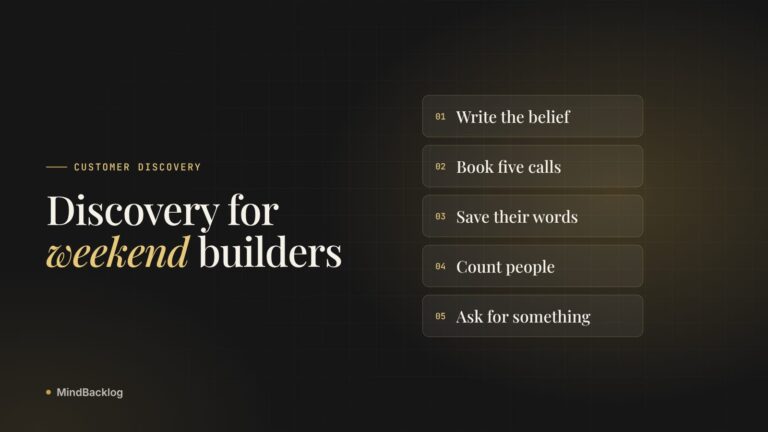
The Mom Test rules in plain terms, with bad and better questions for founders about to build, and how to sort each answer by what it cost the person.
On this page
Mom Test questions ask about the other person’s life and what they’ve already done, never about your idea, so even someone trying to be kind can’t mislead you. Before you open Cursor, use them to learn whether the problem is real and what people do about it now. Then sort each answer by what it cost the person to give.
- Talk about their life, not your idea.
- Ask about specific things that happened, not opinions or predictions.
- Talk less than they do, and steer vague answers back to facts.
- End by asking for something, and count only answers that cost them something.
Where the name comes from
Rob Fitzpatrick’s book The Mom Test is named for a simple idea. Your mother loves you and will tell you your idea is good. A question passes the test if even she couldn’t give you a misleading answer to it.
“Do you think my app is a good idea?” fails, because the kind answer and the true answer can differ. “When did you last change how you handle this, and why?” passes, because it asks for a fact. The rules below all come from that idea.
This matters more when you can build in a weekend. A polite yes used to cost a few weeks of planning. Now it costs a whole product, built straight away on a belief nobody tested.
The examples follow a founder building a booking and payments tool for dog walkers. The full question list, with a script by stage, lives in the customer interview questions guide. This post covers the rules behind it.
Talk about their life, not your idea
Once your idea is in the room, people answer about it instead of about themselves. They picture a version they’d like, and you hear about that version. Keep the conversation on how they work today.
“I’m building an app that handles bookings for dog walkers. Would you use it?”
“How did your bookings come in last week?”
The second question gives you a list of channels, the messy parts and the workarounds. The first gives you a yes that means nothing.
Ask about specifics in the past
Three kinds of answer sound like data and aren’t: generic claims (“I usually”), promises about the future (“I’d definitely”) and hypotheticals (“I might, if”). The book calls this fluff. When you hear it, ask for the last time it happened.
| They say | What it is | Ask next |
|---|---|---|
| “I usually confirm walks by text.” | Generic claim | “When did you last confirm one? Walk me through it.” |
| “I’d definitely use something like that.” | Promise about the future | “What do you use for this now?” |
| “I might switch if it handled payments.” | Hypothetical | “Tell me about the last payment that went wrong.” |
| “Payments are always a mess.” | Generic claim | “What happened with the most recent one?” |
Specific past events are hard to inflate. Either a walk got double-booked last Tuesday or it didn’t. The details (who they called, what they tried) tell you more than any opinion.
Talk less, and dig under compliments and requests
If you’re talking, you’re not learning. Ask, then let the silence run past the point where it feels awkward. People fill it with the detail you came for.
Compliments and feature requests both need a second move. A compliment gets a thank-you and a turn back to their week. A feature request gets a question about what it would let them do, because the request is their guess at a fix and the reason behind it is the problem.
They ask, “Can it sync with my calendar?” You say, “Yes, we can add that.”
They ask, “Can it sync with my calendar?” You ask, “What would syncing let you do that you can’t now?”
End with an ask, then sort what you heard
The book’s other big idea is commitment. A useful conversation ends with the person giving something up to move forward: their time, their reputation or their money. “Keep me posted” commits nobody. A booked second call does.
For example, near the end of a call a walker says, “This sounds really useful, keep me posted.” The founder replies, “Thanks. You mentioned you track payments in a spreadsheet. Could I see it on a 20-minute call next week?” The walker books Thursday. The first answer was praise. The booked call is time given, and the spreadsheet will show exactly what the product has to replace.
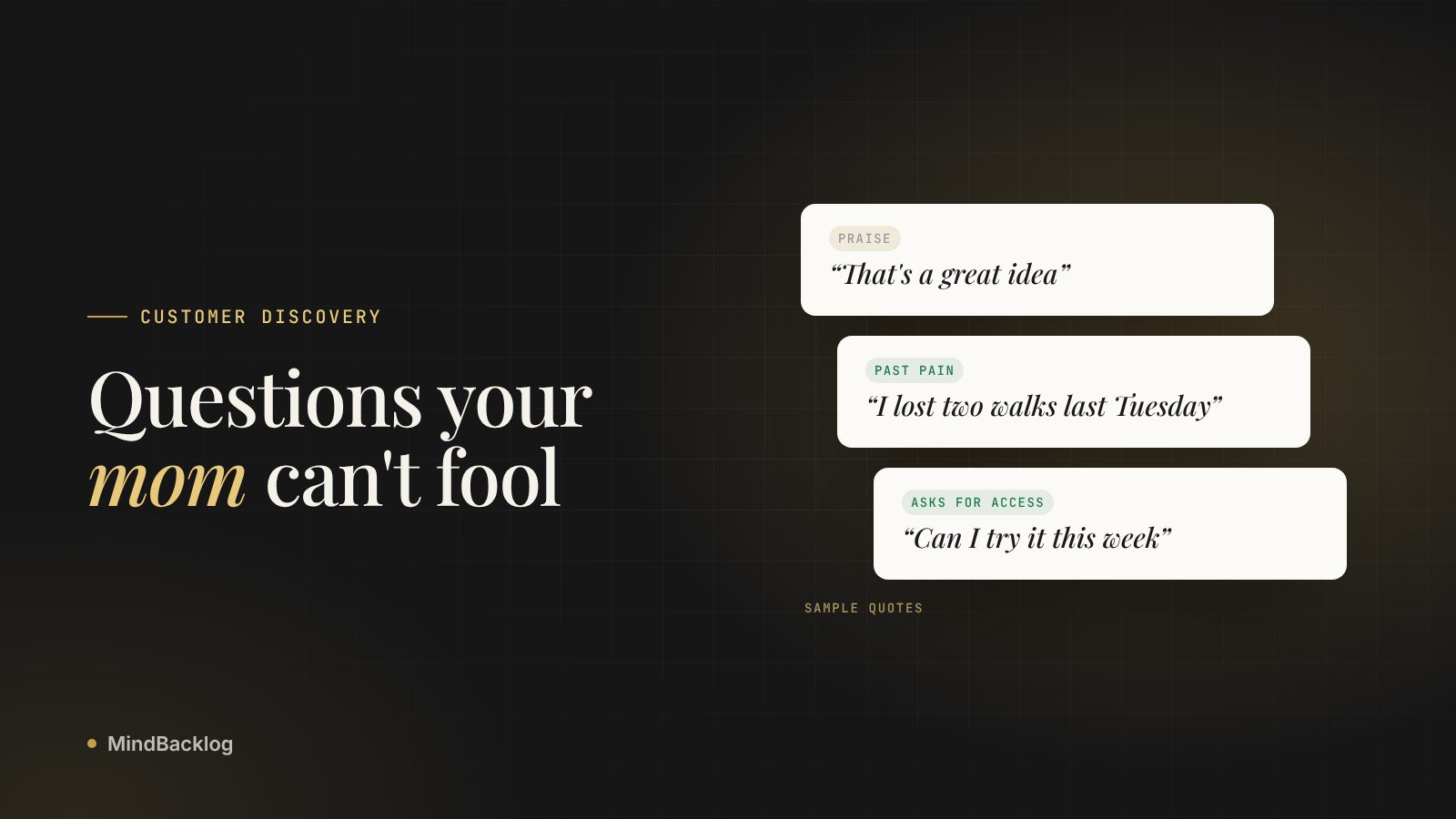
- That's a great idea
- I'd definitely use that
- I'd pay for that
- I usually handle it fine
- Last Tuesday I lost two walks
- Tried an app, then dropped it
- Can I try it this week?
- Talk to my friend Sam
Then grade each answer. The evidence ladder sorts what people said and did into six rungs, and only actions move a belief up.
- Praise. “Love it, great idea.” Never counts.
- Past pain. “Last Tuesday a client cancelled by text, I missed it and walked an empty route.” A real event, not led.
- Asks for access. “Can I try it when it’s ready?”
- Gives time. They book a second call to show you their booking spreadsheet.
- Makes an intro. They introduce you to two other walkers.
- Pays. They pay for a founding spot.
Notice where “I’d pay for that” lands. It sounds like the top rung and sits on the bottom one, with the rest of the praise.
Check these before you open Cursor
- You can describe the problem with a quote about a real past event
- You know what they do about it today, and what that costs
- No decision rests on a compliment or a prediction
- At least one person gave you time, an intro or money
- You know the first question you’d ask on the next call
Note. You can describe your idea, at the end. Do it briefly, then ask for a commitment rather than an opinion. Treat anything said after the pitch as weaker than what came before it.
If you’re still pre-product, the page for founders with an idea and no users yet sets out what to learn first.
Sort what you heard by what it cost them. Track each belief and how strong the evidence is, with praise never counted as proof.
Start free trialDoing this in MindBacklog
Drop a transcript and Mind keeps every piece in their words. Track what you believe and how strong the evidence is, on six rungs: praise, past pain, asks for access, gives time, makes an intro, pays. Praise never counts as proof, and a test’s pass line is set first. How beliefs and evidence work.
Questions
What are the Mom Test rules?
Keep the conversation on their life rather than your idea. Ask about specific things that happened rather than opinions or guesses about the future. Listen more than you talk. Those three cover most of the book’s advice on asking questions.
What is a good Mom Test question?
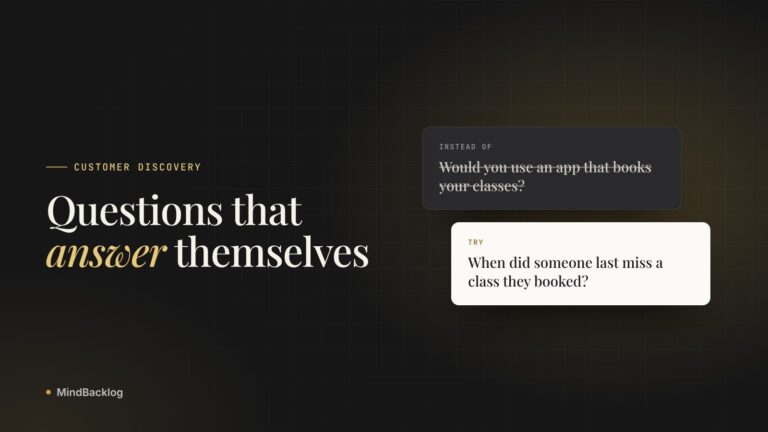
“Tell me about the last time this happened” works for almost any problem. It asks for a real event and what they did, which are facts. “Would you use an app that does this?” is the classic question that fails.
Do Mom Test conversations need to be formal interviews?
No. The book argues that many good ones are casual: a few questions over coffee or at an event, with no meeting booked. Record a formal call when you can, but the rules apply either way.