A product vision statement is the most influential single sentence in product management. When it works, it aligns every team member on where the product is headed, guides hundreds of prioritization decisions without the PM being in the room, and inspires customers, investors, and employees with a compelling picture of the future the product is creating. When it does not work — when it is vague, generic, or disconnected from reality — it hangs on a wall or sits in a slide deck and influences nothing.
The challenge of writing a great vision statement is that it must simultaneously be inspiring (motivating people to work toward a future state), specific (guiding concrete decisions about what to build and what not to build), flexible (accommodating strategic pivots and market changes), and differentiated (distinguishing your product from alternatives). Getting all four right in one sentence is genuinely difficult, which is why most vision statements fail — they achieve one or two of these qualities at the expense of the others.
What a Vision Statement Is (and Is Not)
A product vision statement describes the future state your product is working toward. It is not a description of what the product does today — that is a product description. It is not a list of features — that is a roadmap. It is not a financial target — that is a business plan. It is a picture of the world as it will be when your product has succeeded at its mission.
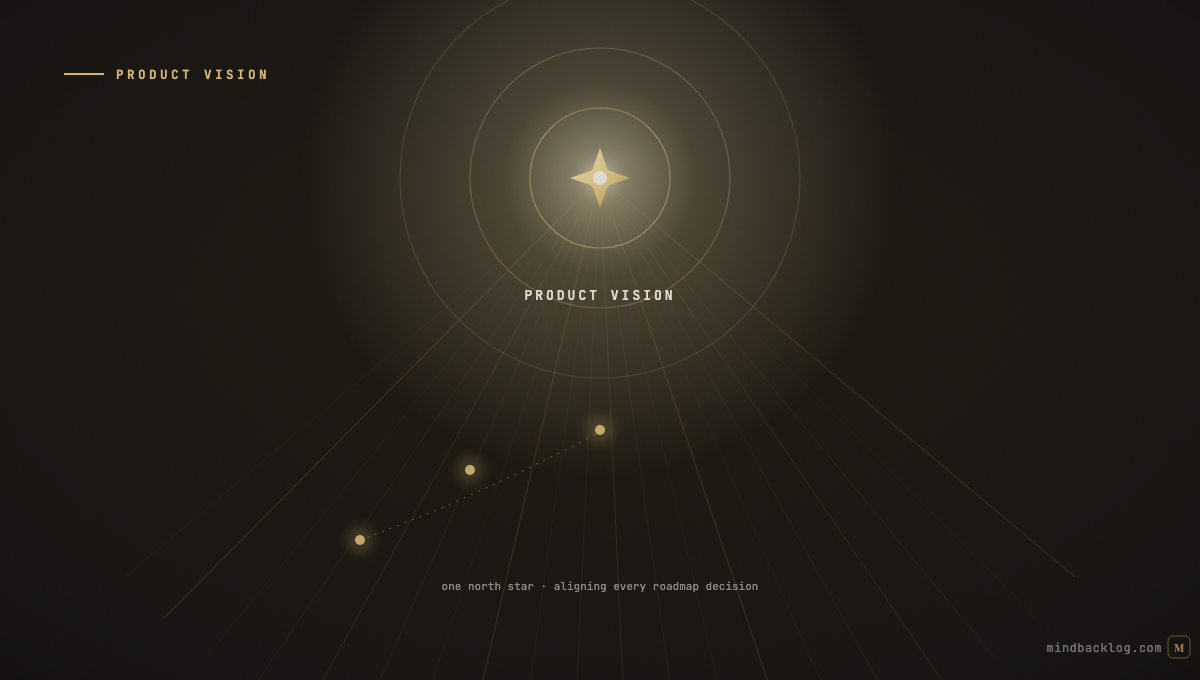
A vision statement operates at a higher level of abstraction than strategy or tactics. Strategy defines how you will achieve the vision. Tactics define what you will do this quarter to execute the strategy. The vision is the north star that both strategy and tactics point toward. It should be stable across multiple strategy cycles — if your vision changes every quarter, it is too tactical.
The best vision statements are short enough to remember, vivid enough to imagine, and aspirational enough to inspire — but grounded enough to be believable. ‘Make the world a better place’ is inspiring but not actionable. ‘Increase market share by 15 percent’ is actionable but not inspiring. The sweet spot is a statement that paints a clear picture of the future while implying the path to get there.
The Vision Statement Framework
A structured framework helps ensure that your vision statement covers the essential components without becoming unwieldy. The components are: who you serve (the target user or customer), what problem you address (the pain or opportunity), how you solve it differently (your unique approach), and what outcome you create (the future state).
Template: ‘For [target users] who [problem], [product name] is the [solution category] that [key benefit] by [differentiator].’ This template is a starting point, not a formula. The best vision statements often deviate from any template, but working through the components ensures nothing essential is missing.
Example: ‘For product managers who drown in scattered customer feedback, MindBacklog is the AI-native intelligence platform that turns every customer voice into evidence-based product decisions by building persistent understanding of your product that compounds with every signal.’ This hits all four components: target user, problem, solution approach, and unique differentiator.
Testing Your Vision Statement
Five tests determine whether your vision statement is effective. The decision test: when two team members disagree about whether to build a feature, does the vision statement help resolve the debate? If the vision is too vague to inform feature-level decisions, it is not specific enough.
The differentiation test: if you replace your product name with a competitor’s name, does the statement still make sense? If it does, the statement is not sufficiently differentiated.
The inspiration test: does the statement make a talented engineer or designer want to work on this product? If it sounds like a corporate mission statement rather than an exciting future, it lacks emotional resonance.
The longevity test: will this statement still be relevant in three years? If it would need to change with your next product release, it is too tactical.
The elevator test: can you say it from memory in one breath? If it requires reading from a document, it is too long to serve as a daily alignment tool.
From Vision to Daily Decisions
A vision statement’s value is measured by its influence on daily decisions, not by its eloquence. The connection from vision to decisions flows through a cascade: the vision defines the destination, strategic objectives define the milestones along the way, feature themes define the areas of investment, and specific features define the work.
When this cascade is intact, every feature on the roadmap can be traced back to the vision through a clear chain of reasoning. ‘We are building advanced search filtering because it supports our retention objective, which supports our vision of turning every customer voice into evidence-based decisions by making it faster to find the evidence.’ This traceability gives every team member context for why their work matters.
AI-powered product management tools strengthen this cascade by maintaining explicit connections between features, objectives, and product context. The AI Priority Score evaluates strategic alignment — how well each feature supports the objectives that advance the vision. This automated alignment check ensures that the roadmap stays connected to the vision even as the backlog grows and the number of features being evaluated exceeds what any PM can manually trace.
Maintaining the Vision Over Time
A vision statement should be revisited annually — not to change it arbitrarily, but to confirm that it still reflects the product’s aspirations in light of market changes, competitive dynamics, and organizational learning. If the market has shifted fundamentally, the vision should evolve. If the core aspiration remains valid, the vision should remain stable, even if the strategy for achieving it has changed.
When the vision does change, the cascade must be updated: objectives realigned, feature themes reconsidered, and AI scoring criteria refreshed. A vision change without a corresponding cascade update creates a dangerous disconnect — the team is ostensibly working toward a new vision while the prioritization system is still optimizing for the old one.
|
MindBacklog connects your product vision to daily decisions through OKR-powered AI scoring. Every feature is evaluated for strategic alignment. Every recommendation reflects your direction. Build toward your vision with evidence. Start at mindbacklog.com. |
Ready to put your product intelligence on autopilot? Start your 14-day free trial at MindBacklog.com — no credit card required.