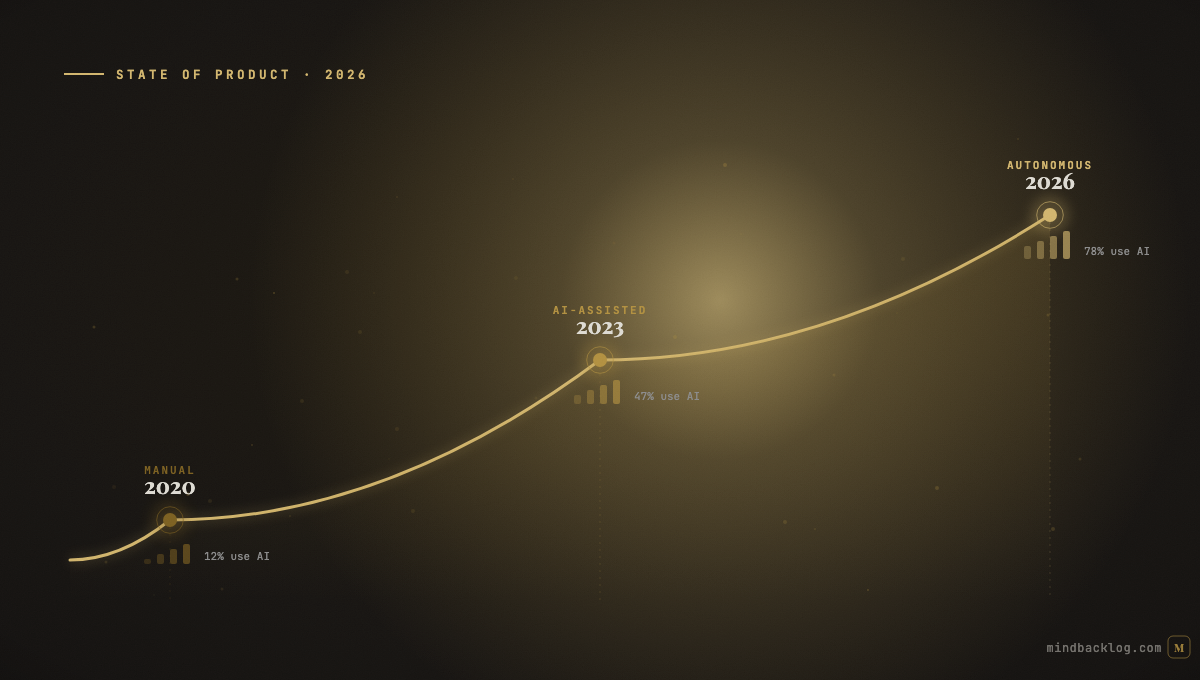
Product management in 2026 looks recognizably similar to product management in 2023 — and profoundly different. The core responsibilities have not changed: PMs still own the intersection of business viability, customer desirability, and technical feasibility. They still need to understand customers deeply, prioritize ruthlessly, and communicate direction clearly. What has changed is how these responsibilities are executed. The operational machinery of product management — the triage, the scoring, the drafting, the cross-referencing — is being absorbed by AI at a pace that would have seemed implausible three years ago.
This report synthesizes the major trends, shifts, and tensions that define the product management discipline as it stands today. It is not a prediction about what might happen. It is an assessment of what is already happening, based on how the most effective product teams are working right now.
The AI Adoption Curve in PM
AI adoption among product teams has followed a characteristic S-curve. In 2023 and early 2024, adoption was experimental — individual PMs using ChatGPT for ad-hoc drafting, small teams testing AI-powered feedback tools. By late 2024, adoption reached the early majority: most PM teams were using at least one AI tool in their workflow, typically for writing assistance or feedback summarization.
In 2026, we are in the late majority phase. AI is no longer a differentiator — it is an expectation. Job postings for PM roles routinely include AI proficiency as a required or preferred skill. Product leadership expects AI-assisted outputs as the baseline. And the conversation has shifted from ‘should we use AI?’ to ‘how deeply should AI be integrated into our workflow?’
The depth of integration varies dramatically. At one end of the spectrum, some teams use AI as a writing assistant — a faster way to produce first drafts of existing document types. At the other end, teams have adopted AI-native platforms where the entire product management pipeline — from signal ingestion through classification, scoring, specification, and roadmap management — operates on an AI foundation. The gap between these two levels of adoption is growing, and it correlates increasingly with the quality and speed of product decisions.
The PM Role Is Evolving, Not Disappearing
The persistent question — will AI replace PMs? — has been answered by reality: no, but it is transforming what PMs do. The operational tasks that consumed 50 to 60 percent of a PM’s time in 2023 — feedback triage, manual scoring, specification drafting, status reporting — are being automated. This does not eliminate the PM role. It elevates it.
The PMs who are thriving in 2026 are those who have reoriented their practice around the tasks that AI cannot perform: strategic vision-setting, stakeholder alignment, ethical judgment, customer empathy, and the creative synthesis that produces novel product insights. They use AI for the operational baseline and invest their freed time in the high-judgment work that creates the most value.
A new competency has emerged alongside this shift: context engineering — the skill of curating and maintaining the product knowledge that AI systems use to make recommendations. PMs who invest in building rich product context for their AI tools see dramatically better outputs than those who use AI tools without context. This skill did not exist three years ago. It is rapidly becoming a defining capability of effective PMs.
The Feedback Problem Is (Almost) Solved
For years, the multi-source feedback problem — customer signals scattered across email, support tickets, social media, app reviews, and internal channels — was the most time-consuming operational challenge in PM. It remains a challenge, but the tools to solve it have arrived.
Multi-source ingestion platforms that capture feedback from seven or more channels through a unified AI pipeline are now available at startup-friendly price points. Semantic deduplication that catches meaning-level duplicates regardless of language has replaced inadequate keyword matching. And evidence-based scoring that synthesizes signal volume, sentiment, strategic alignment, and competitive urgency into defensible priority rankings is replacing gut-feel prioritization.
The feedback problem is not fully solved — Reddit integration, audio/video feedback parsing, and closed-loop learning (comparing predictions to post-ship actuals) remain frontier capabilities. But the core workflow — capture, classify, consolidate, score — is now automatable for any team willing to adopt the right tooling.
Tool Consolidation Is Accelerating
The average PM in 2024 used seven to eight software tools daily. In 2026, the most effective teams have consolidated to three to four by adopting integrated platforms that span multiple stages of the product workflow. The driver is not just cost (though the savings are real) but intelligence continuity — the insight that a single platform with a shared data model and shared AI context produces better outcomes than a collection of disconnected point solutions.
The tools most commonly consolidated are feedback collection, prioritization, roadmapping, and specification writing. Development execution (Jira, Linear, Azure DevOps) remains a separate tool for most teams, connected to the PM platform through sync integrations. Analytics platforms (Amplitude, Mixpanel) similarly remain separate but increasingly connected.
The consolidation trend favors AI-native platforms that were designed around intelligence from the ground up. Platforms that bolted AI onto an existing architecture are hitting ceilings — the underlying data model was not designed for AI-driven workflows, and the resulting user experience feels like a collection of features rather than a coherent intelligence system.
Evidence-Based Prioritization Is Becoming Standard
The era of opinion-based prioritization is ending. The PM who walks into a planning meeting with ‘I think Feature A is more important than Feature B’ is increasingly met with ‘based on what data?’ Teams that have adopted evidence-based scoring — where every feature’s priority is grounded in customer signal volume, sentiment, strategic alignment, and competitive context — report higher stakeholder trust, fewer priority disputes, and better product outcomes.
The shift is driven partly by AI making evidence collection automatic (so the data exists without manual effort) and partly by organizational maturity (leadership teams are demanding data-driven decisions in product just as they have in finance and marketing). The result is a professionalization of product prioritization that brings the discipline closer to the analytical rigor that other business functions have long practiced.
What Comes Next
Three developments will define the next phase of product management evolution. First, closed-loop learning — AI systems that compare their predictions (this feature will reduce churn by X percent) against actual outcomes and recalibrate their scoring models accordingly. This turns the AI from a static scorer into a learning system that gets quantifiably better over time.
Second, velocity-adjusted roadmapping — integrating real-time development velocity data into roadmap timelines so that feature delivery predictions are based on actual team performance rather than initial estimates. This closes the gap between planning and execution that has plagued roadmaps since their invention.
Third, AI participants in product ceremonies — AI systems that attend standup, refinement, and planning meetings (initially as audio-only participants) and contribute by answering questions about the backlog, surfacing relevant customer evidence, and documenting decisions in real time. This is ambitious but technically feasible, and early implementations are already being tested.
The common thread across all three developments is the deepening integration of AI into the product management workflow — not as a separate tool the PM uses occasionally, but as an embedded collaborator that participates in every phase of the product lifecycle.
|
MindBacklog is built for the AI-native era of product management — multi-source feedback consolidation, persistent product intelligence, evidence-based scoring, and a workflow that channels PM energy to strategic decisions. Join the teams defining the next era. Start at mindbacklog.com. |
Ready to put your product intelligence on autopilot? Start your 14-day free trial at MindBacklog.com — no credit card required.


