If you have used a modern product management tool that offers ‘intelligent search,’ ‘automatic deduplication,’ or ‘semantic matching,’ you have benefited from vector embeddings — even if you have never heard the term. Embeddings are the foundational technology that enables AI to understand what text means, not just what words it contains. They are why a system can match ‘the user search takes forever’ with ‘we need better filters on the people directory’ — two pieces of feedback with almost no overlapping words that describe the same customer need.
For product managers, understanding embeddings is not about becoming a machine learning engineer. It is about understanding the capability that powers the most important AI features in your PM toolkit — so you can evaluate tools more effectively, troubleshoot when results seem wrong, and make better decisions about how to structure your product data for AI processing.
What Embeddings Are (Without the Math)
An embedding is a mathematical representation of meaning. When an AI system processes a piece of text — say, a customer feedback email — it converts that text into a list of numbers, typically between 768 and 3,072 numbers long. This list of numbers is the embedding. Each number captures one aspect of the text’s meaning, and the combination of all numbers together represents the text’s overall semantic content.
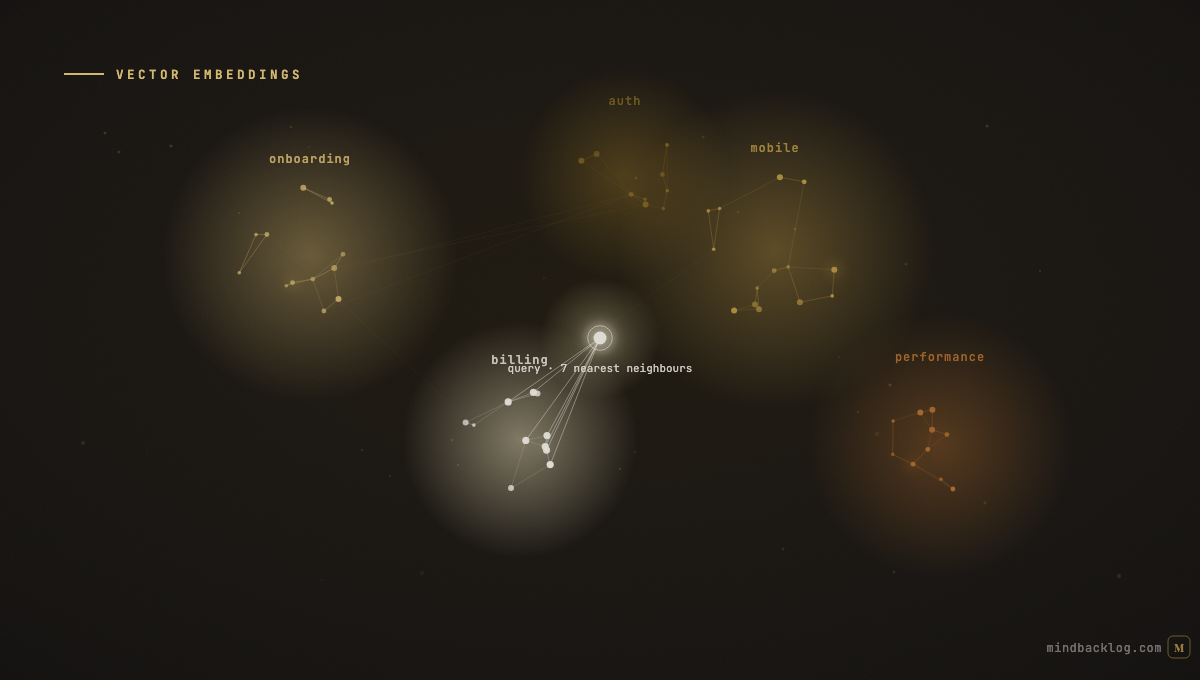
Think of it as coordinates in a very high-dimensional space. In a two-dimensional map, every location has an x and a y coordinate. In embedding space, every piece of text has hundreds or thousands of coordinates. Texts that are similar in meaning have similar coordinates — they are close together in this space. Texts that are different in meaning have different coordinates — they are far apart.
The key insight is that this similarity is semantic, not lexical. The embeddings for ‘the search is too slow’ and ‘I can never find users quickly enough’ are close together — because they mean similar things — even though they share almost no words. The embeddings for ‘the search is too slow’ and ‘the search for a new hire is going well’ are far apart — because despite sharing the word ‘search,’ they mean completely different things.
How Embeddings Power PM Features
Three core PM capabilities are built on embeddings: duplicate detection, feature clustering, and semantic search.
Duplicate detection works by comparing the embedding of a new piece of feedback against the embeddings of all existing feature ideas. If the new feedback’s embedding is very close to an existing feature’s embedding (above a similarity threshold, typically 0.80 to 0.85 on a 0-to-1 scale), the system recognizes them as semantically related and links the feedback to the existing feature. This catches duplicates that keyword matching would miss entirely.
Feature clustering groups unmatched feedback into coherent themes. When multiple pieces of feedback have similar embeddings but do not match any existing feature, clustering algorithms (like HDBSCAN) group them together. The PM can then review each cluster and decide whether it represents a new feature idea worth pursuing. Clustering is how AI discovers feature needs that no individual piece of feedback would have surfaced — the pattern only becomes visible when many similar signals are viewed together.
Semantic search enables meaning-based retrieval. When the PM searches for ‘frustrated with onboarding,’ the system does not look for the words ‘frustrated’ and ‘onboarding’ in the text. It computes an embedding for the query and finds all feedback items with similar embeddings. This returns results like ‘the signup flow is so confusing,’ ‘I couldn’t figure out how to set up my first project,’ and ‘new users keep asking us for help getting started’ — none of which contain the search terms but all of which describe onboarding frustration.
The Product Context Connection
Embeddings become more powerful when combined with product context. A raw embedding model processes text based on general language understanding. A context-enhanced system uses your product’s knowledge to interpret embeddings more accurately.
For example, the word ‘dashboard’ has a generic meaning in embedding space. But in the context of your specific product, ‘dashboard’ refers to a specific feature area with specific functionality and specific users. A context-aware system weights the embedding interpretation toward your product’s definition of ‘dashboard,’ improving matching accuracy for feedback about that feature area.
This is why a product knowledge system — like a MIND engine that maintains persistent context about your product — improves the quality of embedding-powered features over time. The system is not just computing generic text similarity. It is computing product-specific semantic similarity, informed by everything it knows about your product, your users, and your feature landscape.
What PMs Should Know About Embedding Quality
Not all embeddings are created equal. The quality of the embedding model determines the quality of every downstream feature that depends on it. Higher-dimensional embeddings (3,072 dimensions vs. 768) generally capture more nuance but require more storage and computation. Models trained on diverse, high-quality text data produce better embeddings than models trained on narrow or noisy data.
For PMs evaluating AI tools, two questions are diagnostic. First, what embedding model does the tool use, and what is its dimensionality? Higher dimensionality generally means better semantic understanding. Second, is the embedding model general-purpose or fine-tuned for your domain? A general-purpose model works well for most feedback processing. A domain-specific model (trained on SaaS product feedback, for example) would work even better but is rare.
The practical takeaway: embeddings are the invisible foundation of intelligent product management tools. When your tool catches a duplicate you would have missed, clusters feedback into a new feature idea, or finds a relevant signal from three months ago using a meaning-based search — embeddings made it possible.
|
MindBacklog uses 3,072-dimension vector embeddings for semantic matching, duplicate detection, and intelligent search — all powered by the MIND engine’s product context. AI that understands meaning, not just words. Start at mindbacklog.com. |
Ready to put your product intelligence on autopilot? Start your 14-day free trial at MindBacklog.com — no credit card required.