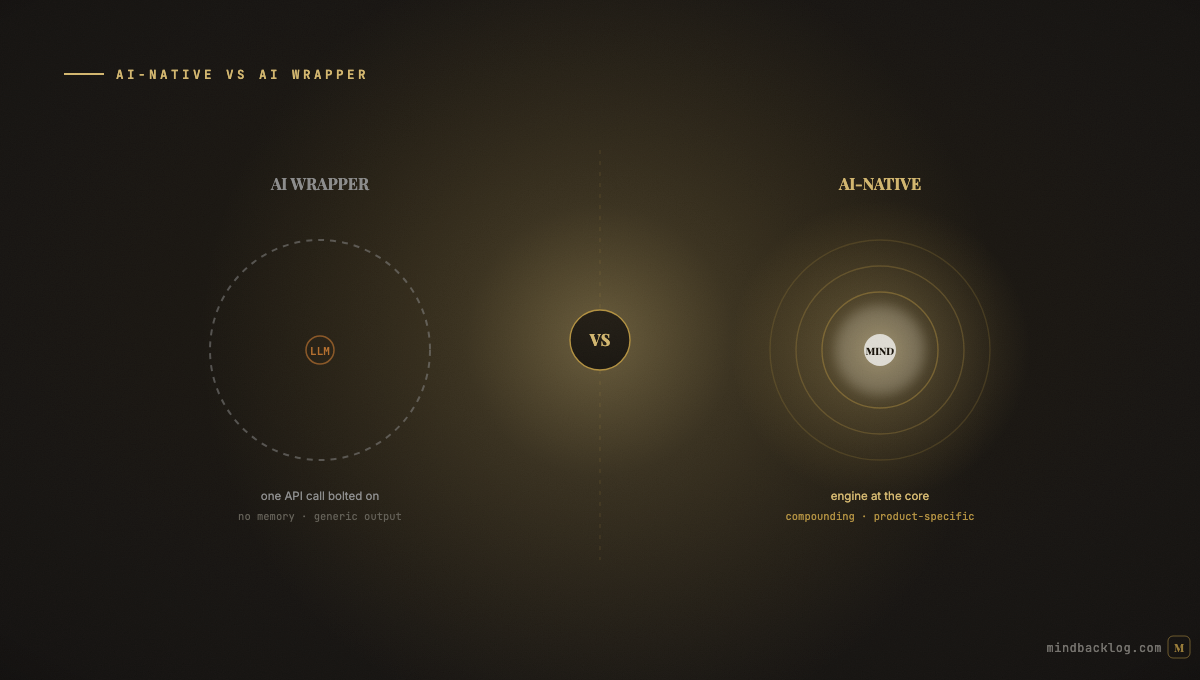
Every product management tool in 2026 claims to be ‘AI-powered.’ Open any PM tool’s marketing page and you will find the phrase. But beneath identical marketing language, two fundamentally different architectures exist. AI wrappers are existing tools that have added AI features on top of their original architecture. AI-native platforms are tools built from the ground up around an AI intelligence engine. The difference is not cosmetic. It determines the quality of AI outputs, the depth of automation possible, and whether the tool gets smarter over time or stays the same.
This distinction matters because it is invisible from a feature checklist. Both an AI wrapper and an AI-native platform can claim ‘AI-powered PRD generation,’ ‘AI feedback classification,’ and ‘AI priority scoring.’ The checklist looks identical. The experience is not, because the architecture determines whether the AI has the context to produce useful outputs or is operating blind.
What Defines an AI Wrapper
An AI wrapper has four architectural characteristics. First, AI features are additive rather than foundational. The tool was originally built without AI, and AI capabilities were added later — typically as buttons that invoke LLM API calls. ‘Summarize this feedback,’ ‘Generate a PRD from this description,’ ‘Write user stories for this feature.’ Each button triggers a one-shot API call that processes only the data explicitly provided, with no persistent context.
Second, every AI interaction starts from zero. The AI has no memory of your product, your users, your previous sessions, or your past decisions. Each time you invoke an AI feature, you are working with a blank-slate model that knows nothing about your specific context. The quality of the output depends entirely on what you paste into the prompt or what the tool passes from the current page.
Third, the underlying data model was not designed for AI. The database schema, the API structure, and the application logic were designed for manual workflows. AI features operate on top of this structure rather than within it, which creates limitations: the AI cannot easily access cross-cutting data (signals from multiple sources, features from multiple stages, historical patterns across the backlog) because the data model does not support those queries efficiently.
Fourth, the AI does not improve with use. The tool produces the same quality output on day one as on day three hundred, because there is no mechanism for the AI to learn from your product’s specific patterns, your feedback history, or your decision outcomes. Usage generates data, but the data does not feed back into the AI’s understanding.
What Defines an AI-Native Platform
An AI-native platform inverts every characteristic of the wrapper. AI is foundational rather than additive. The entire product was designed around an AI intelligence engine — the data model, the processing pipeline, the user workflow. Every feature assumes AI processing. Feedback does not wait for manual classification — it is classified automatically upon arrival. Features are not scored when the PM remembers to click a button — they are scored continuously as evidence accumulates.
Persistent product context means the AI maintains a continuously updated understanding of your product. It knows your product areas, your user segments, your competitive landscape, your strategic objectives, and the patterns in your customer feedback. This context is not rebuilt for each interaction — it persists across sessions, deepens with every signal processed, and informs every AI output across the platform.
The data model is designed for AI from the ground up. Vector embeddings are stored alongside text data. Semantic similarity indices power deduplication and matching. The schema supports the cross-cutting queries that AI needs: all signals related to a product area, all features aligned with an objective, all competitive signals that overlap with customer requests. These queries are not afterthoughts — they are core to the architecture.
The AI compounds with use. Every signal processed improves the system’s understanding of your product. Every PM correction trains the classification accuracy. Every context source merged deepens the product knowledge base. Six months of usage produces an AI that understands your product at a qualitatively different level than day one — classification is more accurate, PRDs are more specific, scoring is better calibrated, and recommendations are more relevant.
The Output Quality Gap
The practical consequence of these architectural differences is a dramatic quality gap in AI outputs. Consider a PRD generated for a search improvement feature. An AI wrapper produces: ‘This feature will improve search functionality, allowing users to find information more quickly and efficiently.’ An AI-native platform produces: ‘This feature addresses the most frequently reported enterprise pain point — account lookup latency — cited in 47 signals from 23 accounts across email, support, and web form channels. CSMs managing 50+ accounts report that finding specific at-risk accounts during morning reviews takes 3-5 minutes, disrupting their workflow. The improvement targets a 95th-percentile lookup time of under 2 seconds for datasets up to 50,000 accounts, directly supporting the Q2 retention objective.’
Same feature. Same AI capability label on the feature checklist. Completely different output quality. The difference is context — and context is an architectural property, not a feature.
The Compounding Advantage
The most consequential difference is compounding. An AI wrapper delivers the same value on month twelve as on month one. An AI-native platform delivers dramatically more value on month twelve because the AI’s understanding of your product has deepened through twelve months of signal processing, context merging, and pattern learning.
This compounding creates both a value moat (the platform becomes more valuable the longer you use it) and a switching cost (the accumulated intelligence cannot be easily transferred to another tool). Both benefit the user: the product gets better with time, and the investment in context engineering pays compounding dividends.
How to Evaluate AI Depth in PM Tools
Five diagnostic questions separate AI-native from AI wrapper. Does the system maintain persistent product context across sessions? Does it connect to your data sources and process information automatically? Can it execute multi-step workflows without manual initiation at each step? Does its accuracy and relevance improve over time? Does it take actions in your workflow (creating features, updating scores, linking signals), or only produce text?
A ‘no’ to any of these suggests a wrapper rather than a native platform. The more ‘yes’ answers, the deeper the AI integration — and the better the outputs will be, especially over time.
| MindBacklog is AI-native — built from the ground up around the MIND intelligence engine. Persistent context, multi-source pipeline, compounding intelligence. Not a wrapper. Experience the difference. Start at mindbacklog.com. |
Ready to put your product intelligence on autopilot? Start your 14-day free trial at MindBacklog.com — no credit card required.


