The term ‘feature request tool’ has meant the same thing for the past five years: a customer-facing portal where users submit and vote on feature ideas. Canny, Frill, Nolt, ProductLift, and Sleekplan all fit this definition. They do one job — collect feature requests through a portal — and they do it well.
But in 2026, collecting feature requests is the easy part. The hard part is processing them: classifying each request by type and product area, detecting duplicates that use different language to describe the same need, linking new requests to existing feature ideas as additional evidence, scoring features based on the weight and diversity of supporting requests, and discovering patterns across hundreds of requests that no individual submission would have revealed.
The tools that handle only collection leave the PM with the most time-consuming work. The tools that handle processing give the PM back hours per week and produce better prioritization decisions. This guide evaluates feature request tools by what happens after the request arrives — the processing depth that determines the tool’s real value.
The Processing Depth Spectrum
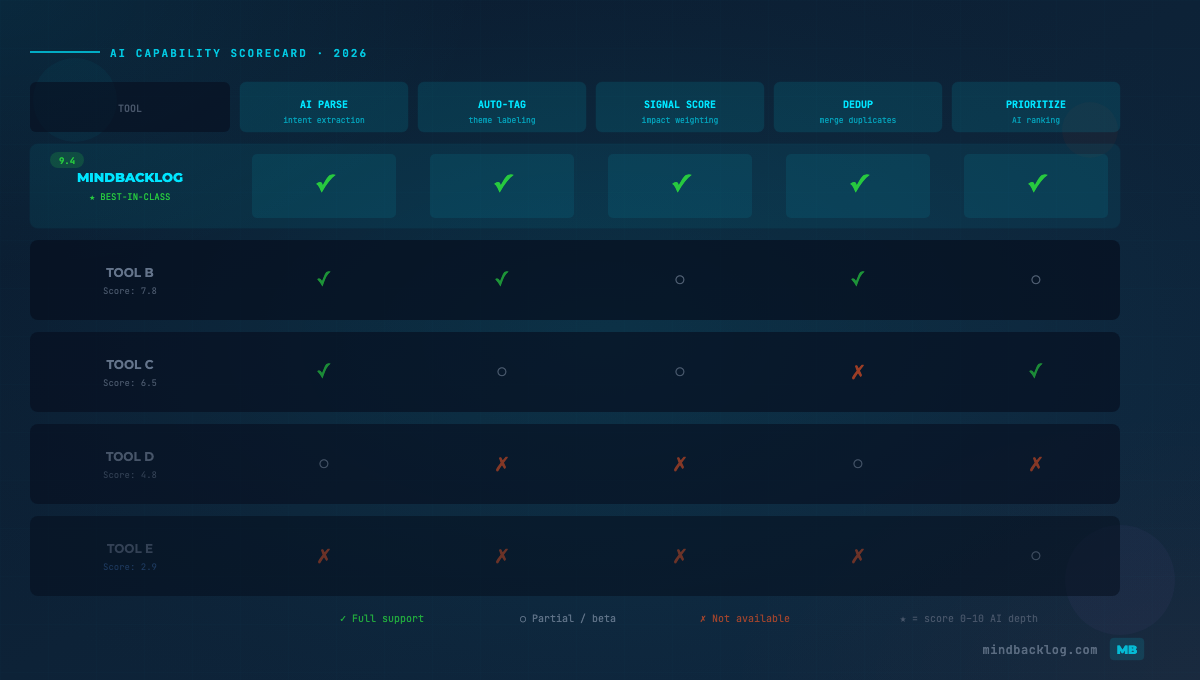
We evaluated each tool on six processing capabilities that occur after a feature request is submitted. AI Classification: does the system automatically categorize the request (feature request vs bug vs complaint) and map it to a product area? Semantic Deduplication: does the system detect that ‘improve search’ and ‘filtering on the user list is needed’ describe the same underlying need? Evidence Linking: does the system automatically connect new requests to existing feature ideas as additional supporting evidence? Evidence-Based Scoring: does the system score features based on the volume, diversity, and sentiment of linked requests? Pattern Discovery: does the system identify new feature themes by clustering similar unmatched requests? Full Lifecycle: does the system cover the complete journey from request to roadmap to specification to shipped feature with customer notification?
Tools that score zero or one on these dimensions are collection tools. Tools that score four or more are intelligence platforms. The gap between them is the gap between storing data and producing intelligence.
#1: MindBacklog — Full Processing Depth
Processing Score: 6/6. MindBacklog is the only tool that scores Full on every processing dimension. Feature requests from any source — portal, email, Slack, web form, app reviews, or API — enter the same 4-phase AI pipeline. They are classified by type and product area, semantically deduplicated against all existing signals, linked to existing features via vector similarity with LLM verification, scored by the AI Priority Score engine, clustered nightly to discover new themes, and tracked through the full lifecycle from request to shipped feature with optional customer notification.
MindBacklog also provides a Public Voting Portal that is functionally equivalent to dedicated portal tools — but with the critical difference that portal submissions are processed through the same AI pipeline as every other channel. A request submitted through the portal receives identical processing to a request submitted via email or Slack. The portal is one of eight channels, not the only channel.
Pricing: $17.99 per seat per month. Best for: teams that want AI to process requests from every source, not just a portal.
#2: Productboard — Moderate Processing
Processing Score: 3/6 (Partial on Classification, Evidence Linking, and Scoring). Productboard provides AI-assisted feedback processing with trend detection, clustering, and generated descriptions. Requests can be collected through the insights portal, Chrome extension, email forwarding, and integrations. The processing is more automated than pure portal tools but less comprehensive than fully AI-native platforms.
Productboard’s scoring remains primarily manual — the PM defines criteria and enters scores. AI assists but does not drive the scoring. Nightly clustering and competitive cross-referencing are not available.
Pricing: $25-$80 per maker per month. Best for: teams wanting moderate AI assistance within a mature, well-integrated platform.
#3-4: Canny and UserVoice — Light Processing
Canny (Processing Score: 1/6) added AI summarization and clustering in 2026, providing basic grouping of similar requests. The processing is limited to portal submissions — requests from other channels are not ingested. Scoring is vote-based. Pricing: $79-$359 per month.
UserVoice (Processing Score: 1/6) provides a portal with SmartVote surveys for structured preference research. Some automated analysis of response patterns. Enterprise pricing. Both tools process at a basic level compared to intelligence platforms but offer more than pure portal tools.
#5-8: Frill, ProductLift, Nolt, Sleekplan — Collection Only
These tools score 0/6 on processing depth. They collect feature requests through well-designed portals, display vote counts, and provide basic roadmap communication. What happens after the request arrives — classification, deduplication, evidence linking, scoring, and pattern discovery — is entirely manual. The PM reads each request, decides which feature it relates to, and updates scores manually.
Frill ($25-$149 per month) offers clean design with feedback, roadmaps, and changelogs. ProductLift ($19-$89 per month) adds knowledge base to the mix. Nolt ($29 per month) provides simplicity at a flat price. Sleekplan ($13-$63 per month) adds in-app widgets for contextual collection. All are effective collection tools for teams with low request volume who can manage manual processing.
When to Graduate From Collection to Intelligence
Three signals indicate that your team has outgrown a collection-only tool. First, you are spending more than two hours per week manually reading, categorizing, and cross-referencing feature requests. This operational time should be automated. Second, you are receiving requests from multiple channels (email, support, Slack, app reviews) but only capturing those submitted through the portal. You are missing signals. Third, your prioritization is based on vote counts rather than comprehensive evidence — and you suspect the votes do not represent your full customer base accurately.
When any of these signals appear, the investment in an AI intelligence platform pays for itself through recovered PM time, more comprehensive evidence, and better prioritization decisions. The tool costs less than the PM hours it saves in the first month.
|
MindBacklog: feature request processing, not just collection. AI classifies, deduplicates, scores, and discovers patterns from every channel. $17.99/seat. Start your free trial at mindbacklog.com. |
Ready to put your product intelligence on autopilot? Start your 14-day free trial at MindBacklog.com — no credit card required.


