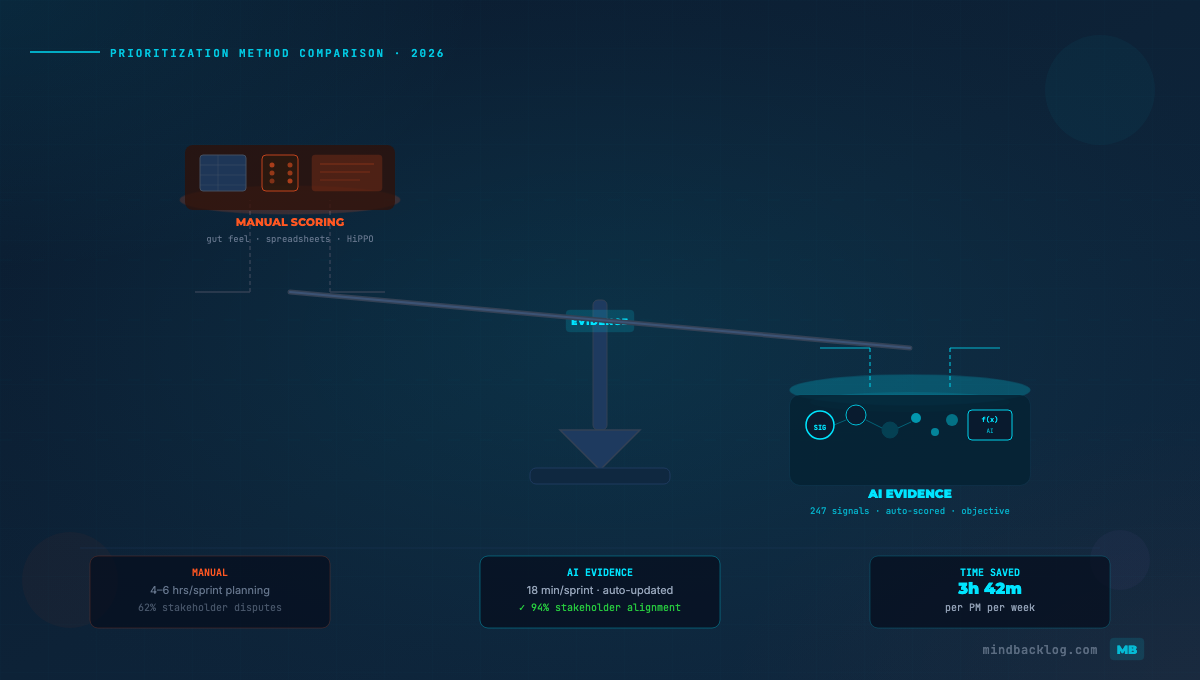
Feature prioritization software exists on a spectrum. At one end, tools provide frameworks and structure for manual scoring — the PM defines criteria, assigns weights, and enters scores for each feature. At the other end, tools calculate scores automatically from customer evidence — the AI evaluates signal strength, sentiment, strategic alignment, and competitive context without manual input. Most tools cluster at the manual end. A few operate at the AI end. This guide evaluates seven prioritization tools across the spectrum so you can choose the approach that matches your team’s data maturity and time constraints.
The central question is not ‘which tool has the best scoring framework?’ but rather ‘what inputs should drive your scores?’ In 2026, the most defensible scores are those grounded in customer evidence — actual signals from real users expressing real needs — rather than in a PM’s subjective estimate of ‘business value: 8 out of 10.’ The tools that connect scoring to evidence produce rankings that stakeholders trust and that correlate with actual product outcomes.
The Scoring Method Spectrum
Pure Manual scoring uses no framework — the PM sorts features by intuition or stakeholder pressure. This is the default when no prioritization tool is in place. It is fast but indefensible, inconsistent across PMs, and vulnerable to the HiPPO effect (highest paid person’s opinion).
Framework-Assisted Manual scoring uses structured frameworks (RICE, WSJF, ICE, weighted scoring) with the PM providing input values for each dimension. The framework provides consistency and rigor. The limitation is that every input is a subjective estimate — the PM guesses at Reach, Impact, Confidence, and Effort rather than measuring them.
AI Evidence-Based scoring uses AI to calculate scores from actual data — customer signal volume, sentiment intensity, source diversity, strategic alignment with defined objectives, and competitive urgency. The PM reviews and overrides where human judgment adds value, but the analytical foundation is evidence rather than estimation. Scoring updates automatically as new evidence arrives.
Hybrid scoring combines framework structure with AI-populated inputs. The PM uses a RICE or WSJF framework, but the input values are pre-calculated by AI from evidence data. The PM adjusts inputs based on strategic context the AI cannot assess, then the framework calculates the composite score.
#1: MindBacklog — AI Evidence-Based + Framework Support
MindBacklog provides three scoring approaches in one platform. The AI Priority Score is fully automated — calculated from signal strength (volume, sentiment, source diversity), strategic alignment (OKR mapping), feature completeness (description quality, linked evidence), and competitive context (competitor signals that overlap). The score updates continuously as new evidence arrives. No manual input required.
WSJF and RICE are available alongside the AI score for teams that prefer traditional frameworks. The frameworks can be used independently (manual input) or as hybrid systems where AI pre-populates the input values from evidence data. This flexibility means the PM can start with the AI score, validate with WSJF, and present whichever score resonates best with their stakeholders.
The evidence foundation is the differentiator. Scores are grounded in customer signals from 8 channels, not subjective estimates. When a stakeholder asks ‘why is this feature ranked #3?’ the answer includes signal counts, source channels, sentiment breakdown, and objective alignment — not ‘I think it is important.’ Pricing: $17.99 per seat per month.
#2: airfocus — Flexible Manual Frameworks
airfocus provides the most flexible manual scoring system on the market. You define your own criteria, your own weights, and your own scales. The framework can model almost any prioritization logic. AI capabilities include some feedback summarization and classification, but the scoring engine remains manual — every score is entered by the PM.
airfocus excels for teams that want precise control over their scoring methodology and have specific prioritization criteria that standard frameworks do not cover. The tradeoff is time investment — scoring twenty features across five dimensions requires one hundred manual entries. Pricing: approximately $69 per user per month.
#3: Productboard — Manual Scoring With AI Assistance
Productboard provides customizable scoring with configurable criteria and weights. AI assists by surfacing feedback trends and generating feature descriptions, but the scores themselves are manually entered. Productboard’s ecosystem strength (Intercom, Zendesk, Salesforce integrations) adds context to scoring decisions, though the context must be manually translated into scores.
Pricing: $25-$80 per maker per month. Best for teams that want scoring within a broader PM platform with strong CRM and support tool integrations.
#4: Aha! — Enterprise Manual Scoring
Aha! provides scoring cards with customizable criteria for enterprise product organizations. The depth of manual configuration is impressive — multiple score cards per product, weighted criteria, and portfolio-level scoring aggregation. AI assistance is limited to writing help. Pricing: $59 per user per month.
#5-7: Notion, Airtable, Google Sheets
These general-purpose tools can be configured for manual scoring using custom databases and formulas. They provide maximum flexibility but zero AI, zero feedback integration, and zero product management workflow. Every score is manually entered, every formula manually maintained, and every prioritization session manually prepared. They are the free or low-cost starting point that teams outgrow quickly.
How to Choose by Data Maturity
If you have no systematic feedback collection, start with a manual framework in airfocus or even a spreadsheet. The framework provides structure that gut-feel prioritization lacks. If you have moderate feedback from two to three sources, Productboard combines feedback collection with manual scoring in a mature platform. If you have multi-channel feedback flowing through an AI pipeline, MindBacklog’s evidence-based scoring produces the most defensible rankings with the least manual effort.
The upgrade path follows data maturity: spreadsheet → manual framework tool → AI evidence platform. Each step improves both the accuracy of scores and the time required to maintain them. The most mature state — AI evidence scoring that updates automatically — produces the best outcomes at the lowest ongoing time investment.
|
MindBacklog: feature prioritization powered by evidence, not estimates. AI Priority Score + WSJF + RICE in one platform. $17.99/seat. Start your free trial at mindbacklog.com. |
Ready to put your product intelligence on autopilot? Start your 14-day free trial at MindBacklog.com — no credit card required.