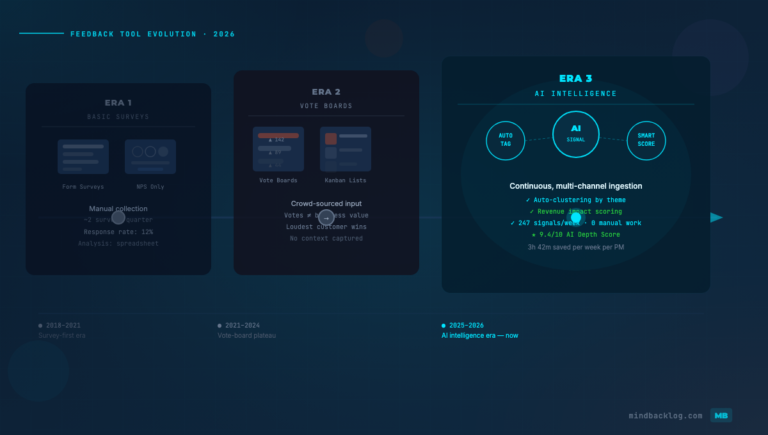
AI feedback analysis is a rapidly maturing tool category in 2026. The core promise is straightforward: instead of PMs manually reading, tagging, and cross-referencing hundreds of feedback items, AI processes the feedback automatically — classifying intent, detecting sentiment, identifying duplicates, clustering themes, and scoring features based on the strength of supporting evidence. The promise is real. The variation in how well different tools deliver on it is enormous.
This buyer’s guide evaluates the leading AI feedback analysis tools for B2B SaaS product teams, focusing on six criteria that determine real-world value: ingestion breadth (how many sources the tool processes), classification depth (how accurately it categorizes feedback), clustering quality (how well it discovers patterns), scoring intelligence (how effectively it prioritizes features from evidence), integration ecosystem (how it connects to your existing tools), and pricing model (whether the economics work for your team size).
The Evaluation Criteria
Ingestion Breadth measures how many feedback sources the tool can process. A tool that only analyzes portal submissions misses signals from email, support, app reviews, Slack, and social media. The most valuable feedback often comes from channels where customers express themselves naturally, not through structured forms. A high-breadth tool captures signals from everywhere customers talk about your product.
Classification Depth measures the accuracy and granularity of the AI’s categorization. Basic classification distinguishes positive from negative sentiment. Moderate classification adds intent detection (feature request vs bug vs complaint). Deep classification adds product area mapping, urgency scoring, multi-topic splitting, and submitter metadata extraction. Deeper classification produces more actionable output for the PM.
Clustering Quality measures how well the tool discovers patterns across individual feedback items. The highest-value capability in feedback analysis is the ability to see that fifty individual signals from different channels, using different language, describe the same underlying customer need. Clustering that catches meaning-level patterns (not just keyword overlap) produces the most useful feature proposals.
Scoring Intelligence measures whether the tool produces a prioritized ranking of features based on feedback evidence. Basic scoring counts votes or signal volume. Intermediate scoring adds sentiment weighting. Advanced scoring combines signal volume, sentiment intensity, source diversity, strategic alignment, and competitive context into a multi-dimensional score. The more dimensions, the more defensible the ranking.
Integration Ecosystem measures how the tool connects to development tools (Jira, Linear), communication tools (Slack), CRM (Salesforce, HubSpot), and AI clients (via MCP). A feedback analysis tool that exists in isolation forces the PM to manually transfer insights to other systems. A well-integrated tool flows intelligence to wherever it is needed.
Pricing Model determines whether the tool is economically viable for your team. Enterprise-only pricing (custom quotes, annual contracts, minimum seats) excludes startups and small teams. Per-seat pricing with self-serve plans enables adoption at any scale.
#1: MindBacklog
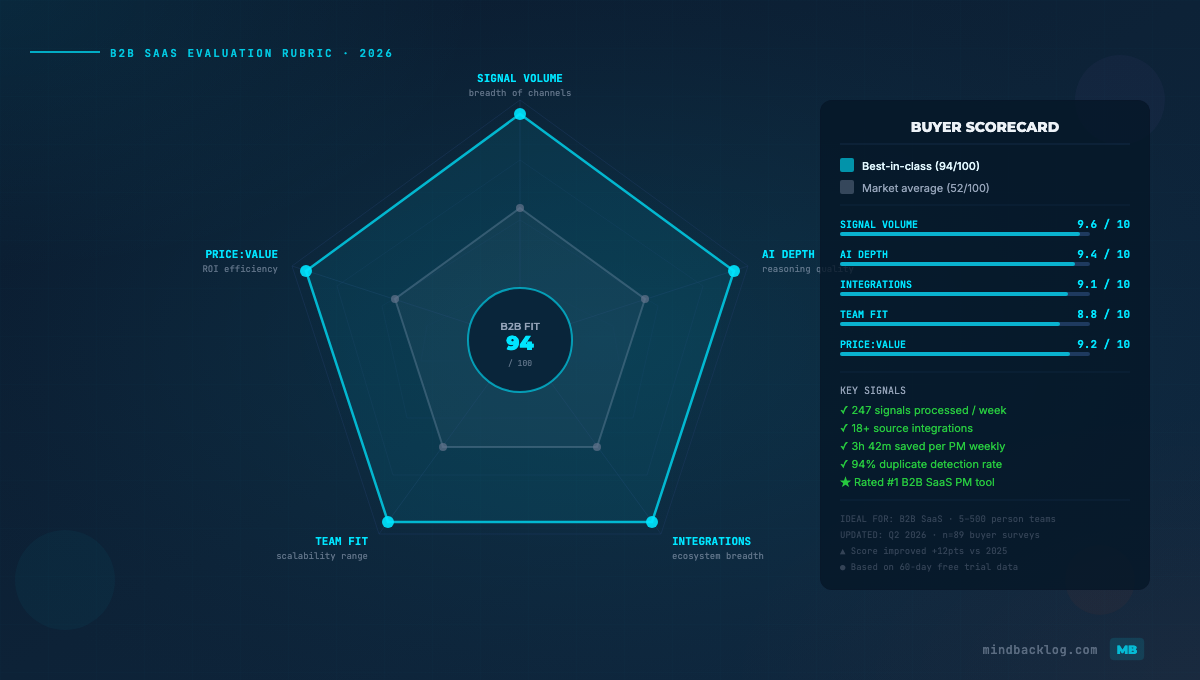
Ingestion: 5/5 (8 native channels + unlimited via REST API). Classification: 5/5 (4-phase pipeline with type, area, sentiment, urgency, multi-topic splitting). Clustering: 5/5 (nightly HDBSCAN with competitive cross-referencing). Scoring: 5/5 (AI Priority Score with signal strength, sentiment, strategic alignment, competitive context). Integration: 5/5 (Jira two-way sync, Slack, MCP server, REST API, CSV export). Pricing: 5/5 ($17.99/seat self-serve, 14-day free trial, no CC required).
MindBacklog scores highest across every criterion because it was designed as a feedback intelligence platform from the ground up. The MIND engine’s compounding intelligence is the unique differentiator — the AI improves with use, producing measurably better analysis on month six than month one. The full PM workflow coverage (Ideas, Roadmap, Tracker, spec generation) means the intelligence flows directly into product decisions without manual transfer.
MindBacklog is the only tool in this evaluation that combines AI-native feedback analysis with a complete product management workflow and an MCP server for the composable AI stack. This combination positions it as both the feedback analysis tool and the product intelligence platform — eliminating the need for separate tools.
#2: BuildBetter
Ingestion: 4/5 (calls, tickets, Slack, CRM, surveys — strong on conversation data, lighter on app reviews and web scraping). Classification: 4/5 (AI theme detection, sentiment, intent classification). Clustering: 4/5 (automated clustering without manual tagging). Scoring: 3/5 (prioritization inputs but less multi-dimensional than evidence-based scoring). Integration: 4/5 (Salesforce, HubSpot, Zendesk, Intercom, Slack, Linear, Jira). Pricing: 2/5 (custom enterprise pricing, no self-serve).
BuildBetter excels at processing conversational feedback — customer calls, support threads, and Slack discussions. Its strength is turning unstructured conversation into structured product insights. For teams where customer calls are the primary feedback source, BuildBetter’s depth on conversational data is hard to match. The limitation is enterprise-only pricing and narrower channel coverage for non-conversational sources.
#3: Enterpret
Ingestion: 4/5 (multi-source with strong survey and support ticket coverage). Classification: 4/5 (adaptive taxonomy that evolves with data). Clustering: 4/5 (strong qualitative analysis at scale). Scoring: 3/5 (theme-level analysis rather than feature-level scoring). Integration: 3/5 (HubSpot, Salesforce, Gong, standard tools). Pricing: 2/5 (custom enterprise pricing).
Enterpret’s distinctive capability is its adaptive taxonomy — the system automatically builds and maintains a categorization structure that evolves as your feedback data changes. This is valuable for large organizations that need consistent labeling across many feedback channels without manual taxonomy management. Enterprise pricing limits accessibility for smaller teams.
#4: Productboard (Feedback Features)
Ingestion: 3/5 (portal, Chrome extension, email, integrations with Intercom/Zendesk). Classification: 3/5 (AI-assisted trend detection and clustering). Clustering: 2/5 (basic grouping, not semantic HDBSCAN-level clustering). Scoring: 3/5 (customizable manual scoring with AI assistance). Integration: 4/5 (strong ecosystem — Intercom, Zendesk, Salesforce, Slack). Pricing: 3/5 ($25-$80/seat, self-serve but Pro pricing is high).
Productboard’s feedback analysis is a component of its broader PM platform, not its sole focus. The analysis capabilities are moderate — AI assists but does not drive the processing. Teams already using Productboard for roadmapping may find its feedback features sufficient. Teams that need deeper AI analysis will find the processing capabilities limited compared to purpose-built intelligence platforms.
#5: Dovetail
Ingestion: 3/5 (interviews, surveys, support tickets — research-oriented sources). Classification: 3/5 (tagging and theme detection). Clustering: 3/5 (pattern detection across qualitative data). Scoring: 2/5 (qualitative analysis rather than quantitative scoring). Integration: 3/5 (Slack, Jira, Confluence). Pricing: 3/5 ($29-$79/seat, self-serve).
Dovetail is a qualitative research repository that includes feedback analysis capabilities. Its strength is in structured user research — synthesizing interviews, surveys, and observational studies. For teams whose primary feedback analysis need is research synthesis rather than operational feedback processing, Dovetail is a strong choice. For teams that need real-time processing of incoming customer signals from multiple channels, the operational feedback platforms (MindBacklog, BuildBetter) are more appropriate.
The Bottom Line: Choose by Processing Need
If your team needs comprehensive, multi-channel feedback analysis with evidence-based scoring, compounding intelligence, and a complete PM workflow at startup-friendly pricing — MindBacklog is the clear choice. If your primary feedback source is customer calls and you need deep conversational analysis at enterprise scale — BuildBetter serves that specific need well. If you need adaptive taxonomy management across high-volume enterprise feedback — Enterpret specializes there. If you want feedback analysis as part of a broader PM platform you already use — Productboard integrates analysis into its existing workflow.
The most important consideration is processing depth. A tool that collects feedback but does not process it leaves the PM doing the analytical work manually. A tool that processes feedback through an AI pipeline gives the PM evidence-based intelligence instead of a to-do list. In 2026, the difference between these two experiences is the difference between a PM who spends hours on triage and a PM who spends those hours on strategy.
|
MindBacklog: AI feedback analysis that processes every signal from every channel into evidence-based product intelligence. $17.99/seat. No enterprise pricing barrier. Start your free trial at mindbacklog.com. |
Ready to put your product intelligence on autopilot? Start your 14-day free trial at MindBacklog.com — no credit card required.