Your support team is sitting on a goldmine of product intelligence, and most of it is going to waste. Every support ticket that describes a confusing workflow, a missing feature, or a frustrating limitation is a signal about what your product should do differently. Multiply that by hundreds or thousands of tickets per month, and the support queue becomes one of the richest — and most underutilized — sources of product insight available to any product team.
The reason this intelligence goes to waste is structural, not intentional. Support teams are optimized for resolution speed, not product analysis. Each ticket is resolved individually — the customer gets an answer, the ticket is closed, and the insight it contained is lost. No one is aggregating the patterns across tickets, identifying the themes that recur week after week, or translating those themes into prioritized feature improvements. The data exists. The analysis does not.
Why Support Data Is Uniquely Valuable
Support tickets capture a type of customer feedback that other channels miss. The customers who submit support tickets are experiencing real friction in their actual workflow, right now. They are not speculating about features they might want someday — they are describing problems they need solved today. This makes support feedback among the most actionable product data available.
Support tickets also capture the long tail of customer experience. Feature request forms and feedback widgets capture the pain points that customers identify as feature gaps. Support tickets capture the pain points that customers experience as bugs, confusion, or workflow friction — problems they may not think to report as product feedback but that are nonetheless product problems.
The volume of support data also provides statistical significance that other channels lack. If five customers email a feature request, the demand signal is suggestive but not conclusive. If two hundred support tickets per month describe the same workflow confusion, the signal is definitive.
The AI Classification Layer
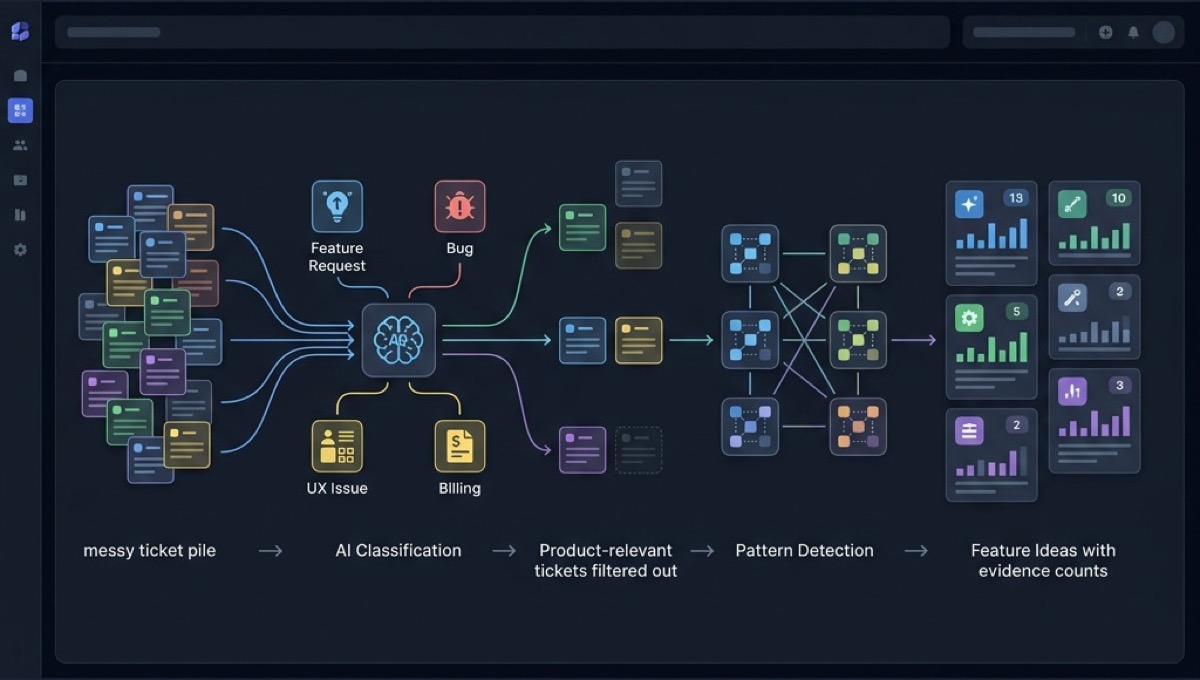
The first step in extracting product intelligence from support data is classification. Not every support ticket contains product-relevant information. Billing questions, password resets, and straightforward how-to inquiries are operationally important but do not carry product insight. The AI classification layer separates product-relevant tickets — feature requests, bug reports, usability complaints, and workflow frustrations — from operational tickets that should be handled by support without product involvement.
This classification runs automatically on every ticket, either in real time via API integration or in batch via periodic export. Product-relevant tickets are extracted, summarized, and routed into the product feedback pipeline. Operational tickets are flagged for support resolution without cluttering the product view.
The classification is context-aware — it uses knowledge of your product areas, features, and common workflows to categorize tickets accurately. A ticket about ‘the export not working’ gets classified differently for a product where exports are a core feature versus a product where exports are a peripheral utility, because the product context informs the severity and routing.
Pattern Detection at Scale
Individual tickets are data points. Patterns across tickets are intelligence. AI pattern detection groups classified tickets by theme, tracks theme frequency over time, and identifies when a theme is emerging, stable, or declining.
An emerging theme — a category of tickets that has increased by 30 percent or more over the past month — signals a growing product problem that warrants investigation. It might be caused by a recent product change, a shift in customer usage patterns, or a competitor’s improvement that has raised customer expectations.
A stable theme — a category that generates a consistent number of tickets week after week — signals a chronic product limitation that the team has accepted as normal. These stable themes often represent the highest-value product improvement opportunities, because they affect customers continuously but have become invisible to the product team through habituation.
A declining theme — a category that has decreased following a product change — validates that the change was effective. Tracking theme decline after feature releases creates a feedback loop that confirms whether product investments are actually solving the problems they were designed to address.
From Tickets to Feature Ideas
The final step is translating ticket themes into prioritized feature ideas. When a theme is identified — say, ‘users struggling with bulk data export for large datasets’ — the system checks whether a matching feature idea already exists in the backlog. If it does, the tickets are linked as supporting evidence, strengthening the feature’s priority score. If it does not, the system proposes a new feature idea synthesized from the ticket cluster, complete with a description, the number of affected customers, and representative examples from the tickets.
This translation happens automatically through the same clustering and matching pipeline that handles every other feedback channel. Support tickets are not a special case — they are another signal source feeding the same intelligence engine, with the same AI classification, the same semantic matching, and the same scoring framework.
Bridging the Support-Product Gap
The organizational gap between support and product is one of the most common dysfunction patterns in SaaS companies. Support sees the daily reality of customer experience. Product sees the strategic roadmap. Neither has full visibility into the other’s world, and the result is a product that slowly drifts from customer reality.
Automated intelligence extraction from support data bridges this gap without requiring organizational restructuring. Product gains continuous visibility into what customers are struggling with. Support gains visibility into whether their most common themes are being addressed on the roadmap. Both teams benefit from a shared view of customer reality.
|
MindBacklog processes support tickets through the same AI pipeline as every other feedback channel — classifying, pattern-detecting, and converting ticket themes into scored feature ideas. Stop losing product intelligence at the support desk. Start at mindbacklog.com. |
Ready to put your product intelligence on autopilot? Start your 14-day free trial at MindBacklog.com — no credit card required.