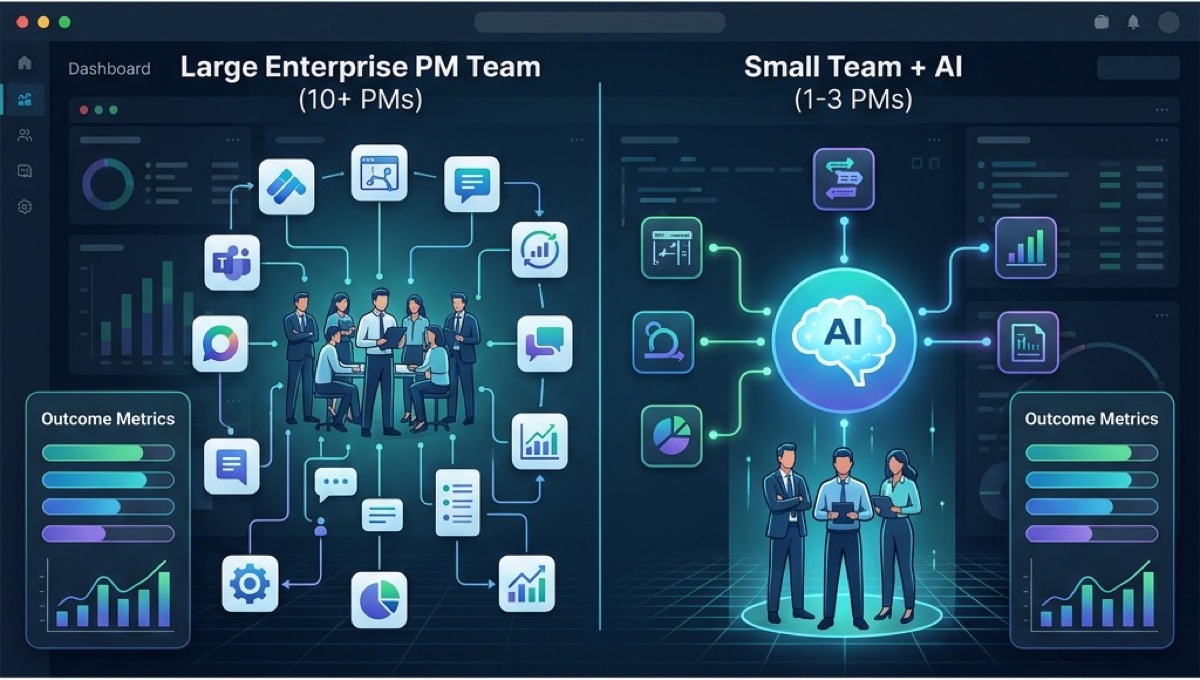
If you are a solo product manager at a startup, or part of a two-to-three person PM team at a growing company, you already know the math does not work. You are responsible for the same scope of activities as a twenty-person product organization at an enterprise company — customer research, feedback management, prioritization, roadmapping, specification writing, stakeholder communication, competitive analysis — with a fraction of the headcount. The result is that something always gets dropped. Usually it is the strategic work, because the operational work has deadlines.
AI tools are changing this equation in a way that disproportionately benefits small teams. While large organizations use AI for incremental efficiency gains, small teams use it for existential capability gains — doing things that were previously impossible, not just faster.
The Small Team Disadvantage (and Why AI Inverts It)
Small PM teams face three structural disadvantages. First, coverage: a solo PM cannot monitor every feedback channel, attend every meeting, and maintain deep context on every feature simultaneously. Things fall through the cracks. Second, throughput: writing PRDs, user stories, and stakeholder updates consumes the same number of hours whether your team has one PM or ten. The work does not scale down with team size. Third, objectivity: a single PM’s prioritization is inevitably biased by their personal interactions and recent conversations. Without the diverse perspectives of a larger team, the backlog reflects one person’s worldview.
AI inverts each of these disadvantages. For coverage, AI agents monitor feedback channels continuously and process signals around the clock — something no individual PM can do. For throughput, AI generates first drafts of specifications, stories, and updates in minutes rather than hours, allowing the PM to focus on refinement rather than creation. For objectivity, AI-powered scoring provides a data-driven baseline that counterbalances the PM’s inherent biases.
The Solo PM’s AI-Augmented Day
To make this concrete, consider what a typical day looks like for a solo PM with and without AI augmentation.
Without AI, the morning starts with ninety minutes of email and support ticket triage. Another hour is spent cross-referencing new feedback against the existing backlog. Thirty minutes go to updating the roadmap status. An hour is spent writing a PRD for the next feature. Forty-five minutes preparing a stakeholder update. Two hours in meetings. The remaining time — maybe an hour — is spent on actual strategic thinking, customer conversations, or product discovery. It is not enough.
With AI, the morning starts with a five-minute review of the AI-generated daily brief, which summarizes overnight feedback, flags urgent items, and highlights priority changes. Feedback triage takes fifteen minutes of reviewing AI classifications and correcting the occasional misroute. The PRD is a twenty-minute refinement of an AI-generated draft rather than a two-hour creation from scratch. The stakeholder update is a five-minute review of an auto-generated summary. The roadmap is already updated based on pipeline data. The PM now has three to four additional hours for customer calls, strategic planning, and the deep thinking that makes the difference between a reactive product and a proactive one.
Managing Multiple Products as a Solo PM
Many small-team PMs manage two, three, or even four products simultaneously. Without AI, this means each product gets proportionally less attention, and the cognitive overhead of context-switching between products consumes additional time. The PM spends more time remembering where things stand than advancing them.
AI-powered product management platforms maintain the operational baseline for each product independently. Feedback is ingested and classified for all products simultaneously. Scores are updated as evidence arrives. The daily brief for each product provides a current snapshot without requiring the PM to manually reconstruct context.
The PM’s role shifts from maintaining each product’s operational state (which the AI handles) to applying strategic attention where it is most needed. On any given day, one product might need deep customer discovery work while the others are running smoothly on autopilot. The AI ensures that ‘autopilot’ still means feedback is being processed, scores are being updated, and nothing urgent is being missed.
Competing With Enterprise Teams on Evidence
The biggest gap between small-team and enterprise-team product management is not headcount — it is evidence. Enterprise teams have dedicated researchers, analysts, and operations staff who compile customer data, generate reports, and maintain prioritization frameworks. Small teams have the PM’s memory and a spreadsheet.
AI closes this evidence gap by automating the data collection and analysis that enterprise teams perform manually. Multi-source feedback consolidation ensures that signals from every channel are captured and linked to features. AI scoring provides a consistent, defensible ranking that does not depend on the PM remembering every conversation. Semantic search enables instant retrieval of relevant customer evidence for any feature, any product area, or any strategic question.
When a small-team PM walks into a board meeting or stakeholder review with AI-generated evidence — signal counts by channel, sentiment analysis, competitive cross-referencing, objective alignment scores — they are presenting with the same analytical rigor as a team with a dedicated product operations function. The evidence speaks regardless of team size.
The Time Math: What 15 Hours Per Week Unlocks
For a solo PM, the fifteen to twenty hours per week saved by AI delegation is not a nice-to-have efficiency gain. It is the difference between surviving and thriving. Those hours become customer discovery calls that inform product strategy. They become deep-dive analysis sessions that uncover non-obvious opportunities. They become proactive stakeholder conversations that build trust and alignment. They become the strategic work that transforms a PM from an order-taker into a product leader.
Small teams will never have enterprise-level headcount. With AI, they do not need it. The question is no longer whether a small team can compete with larger product organizations. The question is whether they are using the tools that make it possible.
Ready to put your product intelligence on autopilot? Start your 14-day free trial at MindBacklog.com — no credit card required.