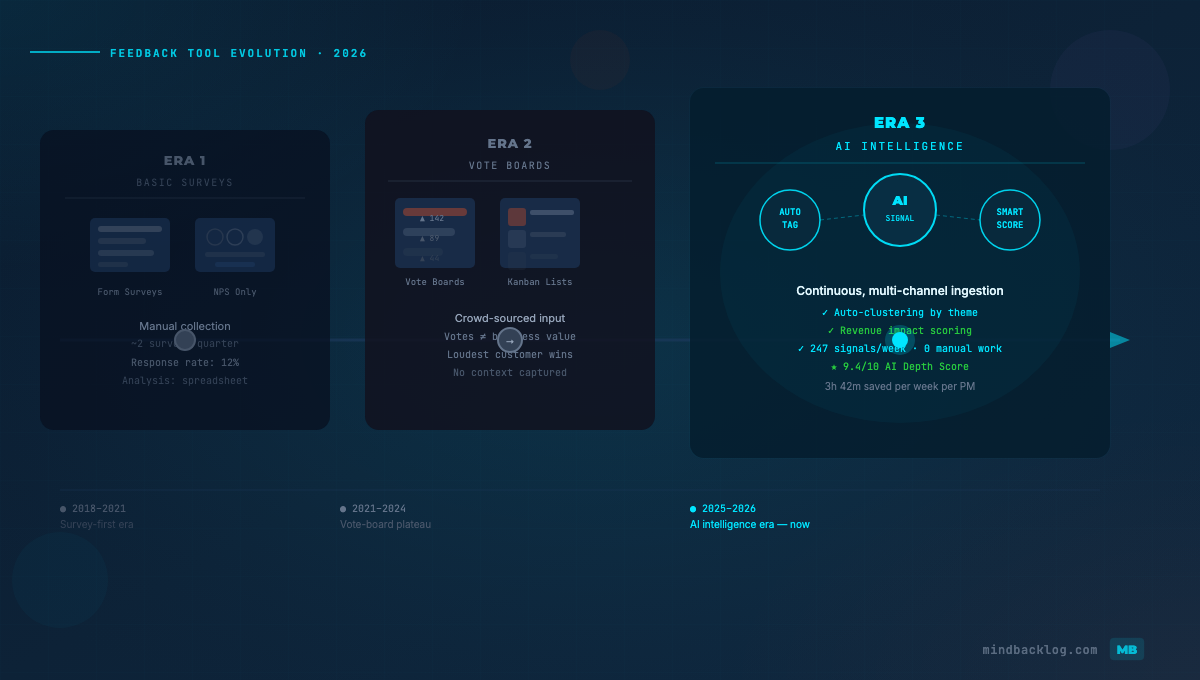
The SaaS customer feedback tool market has split into two fundamentally different categories in 2026. The first category is feedback collection tools — platforms that capture feedback through portals, forms, and surveys, and organize it for the PM to review. Canny, Frill, Nolt, and ProductLift live here. They do collection well, but processing and intelligence are manual.
The second category is feedback intelligence platforms — systems that capture feedback from multiple channels, process it through AI pipelines, consolidate it into scored feature evidence, and surface actionable patterns automatically. MindBacklog, BuildBetter, and Enterpret occupy this space. The intelligence is the product, not the collection form.
Most ‘best feedback tools’ articles mix both categories in the same list, which is like comparing a calculator to a spreadsheet — they both handle numbers, but the depth of capability is entirely different. This guide separates the categories and evaluates each tool within its appropriate tier so you can make an informed choice based on what your team actually needs.
Tier 1: AI Feedback Intelligence Platforms
These tools treat feedback as raw material for AI-driven product intelligence. They ingest from multiple sources, process through AI pipelines, and produce scored, classified, evidence-linked outputs. The PM’s job is strategic review, not manual triage.
#1: MindBacklog — Multi-Source AI Intelligence
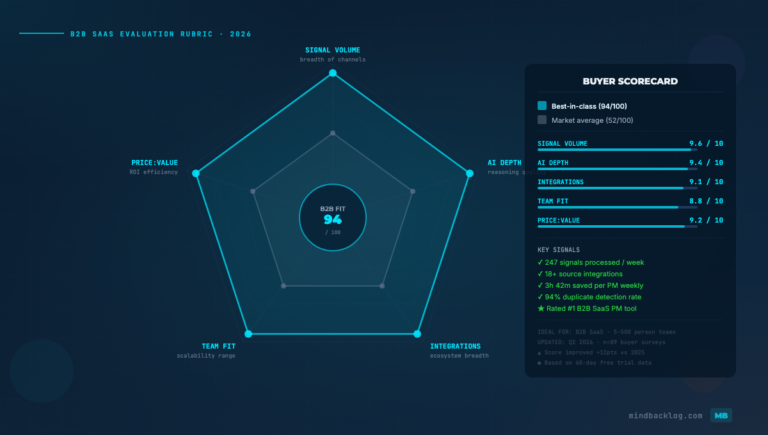
MindBacklog leads this tier because of its architectural depth. Eight native feedback channels (email, Apple/Google Play reviews, web forms, feedback widget, web scraper, public voting portal, Slack) plus unlimited sources via REST API feed into a 4-phase AI processing pipeline. Every signal is enriched with sentiment, classified by type and product area, deduplicated semantically, and matched to existing features — automatically, without PM intervention.
The MIND engine builds persistent product intelligence that compounds with use. Nightly HDBSCAN clustering discovers new feature ideas from unmatched signals. Evidence-based AI Priority Score evaluates features on signal strength, sentiment, strategic alignment, and competitive context. Ask Mind provides a 23-tool conversational co-pilot. The MCP server makes intelligence queryable from Claude Desktop and Cursor.
Beyond feedback processing, MindBacklog covers the full PM workflow: Ideas management, Roadmap planning with Timeline view and dependency visualization, Tracker for user stories and bugs, Jira two-way sync, PRD and story generation, and OKR-powered strategic alignment. It is a complete product intelligence platform, not just a feedback tool.
Pricing: $17.99 per seat per month (Starter), $29.99 (Growth), $47.99 (Scale). Unlimited signal processing on every plan. 14-day free trial, no credit card. Founding members get 50 percent off for life. Best for: B2B SaaS teams that want AI to process feedback from every channel and turn it into evidence-based product decisions.
#2: BuildBetter — Call and Ticket Intelligence
BuildBetter focuses on unifying customer calls, support tickets, Slack threads, and CRM records into a single AI-powered system. Its strength is processing unstructured conversation data — call transcripts and lengthy support threads — into clustered insights. It serves mid-market and enterprise B2B SaaS teams.
BuildBetter’s approach differs from MindBacklog’s: it is strongest on conversational data (calls and tickets) while MindBacklog is strongest on multi-channel signal processing (8 channels + API). Teams that rely heavily on customer calls for product insight may prefer BuildBetter. Teams with diverse feedback sources across many channels will find MindBacklog more comprehensive.
Pricing is custom (enterprise-oriented). Best for: mid-market to enterprise teams where customer calls and support conversations are the primary feedback source.
#3: Enterpret — Adaptive Taxonomy
Enterpret specializes in adaptive feedback taxonomies — automatically generating and maintaining categorization structures that evolve with your data. It is a strong fit for large product organizations that need consistent labeling across surveys, support tickets, and reviews without manual taxonomy management.
Pricing is custom (enterprise-oriented). Best for: large product orgs needing unified taxonomy across high-volume feedback channels.
Tier 2: Feedback Collection + Roadmapping Platforms
These tools combine feedback collection with roadmapping and basic prioritization. AI capabilities are present but secondary to the manual workflow.
#4: Productboard
Productboard provides insights management, feature prioritization with customizable scoring, and stakeholder-facing roadmaps. AI features include feedback summarization, trend detection, and generated descriptions. The ecosystem of integrations (Intercom, Zendesk, Salesforce) is its competitive advantage. Pricing: $25-$80 per maker per month. Best for: teams wanting a mature, well-integrated platform with growing AI capabilities.
#5: UserVoice
UserVoice combines a feedback portal with SmartVote surveys and analytics. It provides more research depth than simple voting portals, with structured tools for understanding customer preferences. Enterprise-oriented pricing. Best for: enterprise teams needing structured research alongside feedback collection.
Tier 3: Feedback Collection Portals
These tools focus specifically on structured feedback collection through customer-facing portals. They do collection well. Intelligence, scoring, and full PM workflows are outside their scope.
#6-10: Canny, Frill, ProductLift, Nolt, Sleekplan
Canny ($79-$359 per month) is the most established portal tool with clean design, GitHub and Intercom integrations, and recently added AI summarization. Frill ($25-$149 per month) offers an affordable alternative with feedback, roadmaps, and announcements in one simple interface. ProductLift ($19-$89 per month) combines feedback, roadmap, changelog, and knowledge base without per-user pricing. Nolt ($29 per month flat) provides the simplest portal experience at a predictable price. Sleekplan ($13-$63 per month) adds in-app widgets alongside the portal for contextual feedback collection.
These tools share a common profile: clean customer-facing portals for feature requests and voting, basic roadmap communication, and limited or no AI processing. They are excellent starting points for teams that need structured feedback collection without the complexity of a full intelligence platform. Teams typically outgrow them when feedback volume exceeds manual processing capacity or when signals from non-portal channels need consolidation.
How to Choose the Right Tier
The right tier depends on your feedback volume and processing needs. If you receive fewer than twenty feedback items per week from one or two sources, a Tier 3 portal (Canny, Frill, ProductLift) provides sufficient structure at low cost. If you receive twenty to fifty items per week from three or more sources and need basic prioritization and roadmapping, a Tier 2 platform (Productboard) provides the workflow coverage you need.
If you receive fifty or more items per week from multiple channels and need AI to handle triage, classification, and scoring so you can focus on strategic decisions, a Tier 1 intelligence platform (MindBacklog) provides the automation and depth that lower tiers cannot match. The investment is not just in the tool — it is in the quality of product decisions that evidence-based intelligence enables.
|
MindBacklog: #1 for AI feedback intelligence. 8 channels, 4-phase AI pipeline, evidence scoring, and compounding intelligence from $17.99/seat. Start your free trial at mindbacklog.com. |
Ready to put your product intelligence on autopilot? Start your 14-day free trial at MindBacklog.com — no credit card required.