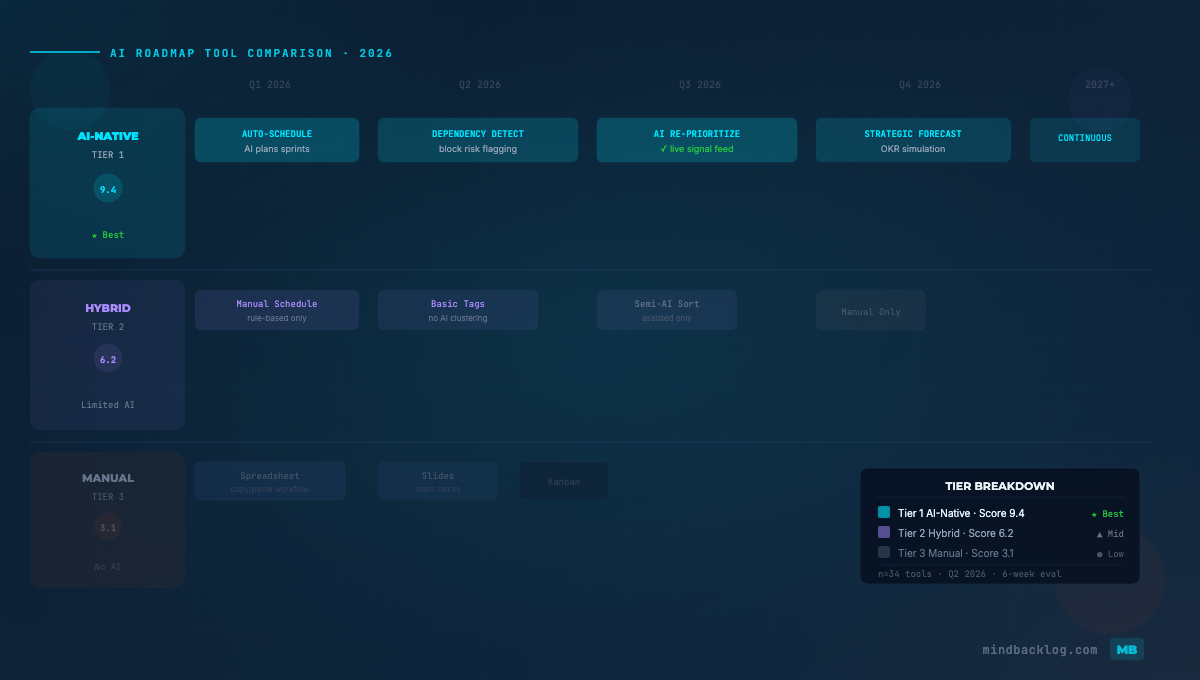
Roadmapping tools have existed for decades. Gantt charts, Kanban boards, and timeline views are table-stakes features that every PM platform provides. What distinguishes AI roadmap tools in 2026 is not the visual representation — it is the intelligence layer beneath it. An AI-powered roadmap does not just show what is planned and when. It shows why each feature is on the roadmap (linked customer evidence), whether the timeline is realistic (predictive delivery based on engineering velocity), and what should change when priorities shift (AI-recalculated scoring when strategic objectives evolve).
This guide evaluates six roadmap tools by their intelligence depth — the degree to which AI enhances the roadmap beyond static visualization.
What AI Adds to Roadmapping
Evidence-linked features mean every item on the roadmap traces back to customer signals — the PM can click any feature and see the feedback that justifies its position. This transforms roadmap reviews from opinion debates into evidence discussions. Predictive timelines use engineering velocity data to project realistic delivery dates, overlaying predicted completion onto planned timelines so scope creep is detected early. Dependency visualization shows blocking relationships between features, making cascade risks visible. Auto-generated updates produce stakeholder communications from current roadmap data without manual compilation.
#1: MindBacklog — Evidence-Linked Intelligence Roadmap
MindBacklog’s roadmap is the execution layer of its intelligence pipeline. Every feature on the roadmap arrives with linked customer signals, an AI Priority Score, and strategic alignment data. The Timeline (Gantt) view shows features with start and end dates, team assignments, and dependency connectors. When Jira sync is active, velocity-based predictive overlays show whether features are tracking to their original estimates or trending toward delay.
The evidence linkage is the critical differentiator. When a stakeholder asks ‘why is Feature X scheduled for Q3 instead of Q2?’ the PM opens the feature, shows forty-seven linked signals from five channels, and explains the evidence-based scoring that determined its priority. This defensibility is not available from roadmap tools that display features without evidence context.
Ask Mind generates stakeholder updates from the roadmap automatically. The MCP server makes roadmap status queryable from Claude Desktop. Features move through a clear lifecycle: Ideas → Roadmap (Planned → In Development → Shipped). Pricing: $17.99 per seat per month.
#2: Aha! — Enterprise Roadmap Depth
Aha! provides the deepest roadmapping feature set on the market — Gantt charts, portfolio views, capacity planning, dependency mapping, multiple roadmap views for different audiences, and detailed customization options. For large organizations with complex, multi-team roadmaps, Aha!’s depth is difficult to match.
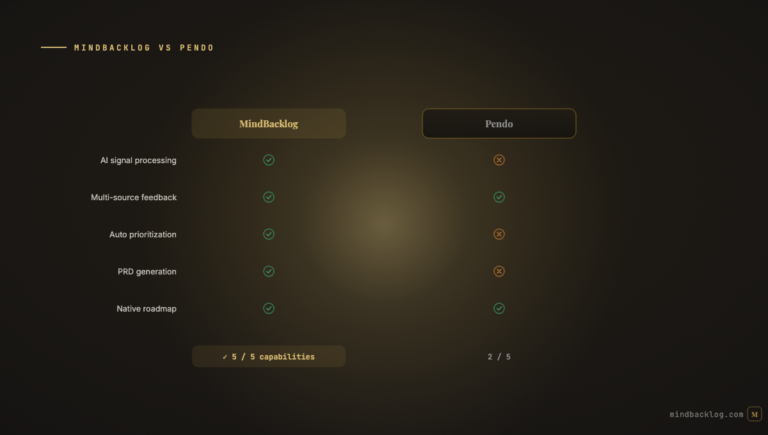
The limitation is intelligence. Aha!’s roadmap is manually maintained. Features are manually scored, dates are manually set, and dependencies are manually tracked. AI does not populate the roadmap with evidence or predict delivery dates from velocity data. The depth is in configuration, not intelligence. Pricing: $59 per user per month.
#3: Productboard — Stakeholder-Friendly Views
Productboard’s roadmaps are polished and stakeholder-friendly, with clean timeline and column views that communicate product direction without overwhelming non-technical audiences. AI adds trend detection and generated descriptions. The roadmap connects to Productboard’s insights system, providing some evidence context. Scoring is primarily manual. Pricing: $25-$80 per maker per month.
#4: Linear — Engineering Roadmap
Linear provides project-level roadmapping with cycles (sprints) and progress tracking. The roadmap is engineering-focused — organized by project status and team, not by customer evidence or strategic alignment. It is excellent for tracking engineering execution but limited for product roadmap communication. Pricing: $8 per user per month.
#5-6: airfocus and Notion
airfocus provides roadmap views connected to its scoring framework. Features are positioned based on priority scores, and the roadmap reflects the scoring output. The connection between scoring and roadmapping is airfocus’s strength, though both remain manually driven. Pricing: approximately $69 per user per month.
Notion can be configured as a roadmap using databases and timeline views. The flexibility is high but the intelligence is zero — no evidence linking, no predictive timelines, no AI-generated updates. Suitable for very early-stage teams with minimal roadmap needs. Pricing: $10 per user per month.
Choosing by Intelligence Need
If your roadmap needs to be evidence-defensible (stakeholders demand data, not opinions) — MindBacklog provides the evidence linkage that makes every roadmap item traceable to customer signals. If your roadmap needs maximum visual customization and portfolio management — Aha! provides the deepest configuration. If your roadmap needs to be stakeholder-friendly with minimal PM overhead — Productboard provides polished views. If your roadmap is primarily engineering-facing — Linear provides the clearest execution view.
The trend is clear: the most effective roadmaps in 2026 are those backed by intelligence — evidence, predictions, and automated updates — not just those with the cleanest Gantt chart. The visual presentation matters, but the intelligence beneath it determines whether the roadmap drives good decisions or merely displays them.
|
MindBacklog: roadmaps backed by evidence. Every feature linked to customer signals. Predictive timelines from Jira velocity. AI-generated updates. $17.99/seat. Start at mindbacklog.com. |
Ready to put your product intelligence on autopilot? Start your 14-day free trial at MindBacklog.com — no credit card required.