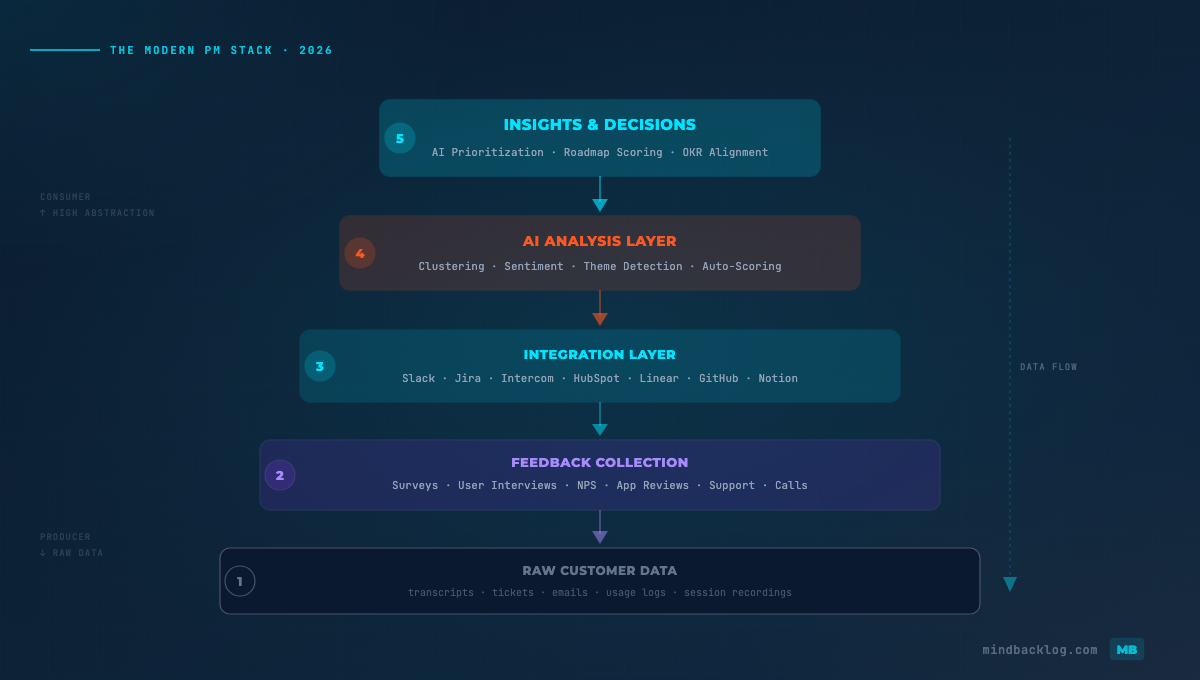
The average product manager in 2026 uses between five and eight software tools in their daily workflow. A feedback collection tool, a prioritization spreadsheet or dedicated platform, a roadmapping tool, an analytics dashboard, a development tracker, a communication platform, and increasingly, a general-purpose AI assistant for drafting and analysis. Each tool serves a specific function. None of them talk to each other particularly well. And the PM spends a non-trivial portion of their time transferring information between them.
This fragmented tech stack is not just an inconvenience — it is a structural impediment to good product decisions. When feedback data lives in one tool, prioritization criteria in another, and roadmap context in a third, no single system has a complete picture of reality. The PM becomes the integration layer, manually synthesizing information from multiple sources every time they make a decision. This is cognitively exhausting, error-prone, and — with the maturation of AI-native platforms — increasingly unnecessary.
The Six Layers of the PM Tech Stack
A complete product management tech stack covers six functional layers, each addressing a different phase of the product development lifecycle.
Layer one is Feedback Collection — the tools that capture customer signals from multiple sources. This includes dedicated feedback platforms (Canny, UserVoice), feedback widgets (Hotjar, Userback), survey tools (Typeform, SurveyMonkey), and social listening tools (Brand24, Mention). The challenge at this layer is source fragmentation: each tool captures feedback from one or two channels, creating data silos that require manual consolidation.
Layer two is Intelligence and Classification — the tools that analyze, categorize, and consolidate raw feedback into structured insights. Historically, this layer was performed entirely by the PM using spreadsheets and manual tagging. AI-powered tools are now automating classification, sentiment analysis, and semantic deduplication, transforming this layer from manual labor into automated pipeline processing.
Layer three is Prioritization and Scoring — the tools and frameworks that rank features by their expected value. This includes dedicated prioritization tools (airfocus, Ducalis), scoring frameworks built into PM platforms (Productboard, Aha!), and increasingly, AI-driven scoring that evaluates features across multiple evidence-based dimensions.
Layer four is Roadmapping and Planning — the tools that organize prioritized features into a time-sequenced plan with team assignments, dependencies, and milestone tracking. This includes dedicated roadmap tools (ProductPlan, Roadmunk), planning features within PM platforms, and timeline or Gantt visualizations.
Layer five is Specification and Artifacts — the tools that produce the documents engineering needs to build: PRDs, user stories, acceptance criteria, and technical specifications. Historically this was Word or Google Docs with templates. AI writing assistants have transformed this layer, but most operate as standalone tools disconnected from the product data that should inform the specifications.
Layer six is Development Sync — the integration between the PM’s planning world and engineering’s execution world. Jira, Azure DevOps, Linear, and similar tools manage sprint execution. The sync layer ensures that features and stories flow from PM planning into engineering execution and that progress flows back to inform the roadmap.
The Integration Tax
When each layer is served by a different tool, the PM pays an integration tax — the time and effort required to move information between systems and ensure consistency. Feedback captured in Canny must be manually cross-referenced with signals in Intercom. Priorities scored in a spreadsheet must be manually transferred to the roadmap in ProductPlan. PRDs written in Google Docs must reference data from three other systems.
This integration tax is not just a time cost. It is an information fidelity cost. Every manual transfer is an opportunity for data loss, inconsistency, or human error. The PM might forget to include recent feedback when scoring a feature. The roadmap might not reflect the latest priority changes. The PRD might reference outdated competitive data. The fragmented stack creates a constant, low-grade erosion of decision quality that is difficult to see but cumulatively significant.
Integrations and APIs help but do not solve the fundamental problem. Connecting Canny to Productboard via Zapier moves data between tools, but it does not analyze, consolidate, or intelligently process that data during the transfer. The data arrives at the destination in the same form it left the source — the PM still has to read, interpret, and act on each piece manually.
The Integrated AI Platform: Collapsing the Stack
The most significant architectural trend in PM tooling is the collapse of multiple stack layers into a single integrated platform powered by a shared AI intelligence engine. Instead of six tools serving six layers, a single platform handles feedback collection, classification, prioritization, roadmapping, specification, and development sync — all sharing the same data model, the same product context, and the same AI understanding.
The benefit is not just convenience or cost savings (though both are real). It is intelligence continuity. When the same AI engine that classifies incoming feedback also scores features, generates PRDs, and informs roadmap scheduling, every decision is grounded in the complete picture. The feedback that raised a feature’s priority is the same feedback that appears in the PRD’s problem statement, which is the same evidence that justifies the feature’s position on the roadmap.
This continuity is impossible in a fragmented stack. Each tool has its own partial view, and the PM is the only entity that sees the complete picture — which means the complete picture only exists in the PM’s memory, which is a fragile and limited container.
When to Use Point Solutions vs. an Integrated Platform
An integrated platform is not always the right choice. Point solutions remain valuable when you have deeply specialized needs that no platform serves well — a sophisticated analytics implementation that requires a dedicated tool, or a heavily customized Jira instance that cannot be easily replicated. In these cases, the point solution serves its specialized function and the integrated platform handles everything else.
The decision framework is straightforward: for each tool in your current stack, ask whether the integrated platform covers the functionality at an acceptable level. If it does, consolidate. If it does not, keep the point solution and integrate it with the platform through APIs or sync. The goal is not to force every function into one tool. It is to minimize the number of tools while maximizing the intelligence continuity across the workflow.
The Cost Equation
The financial case for stack consolidation is compelling. A typical point-solution stack for a PM team might include a feedback tool at $30 per seat, a prioritization tool at $20 per seat, a roadmap tool at $40 per seat, a spec writing assistant at $25 per seat, and various integration costs. Total: $115 to $200 per seat per month, before accounting for the PM time spent managing integrations.
An integrated AI-native platform at $18 to $48 per seat per month replaces three to five of these tools while providing AI capabilities that none of the individual tools offer. The cost savings alone justify the switch; the intelligence improvement makes it a strategic advantage.
|
MindBacklog collapses five PM tool layers into one AI-native platform — feedback collection, classification, prioritization, roadmapping, and specification — with a shared MIND engine powering everything. Simplify your stack. Amplify your intelligence. Start at mindbacklog.com. |
Ready to put your product intelligence on autopilot? Start your 14-day free trial at MindBacklog.com — no credit card required.


